
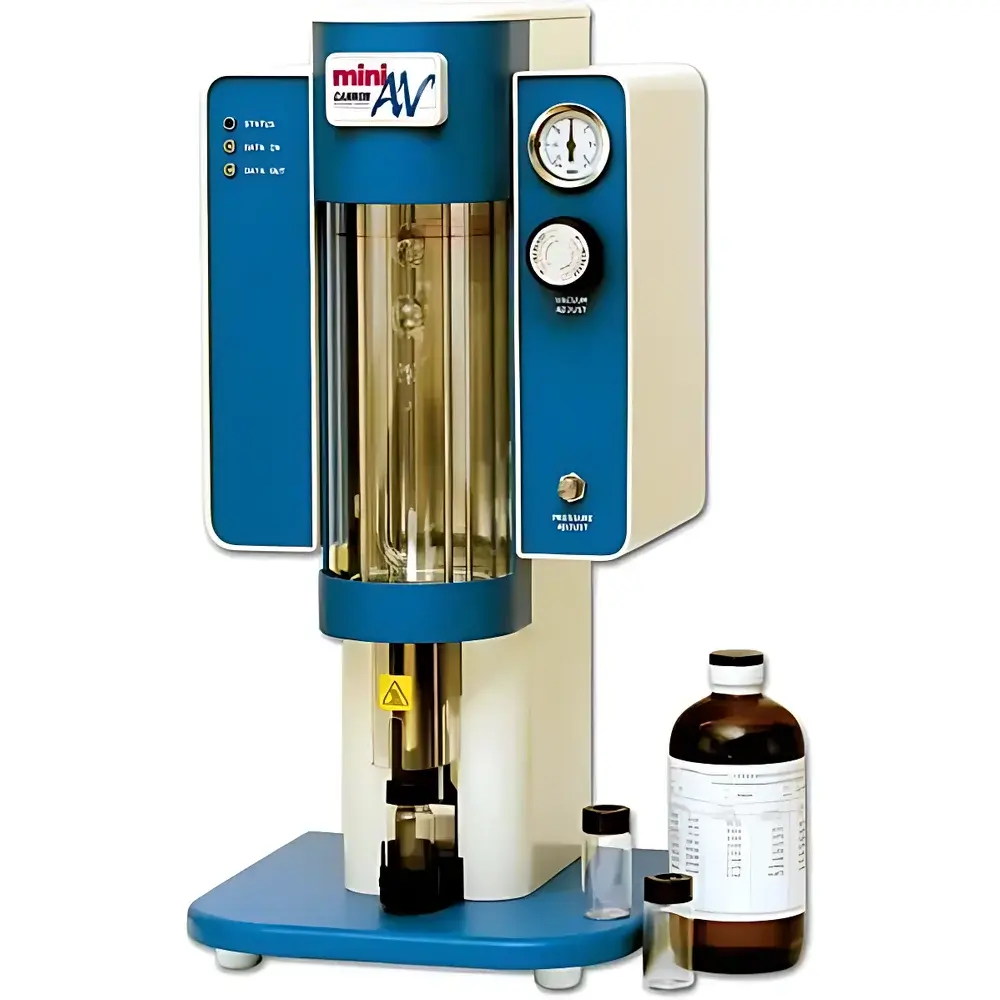
CANNON miniAV Automated Kinematic Viscometer
| Brand | CANNON |
|---|---|
| Origin | USA |
| Model | miniAV |
| Instrument Type | Capillary Viscometer (Fixed-Station, Benchtop) |
| Viscosity Range | 0.5–10,000 mm²/s (cSt) |
| Temperature Range | 15–100 °C |
| Temperature Resolution | 0.01 °C |
| Temperature Accuracy | ±0.01 °C (at setpoint) |
| Compliance | ASTM D445, ASTM D446, ISO 3104, ISO 3105 |
| Sample Volume | 5–10 mL per test |
| Bath Volume | 1 L |
| Dimensions | 254 mm (W) × 533 mm (H) × 381 mm (D) |
| Connectivity | RS-232 |
| Software | VISCPRO II (Windows 98/NT/XP compatible) |
| Multi-unit Control | Up to 4 units per PC |
| LIMS Integration | Yes |
| Operating Humidity | 10–90% RH (non-condensing) |
Overview
The CANNON miniAV Automated Kinematic Viscometer is a benchtop capillary viscometer engineered for precision, reproducibility, and full automation in kinematic viscosity measurement of Newtonian and near-Newtonian liquids. Based on the fundamental principle of capillary flow—where kinematic viscosity (ν) is derived from the measured efflux time (t) and calibrated viscometer constant (C), according to ν = C × t—the miniAV implements standardized gravity-driven flow through Ubbelohde-type capillaries under tightly controlled thermal conditions. Unlike rotational or vibrational viscometers, this instrument delivers true kinematic viscosity values traceable to SI units via primary calibration with certified reference oils. Its design adheres strictly to ASTM D445 (Standard Test Method for Kinematic Viscosity of Transparent and Opaque Liquids), ASTM D446 (Specifications for Glass Capillary Kinematic Viscometers), ISO 3104 (Petroleum products — Determination of kinematic viscosity), and ISO 3105 (Calibration of glass capillary kinematic viscometers), making it suitable for quality control, regulatory submission, and method validation in petroleum, lubricant, biofuel, and chemical laboratories.
Key Features
- True automated kinematic viscosity measurement: fully integrated sample aspiration, thermostatic equilibration, efflux timing, calculation, waste disposal, capillary cleaning, and drying—all executed without operator intervention after initial sample placement.
- Compact benchtop architecture: 10-inch width and <21-inch height minimize footprint; ideal for space-constrained QC labs or multi-instrument workstations.
- High-precision temperature control: 1 L stainless-steel bath with dual Peltier heating/cooling, axial impeller circulation, and redundant Pt100 sensors ensures uniformity ≤±0.01 °C across the full 15–100 °C operating range.
- Multi-range capillary configuration: Each calibrated capillary supports a 100:1 dynamic viscosity span (e.g., 0.5–50 cSt or 100–10,000 cSt), reducing need for manual viscometer swaps and cross-calibration uncertainty.
- Robust sample handling: Accommodates transparent, dyed, and opaque fluids—including dark petroleum distillates and used engine oils—without compromise in timing resolution or repeatability.
- RS-232 digital interface enables real-time data streaming, audit-trail logging, and seamless integration with laboratory information management systems (LIMS).
Sample Compatibility & Compliance
The miniAV accepts liquid samples with kinematic viscosities from 0.5 to 10,000 mm²/s (cSt) at temperatures between 15 °C and 100 °C. It is validated for use with hydrocarbon-based fluids (e.g., base oils, diesel, jet fuel, biodiesel blends), synthetic lubricants, glycols, and certain polymer solutions exhibiting Newtonian behavior within the test window. Non-Newtonian or highly volatile samples require prior method assessment. Regulatory compliance includes full alignment with ASTM D445/D446 and ISO 3104/3105 requirements for apparatus specification, calibration, and procedural execution. While not inherently 21 CFR Part 11–compliant, VISCPRO II supports configurable electronic signatures, user access levels, and immutable audit trails when deployed on validated Windows platforms under GLP/GMP environments.
Software & Data Management
VISCPRO II is a dedicated Windows-based application supporting Windows 98 through Windows XP (32-bit). It provides intuitive workflow navigation for sample registration, method selection, batch queuing, and report generation in PDF or CSV format. The software logs all critical parameters—including efflux time, bath temperature, ambient humidity, capillary ID, calibration constants, and cleaning cycle status—with timestamps and operator IDs. Up to four miniAV units can be synchronized and monitored from a single PC, enabling parallel throughput optimization. LIMS export functions support ASTM E1384-compliant data structures, facilitating automated ingestion into enterprise systems. Raw timing resolution is 0.001 s, contributing directly to the instrument’s certified repeatability of ≤0.1% RSD per ASTM D445 Annex A1.
Applications
- Petroleum refining: Routine monitoring of crude fractions, naphthas, kerosene, diesel, and residual fuel oils per ASTM D445.
- Lubricant manufacturing: Viscosity grading of base stocks (API Group I–V) and finished engine oils (SAE J300), gear oils, and hydraulic fluids.
- Biofuel quality assurance: Kinematic viscosity verification of FAME (biodiesel) and hydrotreated vegetable oils (HVO) per EN 14214 and ASTM D6751.
- Chemical intermediates: Batch release testing of solvents, monomers, and functional fluids where viscosity correlates with molecular weight or purity.
- Academic research: Teaching capillary rheology principles and validating theoretical flow models under controlled thermal boundary conditions.
FAQ
What standards does the miniAV comply with?
ASTM D445, ASTM D446, ISO 3104, and ISO 3105 — covering instrumentation specifications, calibration protocols, and measurement procedures for kinematic viscosity.
Can the miniAV measure dark or opaque samples?
Yes. Optical detection uses infrared phototransistors positioned at the capillary’s timing marks, eliminating dependence on sample transparency.
Is temperature calibration traceable to NIST?
The integrated Pt100 sensors are factory-calibrated against NIST-traceable references; users may perform in-house verification using certified thermometers per ASTM E77.
How many samples can be processed unattended?
The system operates sequentially — one sample per cycle — but supports unattended overnight runs when loaded with a carousel or stackable sample rack (accessory). Cycle time ranges from ~3 min (low-viscosity) to ~5 min (high-viscosity) including cleaning.
Does the miniAV support 21 CFR Part 11 compliance?
VISCPRO II offers foundational elements (audit trail, user roles, electronic signatures); full Part 11 validation requires site-specific risk assessment, IQ/OQ/PQ documentation, and controlled IT infrastructure per FDA guidance.



