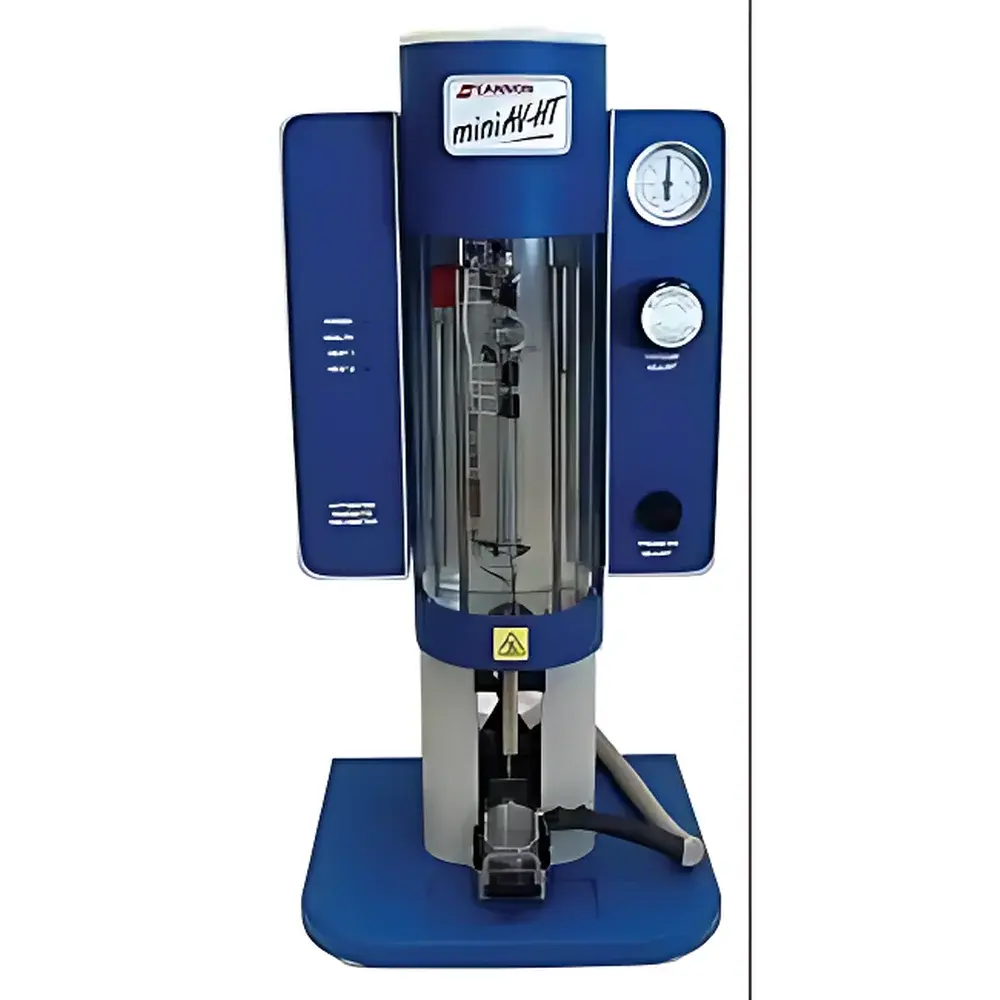
CANNON miniAV-HT Fully Automated Asphalt Kinematic Viscosity Tester
| Brand | CANNON |
|---|---|
| Origin | USA |
| Model | miniAV-HT |
| Temperature Control Range | 40 °C to 150 °C |
| Kinematic Viscosity Measurement Range | 0.5 mm²/s (cSt) to 10,000 mm²/s (cSt) |
| Compliance Standards | AASHTO T201, ASTM D2170, ASTM D445 |
| Throughput | Up to 12 samples/hour |
| Software | VISCPRO® PC (supports up to 4 instruments per workstation) |
| Sample Preheater | Adjustable |
| Waste Line Heater | Integrated |
| Solvent Inlets | Dual standard ports |
| Calibration | Single-point temperature calibration capability |
| Capillary Exchange | Tool-free, operator-performed in minutes |
Overview
The CANNON miniAV-HT Fully Automated Asphalt Kinematic Viscosity Tester is an engineered solution for precise, high-throughput kinematic viscosity determination of asphalt binders at standardized test temperatures—specifically 60 °C and 135 °C—as mandated by AASHTO T201, ASTM D2170, and ASTM D445. Based on the capillary flow principle (Poiseuille’s law), the instrument measures the time required for a fixed volume of asphalt sample to gravitationally flow through a calibrated glass capillary tube under controlled thermal conditions. This fundamental method remains the globally accepted reference for characterizing asphalt fluidity and rheological behavior during mixing, compaction, and pavement performance modeling. Unlike manual capillary viscometers, the miniAV-HT eliminates human timing errors, inconsistent immersion depth, and ambient thermal drift through fully automated aspiration, temperature equilibration, flow timing, and solvent recovery cycles. Its robust architecture integrates precision thermostatic control with real-time viscosity calculation, delivering traceable, repeatable results aligned with GLP and GMP laboratory practices.
Key Features
- Fully automated operation—from sample loading and preheating to flow timing, cleaning, and waste disposal—reducing operator dependency and inter-operator variability.
- Wide dynamic viscosity range (0.5–10,000 mm²/s), spanning 100× the coverage of a single Ubbelohde or Cannon-Fenske capillary, eliminating the need for multiple manual viscometers across viscosity grades.
- Adjustable sample preheater and heated waste line prevent premature asphalt solidification or clogging during transfer and drainage—critical for highly viscous PG 76-22 or polymer-modified binders.
- Tool-free capillary exchange system enables rapid changeover between calibrated tubes (e.g., low-shear vs. high-shear configurations) in under three minutes without service engineer support.
- Single-point temperature calibration protocol simplifies validation: users calibrate only at the primary test temperature (e.g., 135 °C), avoiding redundant multi-point thermometric verification across the full 40–150 °C operating envelope.
- Dual solvent inlet system supports sequential or alternating use of xylene and toluene—enabling efficient residue removal and compliance with ASTM D445 Annex A1 cleaning protocols.
Sample Compatibility & Compliance
The miniAV-HT accommodates neat asphalts, oxidized asphalts, and polymer-modified binders (PMBs) meeting AASHTO M320 and ASTM D6373 specifications. Its temperature stability (±0.02 °C at 135 °C) and uniform bath geometry ensure conformance with ISO 3104 and ASTM D445 requirements for thermal homogeneity and meniscus detection accuracy. All viscosity data are traceable to NIST-certified capillary constants and temperature references. The system supports audit-ready documentation for laboratories operating under ISO/IEC 17025, AASHTO R18, or state DOT quality management systems. Optional integration with LIMS via VISCPRO® export modules satisfies FDA 21 CFR Part 11 requirements for electronic records and signatures when deployed in regulated QA/QC environments.
Software & Data Management
VISCPRO® PC software provides centralized control of up to four miniAV-HT units from a single Windows-based workstation. It delivers real-time monitoring of bath temperature, flow time, calculated kinematic viscosity (mm²/s), and statistical summaries (mean, SD, CV%) per batch. Users configure report templates—including ASTM-compliant headers, pass/fail flags against specification limits (e.g., PG binder viscosity thresholds), and digital signatures—and export data to CSV, PDF, or XML formats. Audit trails log all user actions, parameter changes, and calibration events with timestamps and operator IDs. Data integrity safeguards include automatic backup, read-only archive modes, and role-based access controls compatible with enterprise IT security policies.
Applications
- Quality assurance of incoming asphalt binder shipments per ASTM D3381 and state DOT specifications.
- Performance grading (PG) characterization per AASHTO M320 and ASTM D6373, particularly for high-temperature viscosity input into the Superpave binder specification.
- R&D evaluation of aging effects (RTFO, PAV) on viscosity evolution and temperature susceptibility.
- Validation of viscosity modifiers (SBS, EVA, crumb rubber) and their impact on shear-thinning behavior at construction temperatures.
- Supporting forensic analysis of pavement failures linked to excessive viscosity-induced rutting or insufficient workability.
FAQ
Does the miniAV-HT require external calibration services for routine operation?
No—single-point temperature calibration at the target test temperature (e.g., 135 °C) is sufficient for daily verification. Certified reference standards (e.g., NIST-traceable silicone oils) may be used for periodic viscosity calibration checks.
Can the system handle highly modified asphalt binders with suspended polymers?
Yes—preheater and waste line heating, combined with optimized solvent rinse cycles, enable reliable handling of SBS- and crumb rubber–modified binders up to 5% polymer content.
Is VISCPRO® software validated for 21 CFR Part 11 compliance?
VISCPRO® supports Part 11 functionality (electronic signatures, audit trails, secure login) when deployed on validated Windows OS platforms with appropriate IT governance controls.
What maintenance intervals are recommended for capillary tubes and solvent lines?
Capillaries should be inspected visually before each shift; solvent lines require monthly flushing with fresh toluene. Full preventive maintenance is recommended every 12 months or after 2,000 test cycles.
How does the miniAV-HT ensure reproducibility across different operators and shifts?
By removing manual timing, immersion depth adjustment, and subjective meniscus detection—key sources of inter-operator variance in manual methods—the system achieves within-laboratory reproducibility ≤1.5% RSD, consistent with ASTM D445 repeatability criteria.
Related Products