
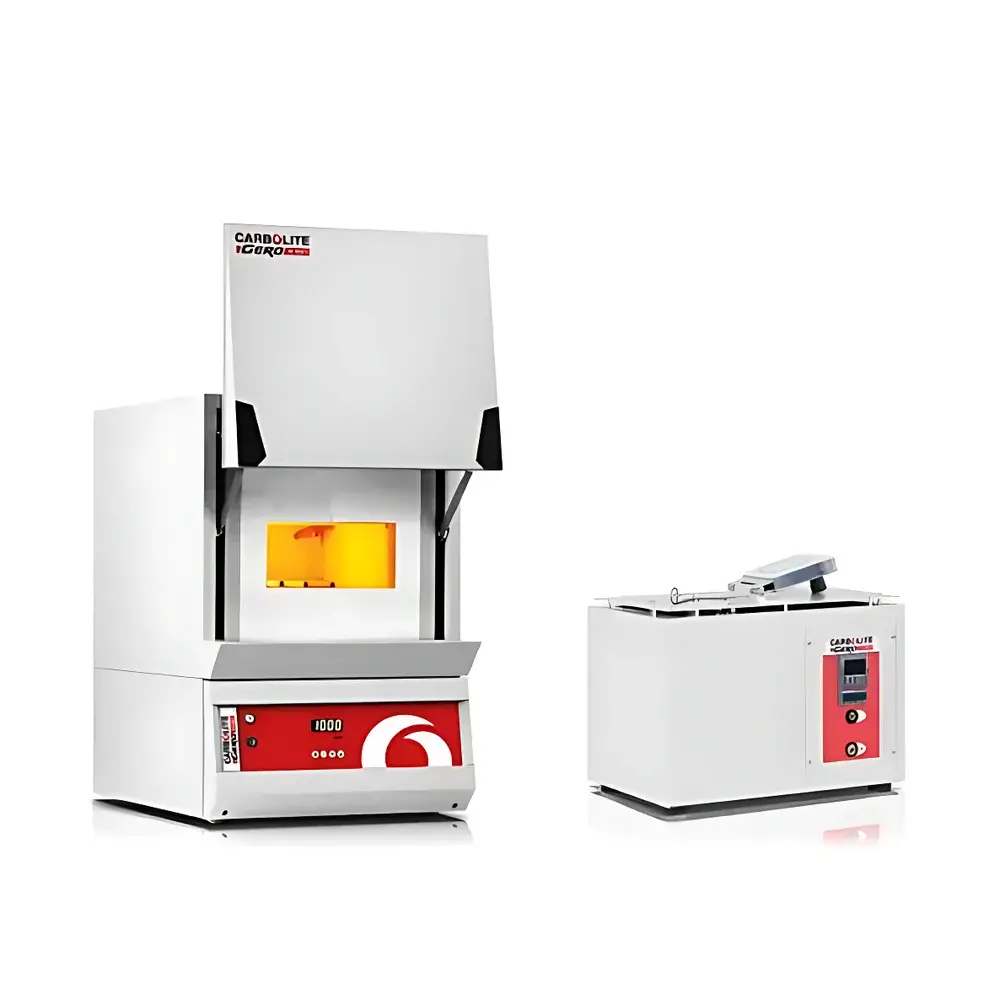
Carbolite Gero VMF Volatile Matter Furnace
| Brand | Carbolite Gero |
|---|---|
| Origin | Germany |
| Instrument Type | Box-Type Muffle Furnace |
| Model | VMF |
| Max Temperature | 1000 °C |
| Continuous Operating Temperature (VMF 10/6) | 950 °C |
| Internal Dimensions (VMF / ASTM) | Ø50 × 100 mm (cylindrical chamber) |
| Internal Dimensions (VMF 10/6) | 100 × 210 × 260 mm (H × W × D) |
| External Dimensions (VMF / ASTM) | 330 × 410 × 300 mm (H × W × D) |
| External Dimensions (VMF 10/6) | 655 × 435 × 610 mm (H × W × D) |
| Max Power (VMF / ASTM) | 950 W |
| Max Power (VMF 10/6) | 3000 W |
| Heating Rate (20 → 900 °C) | 20–30 min typical |
| Thermocouple Type | Type N or K |
| Weight (VMF / ASTM) | 9 kg |
| Weight (VMF 10/6) | 47 kg |
| Supply Voltage | 220–240 V, 50–60 Hz, single-phase with protective earth |
| Overtemperature Protection | Integrated dual-limit safety circuit |
| Data Interface | RS232 or optional odac™ paperless chart recorder |
| Calibration Port | Yes (VMF 10/6 only) |
| Compliance | ASTM D3175-1, ISO 562:2010 |
Overview
The Carbolite Gero VMF Volatile Matter Furnace is a precision-engineered, laboratory-grade muffle furnace designed exclusively for the standardized determination of volatile matter content in solid fuels—primarily coal and coke—according to internationally recognized test methods. It operates on the principle of controlled pyrolysis under inert or low-oxygen conditions: a precisely weighed sample is heated rapidly to a defined temperature (typically 900 ± 5 °C) for a fixed duration (7 minutes per ASTM D3175-1), during which volatilized organic compounds are driven off while the residual char remains. The mass loss—corrected for moisture content—is reported as volatile matter (VM) on a dry, ash-free basis. The VMF series comprises two primary configurations: the top-loading VMF / ASTM model optimized for rapid, single-sample ASTM-compliant testing; and the front-loading VMF 10/6 variant engineered for higher throughput, enhanced operator ergonomics, and full compliance with ISO 562:2010. Both models feature robust ceramic fiber insulation, precise PID-controlled heating, and fail-safe thermal protection architecture.
Key Features
- Dual-standard compliance: VMF / ASTM fully satisfies ASTM D3175-1 requirements; VMF 10/6 meets ISO 562:2010 specifications—including vertical damping door mechanism, calibrated crucible support geometry, and integrated calibration port for direct thermocouple placement beneath each crucible.
- Thermally optimized chamber design: High-density ceramic fiber insulation ensures rapid heat-up, minimal thermal lag, and exceptional temperature uniformity (±3 °C across working zone at 900 °C, per internal validation).
- Configurable sample handling: VMF / ASTM accommodates standard ASTM crucibles (Ø25 mm × 30 mm height); VMF 10/6 supports either 4-position or 9-position crucible racks with long-handle tongs—enabling batch processing without manual repositioning.
- Integrated safety and traceability: Dual independent overtemperature cutoffs (mechanical and electronic), grounded chassis, and Class I electrical protection per IEC 61010-1. Optional odac™ paperless chart recorder provides time-stamped, tamper-evident thermal profiles compliant with GLP audit requirements.
- Modular instrumentation interface: Standard RS232 port enables integration with LIMS or custom data acquisition software. Optional calibrated reference thermocouples (Type N) allow periodic verification against NIST-traceable standards.
Sample Compatibility & Compliance
The VMF furnace is validated for use with coal, lignite, anthracite, petroleum coke, and biomass-derived solid fuels. Sample preparation follows strict pre-conditioning protocols: samples must be air-dried to constant mass and ground to pass through a 212 µm sieve prior to weighing. Crucibles are pre-fired at 900 °C for 30 minutes and cooled in a desiccator before use. All operational parameters—including ramp rate, dwell time, and atmosphere control (ambient air or nitrogen purge)—are defined in ASTM D3175-1 and ISO 562:2010. The VMF 10/6’s calibration port permits real-time validation of temperature at the crucible base—critical for method equivalence studies and regulatory submissions requiring metrological traceability (e.g., EPA Method 5, EN 15148). Units are supplied with CE marking and conform to EMC Directive 2014/30/EU and Low Voltage Directive 2014/35/EU.
Software & Data Management
No proprietary software is bundled; however, the RS232 interface supports ASCII-based serial communication using standard Modbus RTU or custom ASCII command sets. Users may log temperature vs. time data directly into Excel, LabVIEW, or validated LIMS platforms. When equipped with the odac™ recorder, the system generates PDF or CSV output files containing timestamped temperature readings, setpoint tracking, alarm events, and operator ID (if integrated with network authentication). All records comply with FDA 21 CFR Part 11 requirements when deployed with appropriate access controls and electronic signature workflows. Audit trails include date/time stamps, user login, parameter changes, and calibration history—fully exportable for internal QA review or external accreditation audits (e.g., ISO/IEC 17025).
Applications
- Quality control laboratories in coal mining, power generation, and metallurgical coke production.
- Contract testing facilities performing ASTM D3175-1 or ISO 562:2010 for third-party certification.
- Research institutions studying fuel reactivity, devolatilization kinetics, and thermal decomposition pathways.
- Regulatory agencies conducting routine surveillance of commercial coal shipments per national energy standards.
- Educational labs teaching ASTM-compliant proximate analysis methodology in chemical and materials engineering curricula.
FAQ
What is the difference between VMF / ASTM and VMF 10/6?
The VMF / ASTM is a compact top-loading furnace optimized for single-sample ASTM D3175-1 testing; the VMF 10/6 is a larger front-loading unit with enhanced thermal stability, ISO 562:2010 compliance features (e.g., calibration port, damped door), and multi-crucible capacity.
Does the VMF require a nitrogen purge for volatile matter testing?
ASTM D3175-1 specifies ambient air atmosphere; however, nitrogen purging is permitted under ISO 562:2010 for improved reproducibility in high-ash or reactive samples. Optional gas inlet ports are available upon request.
Can the VMF be used for ash content determination?
No—ash testing requires longer dwell times (up to 3 hours) and higher thermal mass stability. Carbolite Gero recommends dedicated ash furnaces (e.g., AAF series) for ASTM D3174 or ISO 1171 compliance.
Is factory calibration included with delivery?
Yes—each unit ships with a UKAS-accredited calibration certificate covering temperature uniformity and controller accuracy at 500 °C, 750 °C, and 900 °C, traceable to NPL standards.
What maintenance is required for long-term accuracy?
Annual verification of thermocouple drift and insulation integrity is recommended. Ceramic fiber lining should be inspected for cracking or compression; replacement kits and OEM spare parts are available with 24-month shelf-life warranty.



