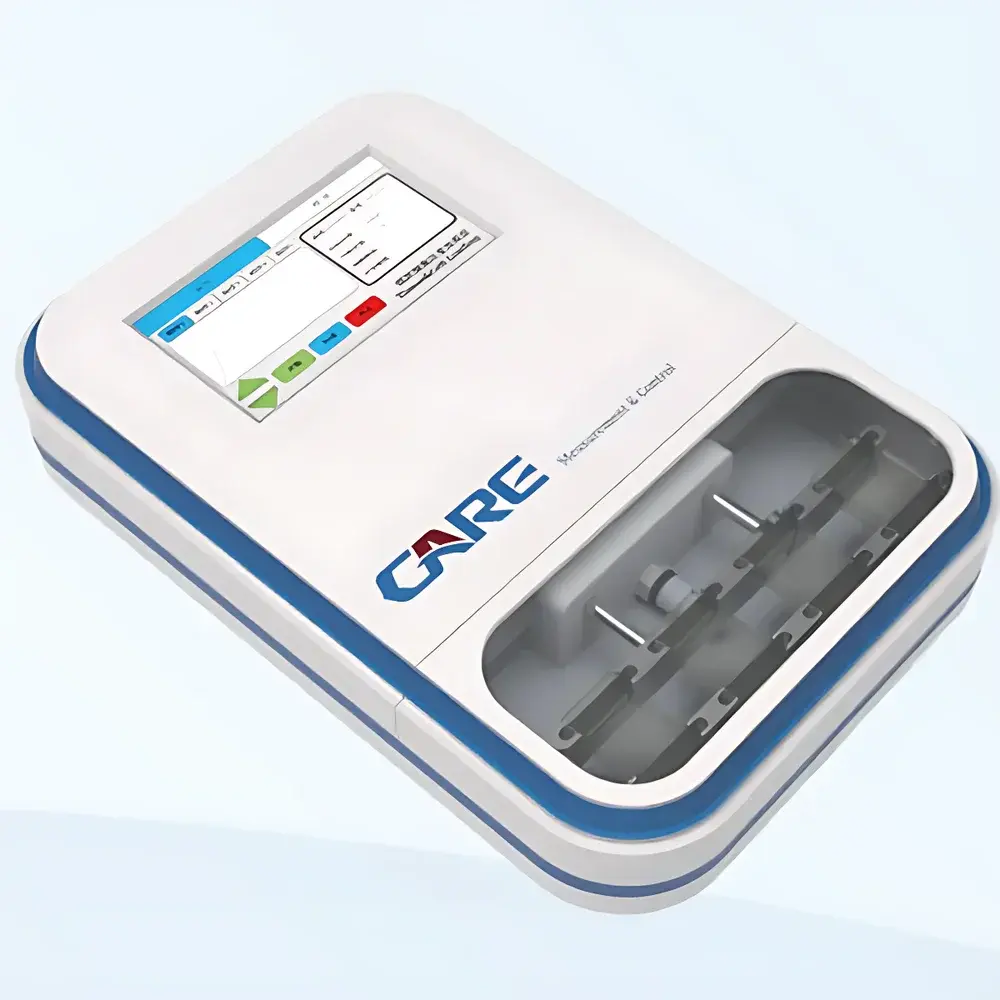
CARE IBTC-100S Cell Stretching Instrument
| Brand | CARE |
|---|---|
| Origin | Tianjin, China |
| Manufacturer Type | Original Equipment Manufacturer (OEM) |
| Country of Origin | China |
| Model | IBTC-100S |
| Stretch Rate | 1–15% strain per cycle |
| Stretch Frequency | 0.2–5 Hz |
| Waveform | Sinusoidal |
| Static & Dynamic Stretch Modes | Yes |
| Custom Strain Profile Support | Yes |
| Microscopy-Compatible Substrate | Transparent bottom for live-cell imaging |
| Strain Uniformity Across Culture Area | ≥95% |
| Measurement Uncertainty | <1% (engineering strain output) |
Overview
The CARE IBTC-100S Cell Stretching Instrument is a precision-engineered in vitro mechanical stimulation platform designed for quantitative biomechanical interrogation of adherent mammalian cells cultured on elastic substrates. It operates on the principle of uniaxial or biaxial cyclic tensile strain application—mimicking physiological mechanical cues such as those experienced by cardiomyocytes, vascular smooth muscle cells, lung epithelial cells, and tendon fibroblasts under native loading conditions. The system delivers controlled, repeatable, and traceable mechanical deformation via motor-driven actuation coupled with closed-loop displacement feedback. Its core architecture supports both static (sustained) and dynamic (cyclic) strain protocols, enabling rigorous investigation of mechanotransduction pathways, cytoskeletal remodeling, gene expression modulation, and phenotypic adaptation in response to defined mechanical inputs.
Key Features
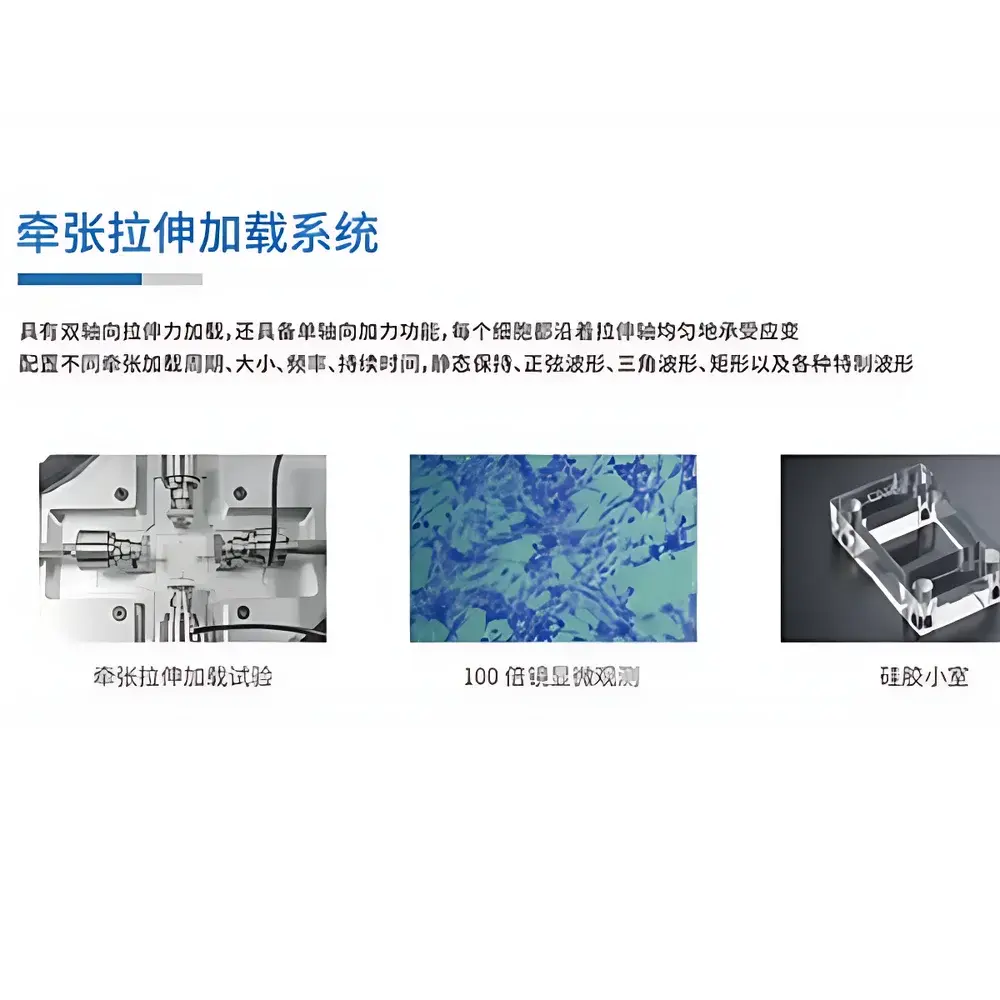
- Programmable sinusoidal waveform generation with adjustable frequency (0.2–5 Hz) and amplitude (1–15% peak-to-peak strain), compliant with physiologically relevant loading regimes observed in cardiovascular and respiratory tissues.
- Dual-mode operation: supports static stretch (constant strain hold), constant-rate cyclic stretch, and user-defined time-varying strain profiles via embedded firmware interface.
- Optically transparent silicone-based or PDMS-coated culture substrates enable real-time phase-contrast, fluorescence, or confocal microscopy during active mechanical stimulation—without optical distortion or thermal interference.
- High spatial strain uniformity (>95% across active culture area) ensured by precision-machined linear motion stages and calibrated substrate clamping geometry—critical for reproducible single-cell and population-level assays.
- Integrated displacement transduction with sub-micron resolution and <1% engineering strain uncertainty, validated against ISO/IEC 17025-accredited calibration standards for biomedical test instrumentation.
- Compact benchtop footprint (320 × 240 × 180 mm) with modular design for integration into biosafety cabinets or environmental chambers (temperature/humidity/CO₂ control).
Sample Compatibility & Compliance
The IBTC-100S accommodates standard 6-, 12-, or 24-well flexible-bottom culture plates (e.g., Flexcell®-compatible formats) as well as custom-patterned elastomeric membranes (PDMS, silicone, hydrogels). It supports both monolayer and 3D organoid-on-chip configurations when paired with appropriate microfluidic adapters. All wetted components comply with USP Class VI biocompatibility requirements. The system meets essential safety provisions of IEC 61010-1 for laboratory electrical equipment and incorporates electromagnetic compatibility (EMC) shielding per EN 61326-1. While not FDA-cleared as a diagnostic device, its operational parameters align with ASTM F2609 (Standard Guide for In Vitro Mechanical Stimulation of Cells) and support GLP-compliant experimental documentation workflows.
Software & Data Management
The instrument is operated via CARE’s proprietary StretchControl™ software (Windows 10/11 compatible), which provides intuitive protocol builder, real-time strain monitoring, and synchronized timestamped data logging (strain %, frequency, cycle count, elapsed time). Export formats include CSV and HDF5 for downstream analysis in MATLAB, Python (NumPy/Pandas), or commercial statistical platforms. Audit trail functionality records all parameter changes, user logins, and session metadata—supporting 21 CFR Part 11 readiness when deployed in regulated research environments. Remote monitoring via Ethernet connection enables multi-instrument fleet management and centralized data archival.
Applications
- Mechanobiology studies: quantifying nuclear deformation, YAP/TAZ translocation, and focal adhesion kinase (FAK) phosphorylation under graded mechanical load.
- Cardiovascular disease modeling: simulating pathological stretch in engineered heart tissues or iPSC-derived cardiomyocyte monolayers.
- Fibrosis research: assessing TGF-β secretion and α-SMA upregulation in fibroblasts subjected to chronic cyclic strain.
- Drug screening: evaluating compound efficacy on stretch-induced arrhythmogenicity or barrier integrity loss in endothelial layers.
- Tissue engineering: preconditioning scaffold-seeded constructs prior to implantation to enhance extracellular matrix alignment and mechanical resilience.
FAQ
What types of cell culture substrates are compatible with the IBTC-100S?
Standard commercially available flexible-bottom plates (e.g., BioFlex®, UniFlex®) and user-fabricated PDMS or silicone membranes with thicknesses between 0.5–2.0 mm and Young’s modulus ranging from 10 kPa to 2 MPa.
Can the system be integrated with an inverted microscope for live imaging?
Yes—the transparent substrate base and low-profile actuator design permit direct coupling with high-NA objectives and motorized stage systems without mechanical obstruction or vibration coupling.
Is strain calibration traceable to national metrology standards?
Yes—each unit undergoes factory calibration using laser interferometry and NIST-traceable displacement references; calibration certificates are provided upon delivery.
Does the software support automated long-term experiments overnight or over weekends?
Yes—protocol scheduling, power-failure recovery, and automatic file versioning ensure uninterrupted multi-day experiments with full data integrity.
How is mechanical cross-talk between adjacent wells minimized?
Independent actuator channels per well (in multi-well configurations) and decoupled membrane anchoring geometry prevent inter-well strain transmission, verified by digital image correlation (DIC) mapping.
Related Products