
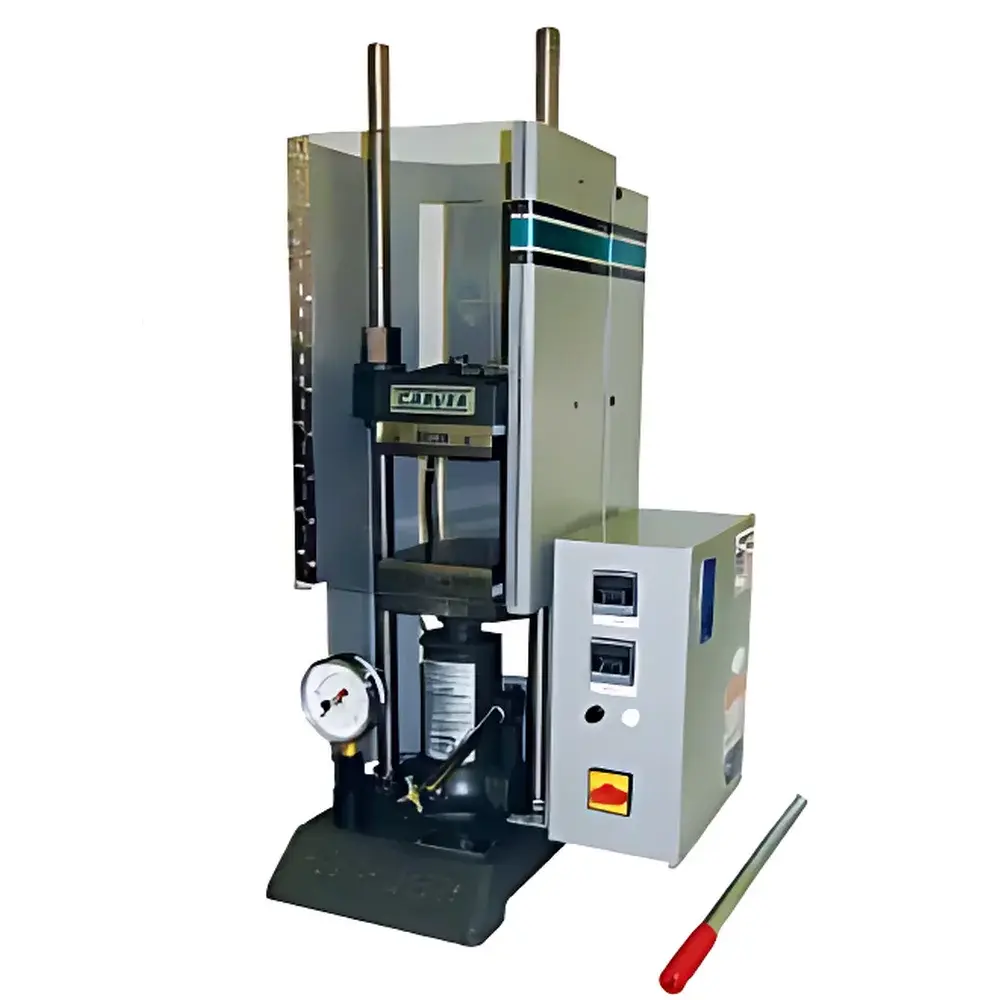
Carver 4386 Heated Laboratory Hydraulic Pellet Press
| Brand | Carver |
|---|---|
| Origin | USA |
| Model | 43860 |
| Type | Semi-Automatic Heated Pellet Press |
| Maximum Force | 12 tons (24,000 lbf) |
| Platen Spacing Range | 0–15 in (0–381 mm) |
| Hydraulic Ram Stroke | 5.125 in (130 mm) |
| Platen Size | 6 × 6 in (152.4 × 152.4 mm) |
| Heating Power per Platen | 700 W |
| Max Temperature | 650 °F (343 °C) |
| Temperature Control | Digital PID Controller per Platen |
| Operating Voltage | 240 V AC, 6 A Full Load |
| Dimensions (W×D×H) | 22 × 16 × 39 in (55.9 × 40.6 × 99.1 cm) |
| Net Weight | 300 lb (136 kg) |
| Safety Features | Interlocked Gray Safety Shield, Electronic Emergency Power Cut-off (Fuseless) |
Overview
The Carver 4386 Heated Laboratory Hydraulic Pellet Press is an engineered solution for reproducible, temperature-controlled sample compaction in analytical and materials science laboratories. Designed around a robust dual-column hydraulic architecture with full-threaded guide posts, it delivers precise mechanical force transmission under controlled thermal conditions—enabling preparation of homogeneous pellets for X-ray fluorescence (XRF), Fourier-transform infrared (FTIR), near-infrared (NIR), and elemental analysis applications. Unlike ambient-only presses, the 4386 integrates independently regulated, electrically heated stainless steel platens capable of sustained operation up to 343 °C (650 °F), supporting both thermoplastic binder activation and solvent-free consolidation of heat-stable powders. Its semi-automatic operation—lever-actuated hydraulic pumping with manual platen positioning—balances operator control with process repeatability, making it suitable for method development, quality control, and GLP-compliant sample preparation workflows.
Key Features
- 12-ton (24,000 lbf) nominal force capacity with calibrated analog pressure gauge (0–24,000 psi range) for real-time mechanical load monitoring
- Two independently controlled 6 × 6 in (152.4 mm × 152.4 mm) stainless steel heating platens, each rated at 700 W and equipped with dedicated digital PID temperature controllers for ±1.5 °C stability across the full 25–343 °C operating range
- Adjustable platen spacing from 0 to 15 inches (0–381 mm), accommodating thick die sets, multi-layer configurations, or custom tooling assemblies
- 5.125-inch (130 mm) hydraulic ram stroke with low-friction seals and pressure-hold capability for extended dwell times without manual re-pumping
- Interlocked gray safety shield with electronic cut-off circuitry—power is automatically disabled when the shield is opened, eliminating reliance on fuses or external breakers
- Sturdy cast-iron frame finished in matte dark gray, mounted on adjustable leveling feet; compact footprint (22″ W × 16″ D) optimized for standard lab bench integration
Sample Compatibility & Compliance
The Carver 4386 supports a broad spectrum of powder-based samples—including geological digests, polymer composites, pharmaceutical blends, ceramic precursors, and metallurgical alloys—provided they fall within established thermal and compressive limits. It accommodates standard ASTM E11–21 compliant die sets (e.g., 13 mm, 32 mm, and 40 mm diameter), as well as custom tooling via its 6-inch square platen interface. The press meets UL 61010-1 requirements for laboratory electrical equipment and incorporates design elements aligned with ISO/IEC 17025 documentation expectations for equipment qualification (IQ/OQ). While not intrinsically certified for hazardous environments, its fuseless emergency shutdown and grounded chassis support safe operation in Class 1, Division 2 laboratory spaces per NEC Article 500.
Software & Data Management
The 4386 operates as a standalone instrument without embedded microprocessor control or native data logging. However, its analog pressure gauge and dual digital temperature displays provide traceable, operator-recorded parameters compatible with paper-based or LIMS-integrated SOPs. For labs requiring audit-ready records, third-party USB data loggers (e.g., Omega OM-DAQPRO-5300 series) can be connected to the RTD outputs of the temperature controllers, enabling time-stamped thermal profiles synchronized with manual pressure/dwell annotations. All operational settings—including target temperature, dwell duration, and applied load—are fully configurable per test method, supporting compliance with USP , ASTM C1105, and ISO 16014-3 protocols where documented press parameters are required for pellet certification.
Applications
- XRF sample preparation: Production of fused beads and pressed pellets from oxide mixtures, ores, and slags with minimized particle segregation
- FTIR/NIR spectroscopy: Fabrication of KBr or polyethylene dispersion pellets with uniform density and minimal spectral interference
- Pharmaceutical QA/QC: Compaction of API-excipient blends for content uniformity testing and dissolution method validation
- Materials research: Cold and hot pressing of battery electrode slurries, metal-organic frameworks (MOFs), and nanocomposite powders
- Environmental testing: Consolidation of soil/sediment extracts prior to heavy-metal leaching assays (TCLP, SPLP)
FAQ
Is the Carver 4386 compatible with automated data acquisition systems?
Yes—though the press lacks built-in digital interfaces, its dual RTD sensor outputs (J-type thermocouple equivalent) and analog pressure gauge signal can be interfaced with external DAQ hardware using standard 0–5 V or 4–20 mA adapters.
What maintenance is required for long-term thermal accuracy?
Annual calibration of the digital temperature controllers against NIST-traceable reference thermometers is recommended; heater element resistance should be verified biannually to detect incipient open-circuit degradation.
Can the 4386 be used for cold isostatic pressing (CIP)?
No—the 4386 applies uniaxial force only and does not generate hydrostatic pressure; it is not designed for elastomeric mold encapsulation or fluid-mediated compression.
Does the unit include die sets or punches?
No—die sets, punches, and alignment fixtures are sold separately and must be selected based on application-specific geometry, material compatibility, and maximum operating temperature requirements.
Is CE marking available for EU installation?
The 4386 is supplied as a UL-listed device; CE compliance requires lab-specific risk assessment and may necessitate supplementary EMC filtering or enclosure modifications per EN 61326-1, depending on local installation conditions.
Related Products



