
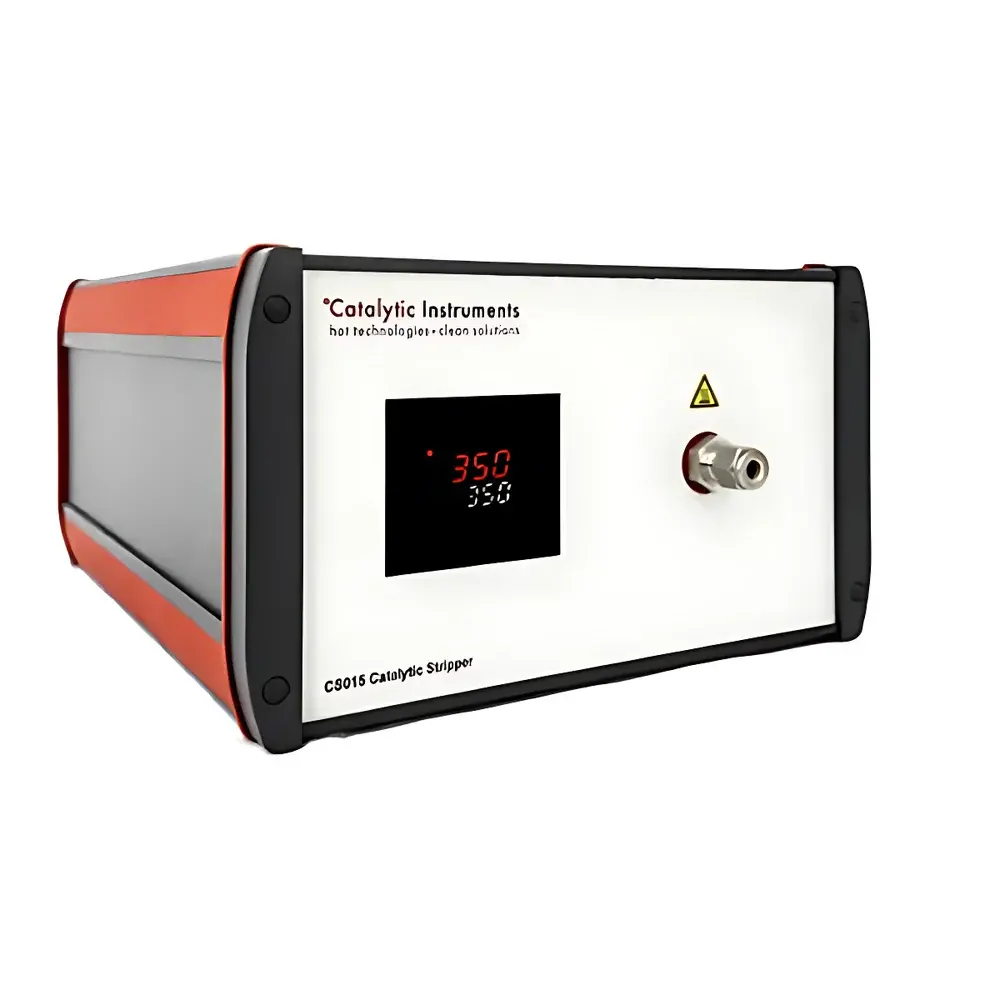
Catalytic Model CS015 High-Temperature Catalytic Stripper
| Brand | Catalytic |
|---|---|
| Origin | Germany |
| Model | CS015 |
| Operating Temperature | 350 °C |
| Standard Flow Rate | 1.5 L/min (STP) |
| Oxidation Efficiency | ≥99.9% for n-tetradecane (PMP-compliant) |
| Power Supply | 100–240 V AC, 50/60 Hz, 210 W |
| Communication Interface | USB with MODBUS protocol |
| Inlet/Outlet Diameter | 6 mm |
| Exit Temperature | Ambient + 25 °C |
| Particle Loss Optimization | Minimized for solid particles ≥50 nm at 1 mg/m³ mass concentration |
Overview
The Catalytic Model CS015 High-Temperature Catalytic Stripper is an engineered thermal-catalytic conditioning device designed for selective removal of semi-volatile organic compounds (SVOCs) from aerosol streams prior to physical or chemical characterization. It operates on the principle of catalytic oxidation within a precisely controlled high-temperature environment (up to 350 °C), where gaseous and condensed-phase semi-volatiles—such as unburned hydrocarbons, lubricant-derived organics, and condensable pyrolysis products—are quantitatively converted to CO₂ and H₂O over a proprietary platinum-based catalyst bed. Unlike thermally driven denuders or dilution-based stripping methods, the CS015 maintains particle integrity for solid-core aerosols while eliminating re-nucleation artifacts that compromise number-based measurements downstream. This makes it essential for regulatory-compliant particulate matter analysis in mobile source emissions testing, particularly under PMP (Particle Measurement Programme) frameworks defined by UN/ECE R83 and ISO 8573-1.
Key Features
- High-fidelity solid particle isolation: Engineered to minimize solid particle losses (<5% for 50 nm particles at 1 mg/m³), ensuring metrologically traceable counting and sizing downstream.
- PMP-compliant catalytic oxidation: Achieves ≥99.9% oxidation efficiency for n-tetradecane—a standardized PMP test compound—validating compliance with UNECE Regulation No. 83 and ISO 29463-3 for aerosol conditioning systems.
- No consumables or replaceable catalyst cartridges: The monolithic catalytic core is sinter-bonded and thermally stabilized for continuous operation over >10,000 hours without performance drift or recalibration.
- Thermally balanced exit stream: Maintains outlet temperature at ambient +25 °C to prevent condensation in downstream sampling lines and avoid thermal shock to condensation particle counters (CPCs) or SMPS systems.
- Integrated digital control and data logging: USB-MODBUS interface enables remote parameter monitoring (temperature setpoint, actual catalyst zone temperature, flow status) and time-stamped event logging compatible with LabVIEW, Python, or custom SCADA platforms.
- Compact, field-deployable architecture: All-metal housing with IP54-rated enclosure supports benchtop use in emission laboratories and mobile test cells—including onboard vehicle and marine engine testing rigs.
Sample Compatibility & Compliance
The CS015 interfaces seamlessly with a wide range of aerosol instrumentation, including but not limited to TSI 3776 CPCs, Grimm 1.109 spectrometers, Cambustion DMS500, and AVL MicroSoot Sensor systems. Its 6 mm inlet/outlet ports are compatible with standard Swagelok®-type stainless-steel tubing and heated transfer lines. The device complies with key international standards governing aerosol measurement integrity: ISO 29463-3 (high-efficiency filter testing methodology), UNECE R83 Annex 8 (PMP catalytic stripper requirements), and ASTM D6245 (standard practice for measuring diesel particulate matter). For GLP/GMP-regulated environments, audit-trail-capable data logging supports 21 CFR Part 11 compliance when integrated with validated software platforms.
Software & Data Management
Firmware v2.3+ supports real-time temperature telemetry, fault diagnostics (e.g., thermal runaway detection, flow deviation alerts), and firmware-over-the-air (FOTA) updates via USB. Logged data includes timestamped catalyst temperature (±0.5 °C accuracy), power-on duration, and cumulative operational cycles. Raw MODBUS registers (e.g., 40001 = setpoint temp, 40002 = actual temp, 40003 = error code) are fully documented in the IEC 61131-3 compliant register map included with each unit. Export formats include CSV and SQLite; no proprietary software installation is required.
Applications
- Regulatory vehicle exhaust certification (light-duty, heavy-duty, non-road engines) per EPA 40 CFR Part 1065 and EU Commission Regulation (EU) 2017/1151.
- Marine engine emissions monitoring under IMO MARPOL Annex VI Tier III requirements, especially for low-sulfur fuel and SCR system validation.
- Aerosol toxicity studies: Isolation of refractory black carbon (BC) cores for oxidative potential assays (e.g., DTT, AA assays) and electron microscopy analysis.
- Alternative fuel evaluation: Quantification of solid nanoparticle fraction in biofuel, e-fuel, and hydrogen combustion exhausts where SVOC interference dominates total PM mass.
- Tobacco and e-cigarette aerosol research: Discrimination between nicotine-carrier droplets and thermally stable solid residues in inhalation toxicology protocols.
- Aircraft turbine engine soot characterization: Integration into ground-test rigs for FAA AC 34-1A-compliant particulate sampling systems.
FAQ
What is the maximum allowable aerosol loading for stable CS015 operation?
The device is rated for continuous operation at mass concentrations up to 5 mg/m³ of solid particulate matter. For higher loadings, optional pre-dilution modules (e.g., catalytic diluter CD-200) are available.
Does the CS015 require periodic catalyst regeneration or replacement?
No. The catalyst is permanently sintered and does not require regeneration, poisoning mitigation, or scheduled replacement under normal operating conditions.
Can the CS015 be used upstream of a Scanning Mobility Particle Sizer (SMPS)?
Yes—its low particle loss profile and stable thermal output make it fully compatible with SMPS differential mobility analyzers (DMA) and butanol-based CPCs.
Is calibration traceable to national standards?
Temperature calibration is NIST-traceable (certificate provided); flow verification is performed using a primary-standard critical orifice calibrated per ISO 6741-2.
What safety certifications does the CS015 hold?
It carries CE marking per 2014/30/EU (EMC Directive) and 2014/35/EU (Low Voltage Directive), and conforms to IEC 61010-1:2010 for laboratory electrical equipment safety.
Related Products







