
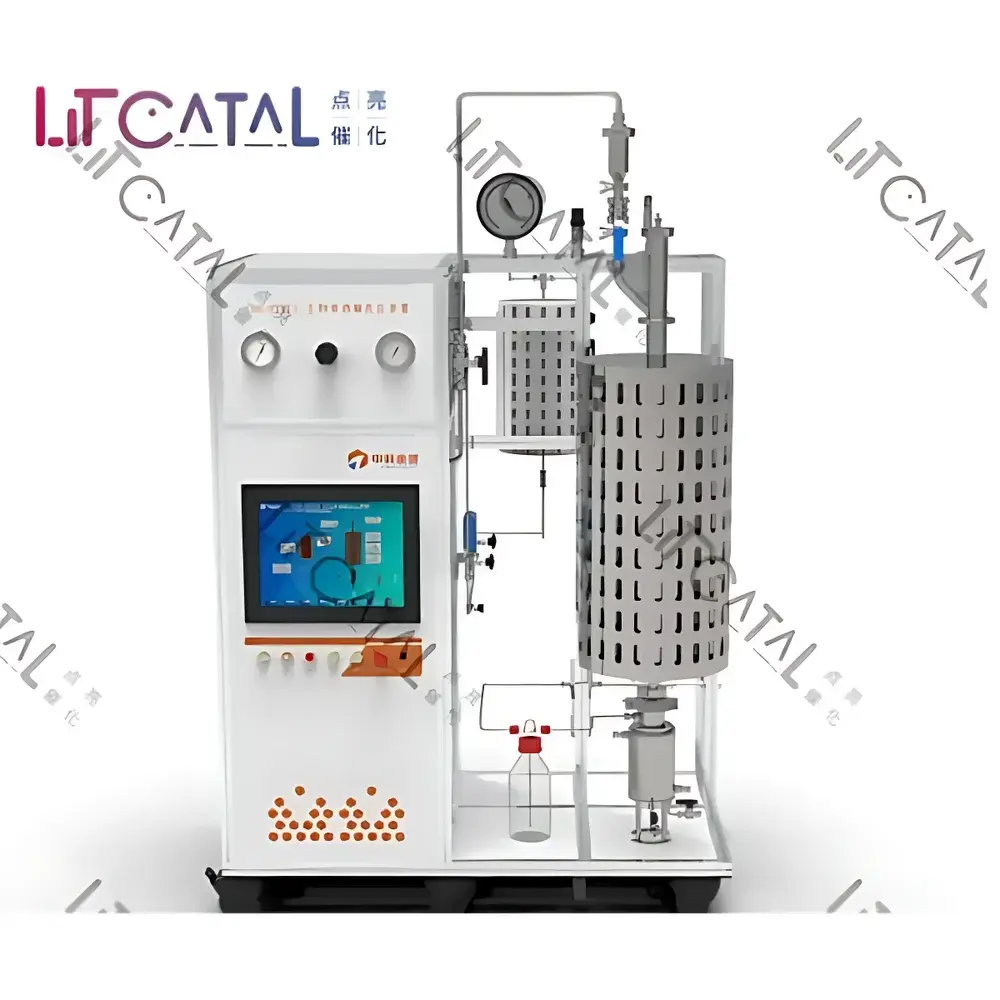
CEL-GPPCZ Custom Biomass Pyrolysis Reaction System by CEAULIGHT
| Brand | CEAULIGHT |
|---|---|
| Origin | Beijing, China |
| Manufacturer Type | Original Equipment Manufacturer (OEM) |
| Country of Origin | China |
| Model | CEL-GPPCZ |
| Pricing | Upon Request |
| External Dimensions | 1100 mm × 549 mm × 1664 mm |
| Reactor Material | 310S Stainless Steel |
| Preheater Temperature Range | 0–700 °C |
| Reactor Temperature Range | 0–1000 °C |
| Tubing Material | 316L Stainless Steel |
| Tube Tracing Temperature | 0–200 °C |
| Operating Pressure | Atmospheric |
| Catalyst Bed Capacity | < 400 mL |
| Gas Flow Rate | 0–100 SLPM (scalable gas lines) |
| Safety Features | Overtemperature Alarms at All Critical Zones, Interlocked Emergency Shutdown, Proportional Pressure Relief Valve, Vacuum Integration Capability |
| Control Interface | Industrial Touchscreen PC with Real-Time SCADA Software |
| Data Handling | Automated Logging, Time-Stamped Mass Tracking of Condensates, Exportable CSV/Excel Reports, GLP-Compliant Audit Trail Optional |
Overview
The CEL-GPPCZ Custom Biomass Pyrolysis Reaction System is a modular, software-controlled laboratory-scale platform engineered for fundamental and applied research in thermal decomposition kinetics, catalytic pyrolysis, and thermochemical conversion of heterogeneous feedstocks. It operates on the principle of controlled inert-atmosphere or reduced-pressure thermal degradation—where solid biomass (e.g., lignocellulosic residues, agricultural waste, manure-derived solids), synthetic polymers (e.g., polyethylene, polypropylene), or elastomers (e.g., waste tires) undergo endothermic bond cleavage under precisely regulated temperature profiles. The system integrates resistive heating elements with multi-zone PID control, enabling ramp rates from 0.1 to 50 °C/min and isothermal holds up to 1000 °C in the main reactor zone. Unlike batch retorts, the CEL-GPPCZ supports quasi-continuous feeding via a lock-hopper interface—allowing incremental solid addition without interrupting reaction continuity or vacuum integrity. This capability is critical for simulating staged devolatilization, catalyst deactivation studies, and long-duration stability testing under representative process conditions.
Key Features
- Modular reactor architecture with dual independent thermal zones: preheater (0–700 °C) and main pyrolysis zone (0–1000 °C), both constructed from high-temperature 310S stainless steel with low thermal mass design for rapid response.
- Full-process pressure management: integrated vacuum pump interface (≤10 Pa base pressure), proportional relief valve with setpoint tuning, and leak-tight 316L stainless steel tubing throughout all gas and vapor pathways.
- Real-time mass tracking of condensable fractions: cooled collection traps equipped with high-resolution load cells (±0.01 g resolution) linked directly to the control software for continuous gravimetric yield quantification.
- On-line analytical readiness: standardized 6-mm OD Swagelok® ports and heated transfer lines (0–200 °C) enable direct coupling to GC, GC-MS, FTIR, or online micro-FTIR systems without cold spots or condensation artifacts.
- Industrial-grade automation: Windows-based SCADA interface running on an embedded industrial touchscreen PC; supports recipe-driven operation, event-triggered sampling, alarm logging, and role-based user access control.
- Mechanically robust frame: extruded aluminum chassis with six locking casters, tool-free panel access, and DIN-rail-mounted I/O modules for field serviceability and future expansion (e.g., TPR/TPD add-ons, electrochemical integration).
Sample Compatibility & Compliance
The CEL-GPPCZ accommodates diverse solid feedstocks—including but not limited to wheat straw, corn stover, pine sawdust, sewage sludge biochar precursors, post-consumer PET flakes, and vulcanized rubber crumb—with particle size ranges from 50 µm to 8 mm. Feed introduction is compatible with screw feeders, vibratory hoppers, or manual quartz boat loading. All wetted materials meet ASTM A269 and ASTM A270 specifications for sanitary-grade stainless steel. The system complies with CE machinery directive 2006/42/EC, IEC 61000-6-2 (EMC immunity), and IEC 61000-6-4 (EMC emissions). Optional 21 CFR Part 11-compliant software configuration provides electronic signatures, audit trails, and data integrity safeguards required for GMP/GLP-regulated environments.
Software & Data Management
Control and acquisition are managed through CEAULIGHT’s proprietary PyroSoft v4.x platform—a deterministic real-time application built on LabVIEW RT and SQL Server Express. It records >100 channels simultaneously (temperature, pressure, flow, mass, valve states) at configurable sampling intervals (100 ms to 10 s). Data is stored in encrypted .tdms files with metadata embedding (operator ID, experiment ID, calibration timestamps). Reporting modules generate ASTM D7544-compliant pyrolysis yield tables, Arrhenius kinetic plots, and mass balance summaries. Raw datasets export natively to MATLAB, Python (via HDF5), or third-party chemometrics tools. Remote monitoring via secure HTTPS tunnel is supported with TLS 1.2 encryption and optional LDAP authentication.
Applications
- Kinetic modeling of cellulose/hemicellulose/lignin decomposition pathways under varying heating rates (ASTM E2070).
- Catalyst screening for selective bio-oil upgrading (e.g., ZSM-5, Ni/Al₂O₃, MoS₂) with real-time vapor-phase composition tracking.
- Co-pyrolysis behavior analysis of biomass–plastic blends to assess synergistic tar suppression effects.
- Thermal stability assessment of emerging carbonaceous materials (e.g., hydrochars, algae-derived chars) under inert and mildly oxidative atmospheres.
- Method development for ISO 18887-compliant solid fuel characterization and volatile matter determination.
- Process intensification studies targeting residence time distribution (RTD) optimization in fluidized-bed analog configurations.
FAQ
Can the CEL-GPPCZ operate under vacuum or mild positive pressure?
Yes—the system includes a dedicated vacuum port rated to ≤10 Pa and a proportional pressure relief valve calibrated for 0–200 kPa(g); pressure mode selection is software-configurable.
Is catalyst regeneration possible within the same run?
Not natively; however, the reactor geometry permits post-run in-situ calcination under air/N₂ mixtures up to 900 °C using the same thermal control system.
What level of temperature uniformity is achieved across the 300-mm reactor zone?
At 800 °C isothermal hold, axial gradient is ≤±5 °C over central 200 mm (verified per ASTM E742); radial uniformity is ±3 °C (measured via multi-point thermocouple mapping).
Does the system support automated liquid product fractionation?
No—fractional condensation requires external cryogenic traps or chilled column modules; the base system delivers total condensate mass only.
Are calibration certificates provided for integrated sensors?
Yes—NIST-traceable calibration reports (temperature, pressure, mass) are included with delivery; annual recalibration services are available under CEAULIGHT’s ISO/IEC 17025-accredited program.
Related Products



