
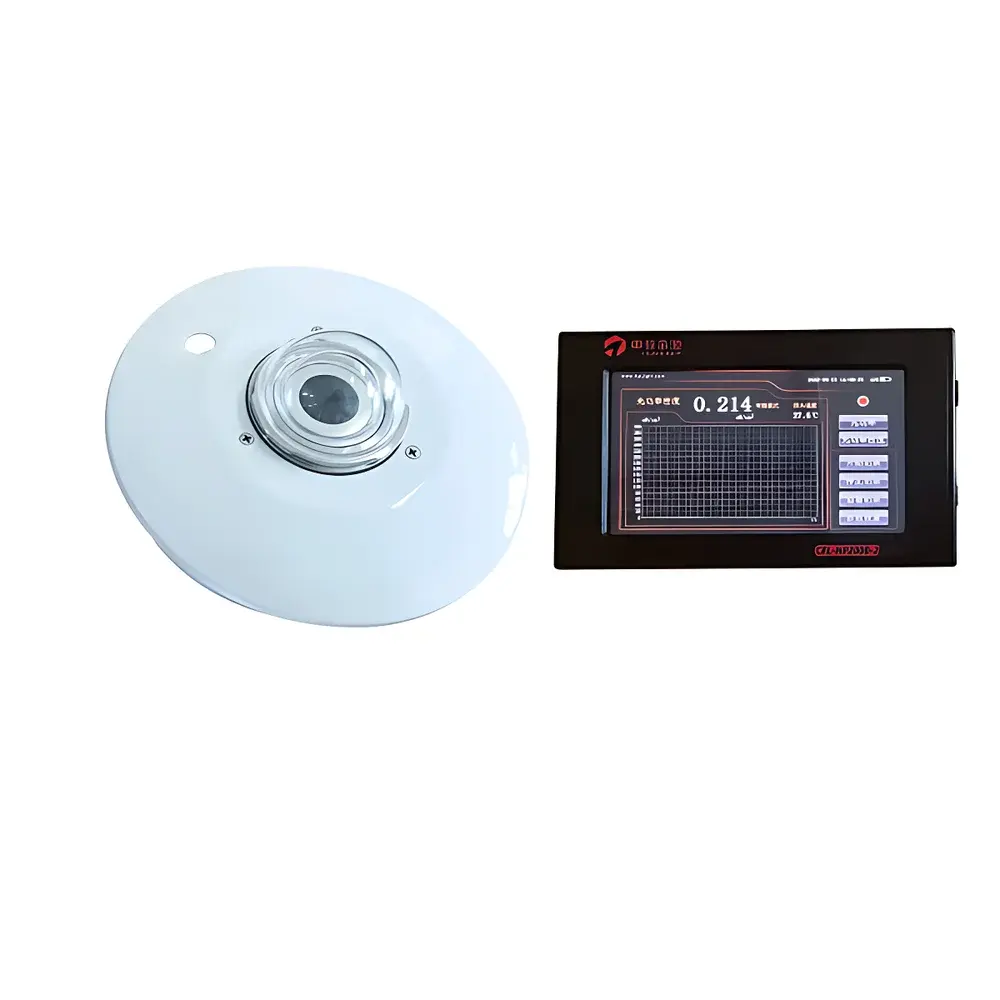
CEL-NP2000-Sun180 Solar Radiometer by CEAULIGHT
| Brand | CEAULIGHT |
|---|---|
| Model | CEL-NP2000-Sun180 |
| Measurement Principle | Thermopile-based Broadband Pyranometry |
| Spectral Range | 300–3000 nm |
| Angular Response | 0–180° (Hemispherical) |
| Irradiance Range | 0–2000 W·m⁻² |
| Sensitivity | 7–14 µV·W⁻¹·m² |
| Cosine Error | ≤±7% at 10° solar elevation |
| Azimuthal Error | ≤±2% at 10° solar elevation |
| Response Time (95%) | <10 s |
| Non-linearity | ≤±2% |
| Annual Stability | ≤±2% |
| Temperature Drift | ≤±2% (−10 to +40 °C) |
| Output Signal | 0–20 mV |
| Construction | Dual-quartz dome, blackened thermopile sensor, desiccant chamber, precision shading ring assembly |
Overview
The CEL-NP2000-Sun180 Solar Radiometer is a high-stability, broadband pyranometer engineered for continuous, all-weather measurement of global solar irradiance across the full terrestrial solar spectrum (300–3000 nm). Designed and manufactured in Beijing by CEAULIGHT—a vertically integrated producer of optical instrumentation—the instrument employs a calibrated thermopile sensor with blackened, wire-wound junctions to convert incident radiant flux into a proportional millivolt output. Its dual-quartz dome architecture minimizes convective heat transfer and suppresses thermal offset from dome self-emission, while the internal secondary dome blocks longwave infrared radiation emitted by the outer housing—ensuring accurate net shortwave-to-near-IR radiometric response. Unlike photodiode-based sensors, this thermoelectric design provides true spectral flatness and minimal angular dependence, meeting the functional requirements of ISO 9060:2018 Class C (formerly Secondary Standard) for routine outdoor solar monitoring.
Key Features
- Full-hemispherical angular acceptance (0–180°), enabling simultaneous capture of direct, diffuse, and reflected components without mechanical repositioning
- Dual-quartz dome system with integrated desiccant chamber to maintain optical clarity and prevent internal condensation under variable humidity conditions
- Thermopile sensor with spectrally neutral black coating, delivering uniform responsivity across UV-A, visible, and near-infrared bands
- Shading ring accessory included for standardized diffuse irradiance separation per ASTM E892 and ISO 9060 Annex B protocols
- Low thermal drift (≤±2% over −10 to +40 °C) and high annual stability (≤±2%) support multi-year field deployments without recalibration
- Fast dynamic response (<10 s to 95% of final value) suitable for transient irradiance events including cloud passage and solar tracking validation
- Output signal compatible with standard data loggers (0–20 mV, low-impedance, ratiometric scaling)
Sample Compatibility & Compliance
The CEL-NP2000-Sun180 is designed for outdoor deployment on fixed mounts, solar trackers, or tilted surfaces—including building-integrated photovoltaic arrays and agricultural test plots. It complies with key international standards governing solar radiation instrumentation: its spectral response and cosine correction align with ISO 9060:2018 Class C specifications; its construction and calibration traceability support adherence to IEC 61724-1 for PV system performance monitoring; and its mechanical robustness meets IP67 environmental protection requirements for dust and water ingress resistance. While not certified to GLP or FDA 21 CFR Part 11 (as it is a passive analog sensor), its documented calibration history, linearity verification, and temperature coefficient characterization enable audit-ready data collection in GMP-aligned solar materials aging studies (e.g., ASTM G155, ISO 4892-2).
Software & Data Management
As an analog-output device, the CEL-NP2000-Sun180 interfaces directly with industry-standard data acquisition systems—including Campbell Scientific CR series, HOBO UX120, and National Instruments CompactDAQ platforms—via differential voltage input channels. CEAULIGHT provides NIST-traceable calibration certificates (including spectral responsivity curves and temperature compensation coefficients) and supports integration with open-source Python libraries (e.g., pvlib, PyRadiomics) for real-time irradiance modeling, plane-of-array (POA) correction, and albedo derivation. Optional firmware-enabled signal conditioning modules (sold separately) add onboard cold-junction compensation and digital RS-485/Modbus RTU output for centralized SCADA integration in large-scale solar farms or atmospheric observatories.
Applications
- Solar resource assessment for photovoltaic plant siting and yield forecasting
- Performance validation of concentrating solar thermal collectors and CPV systems
- Long-term climatological monitoring in national weather networks and atmospheric research stations
- Accelerated weathering testing of polymers, coatings, and architectural glazing per ISO 877 and ASTM D7892
- Agronomic light-use efficiency studies, canopy radiation partitioning, and evapotranspiration modeling
- Urban heat island effect quantification through surface albedo mapping using paired upward/downward-facing units
FAQ
Is the CEL-NP2000-Sun180 suitable for use with solar trackers?
Yes—it is mechanically and electrically optimized for continuous operation on single- or dual-axis trackers, with minimal cable torsion sensitivity and no moving internal components.
Does it require periodic recalibration?
Annual recalibration is recommended for metrological continuity in regulatory or research-grade applications; the unit’s ≤±2% annual stability allows extended intervals in less demanding operational contexts.
Can it measure reflected (albedo) radiation?
Yes—when inverted (sensor face downward) and leveled, it measures upwelling shortwave radiation; pairing with a second unit facing upward enables albedo calculation with sub-3% combined uncertainty.
What mounting hardware is included?
A universal stainless-steel leveling base with ⅜″-16 UNC thread, bubble level, and adjustable tilt plate is supplied; optional wind-shield and ventilation unit available for high-wind or dew-prone environments.
Is spectral correction required for PV performance modeling?
No—its 300–3000 nm response closely matches the AM1.5G reference spectrum; however, users applying it to narrowband technologies (e.g., perovskite or quantum dot cells) may apply empirical spectral mismatch factors derived from concurrent spectroradiometer measurements.




