
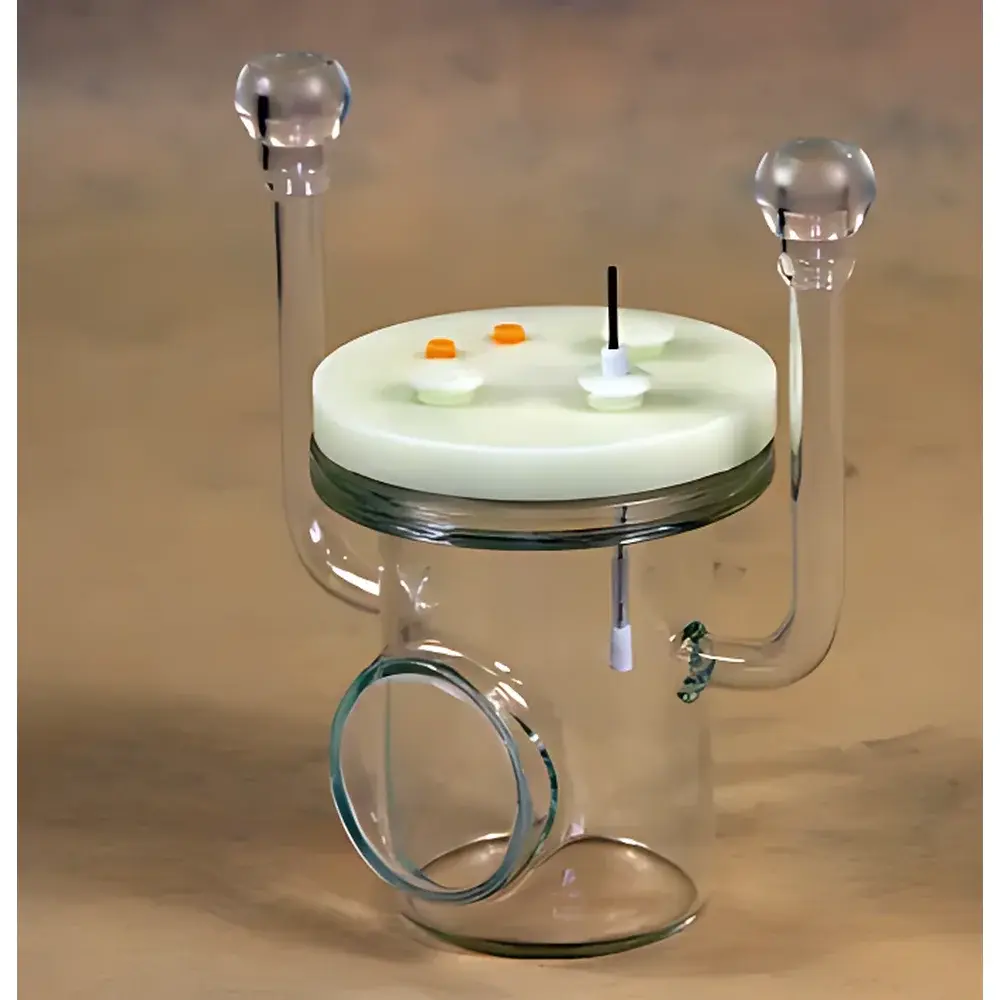
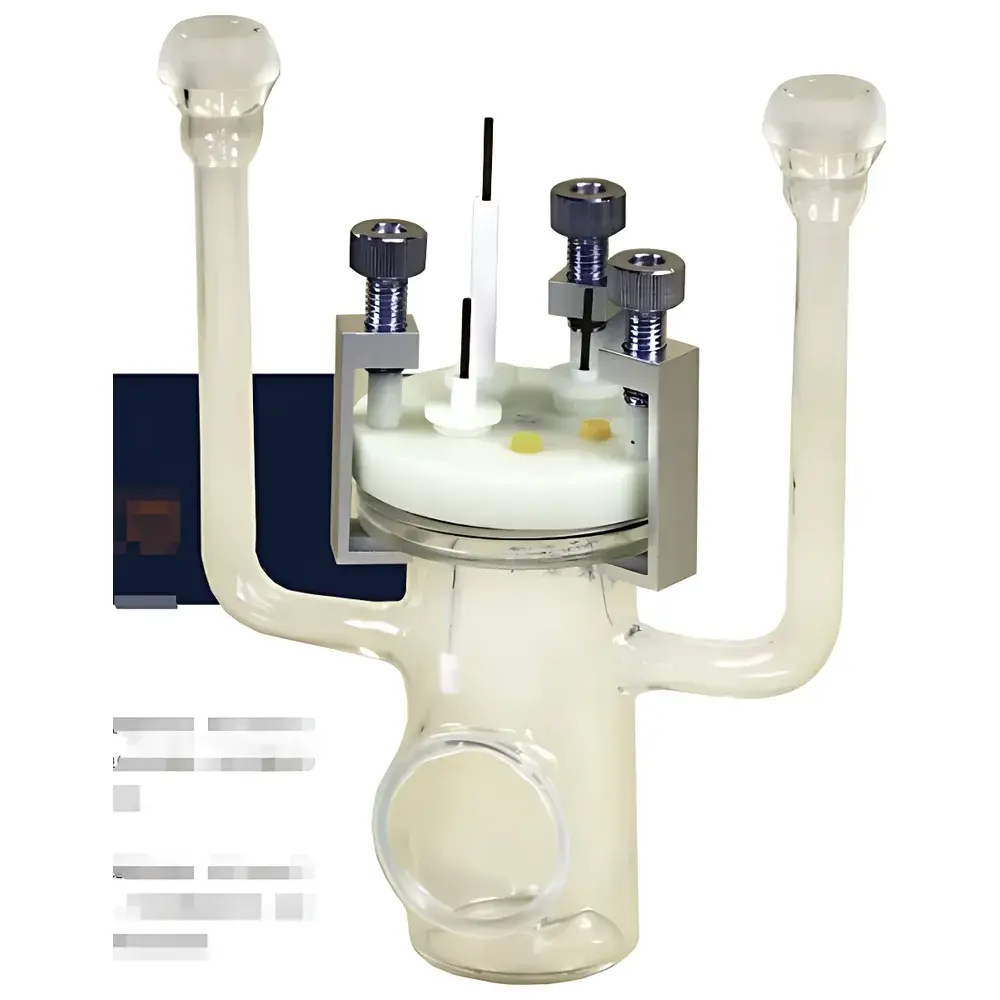
CEL-PEO40 Online Photoelectrochemical Reactor
| Brand | CEA-Light (Zhongjiaojinyuan) |
|---|---|
| Origin | Beijing, China |
| Manufacturer Type | OEM Manufacturer |
| Model | CEL-PEO40, CEL-PEO60 |
| Volume | 100 mL (CEL-PEO40), 250 mL (CEL-PEO60) |
| Quartz Window Diameter | 40 mm (CEL-PEO40), 60 mm (CEL-PEO60) |
| Electrode Ports | 2–8 configurable |
| Sealing | Flanged vacuum-tight design |
| Sampling | Integrated liquid sampling port & gas inlet/outlet |
| Compatibility | Designed for integration with CEL-SPH2N photocatalytic hydrogen evolution systems |
| Interface | Standard 19/22 ground-glass joints (PEO-L variants) |
| Material | Borosilicate glass body with fused quartz optical windows |
Overview
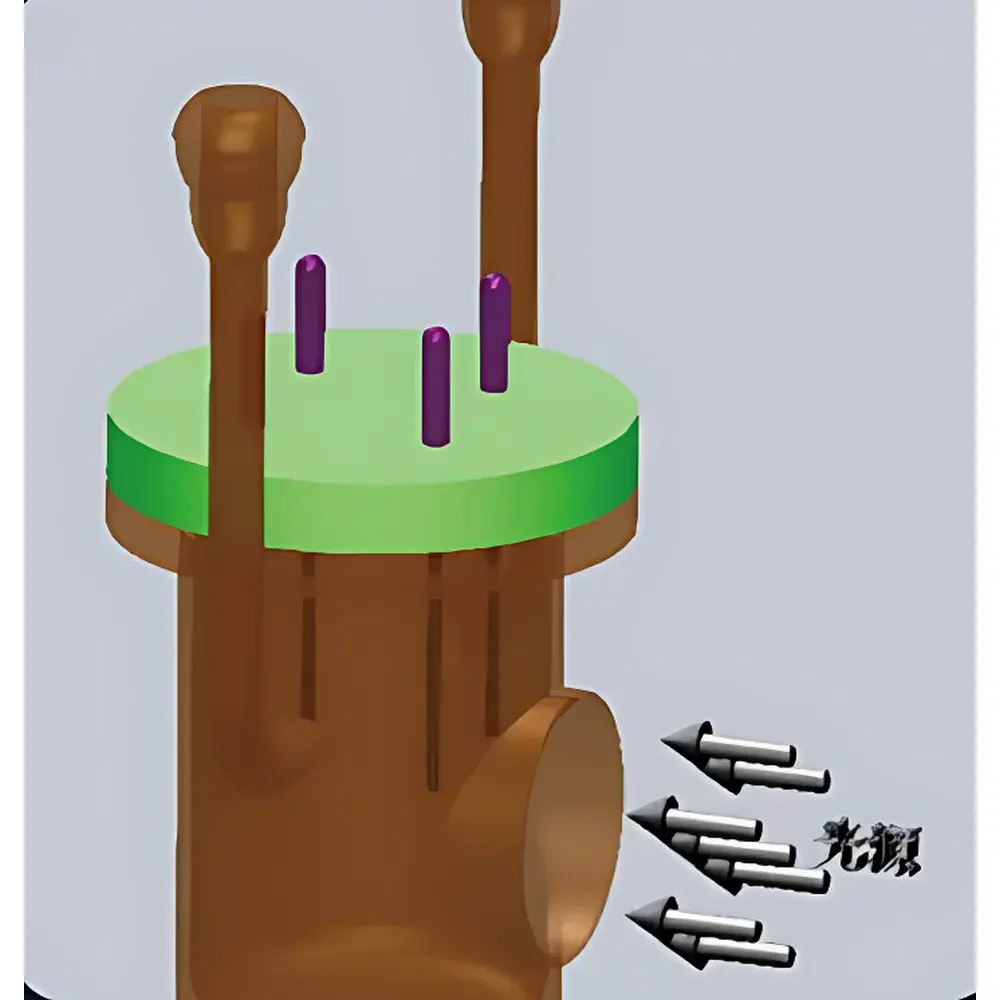
The CEL-PEO40 Online Photoelectrochemical Reactor is an engineered flow-through reaction cell designed for real-time, in situ monitoring of photoelectrochemical (PEC) processes under controlled illumination and electrochemical bias. Built on the principles of semiconductor-electrolyte interfacial kinetics and incident photon-to-current efficiency (IPCE) quantification, this reactor enables precise coupling between light irradiation (via high-transmittance quartz optical windows) and multi-channel electrochemical measurement. Its flanged, vacuum-rated construction ensures rigorous exclusion of ambient oxygen and moisture—critical for reproducible H₂ evolution studies, CO₂ reduction, or photoanode stability testing. The CEL-PEO40 (100 mL active volume) and its larger counterpart CEL-PEO60 (250 mL) are purpose-built to interface directly with the CEL-SPH2N series photoreactor platforms, supporting continuous gas-phase product analysis (e.g., via online GC) and potentiostat/galvanostat synchronization without system disassembly.
Key Features
- Vacuum-tight flanged sealing architecture compliant with ISO-KF and DIN 28178 standards, enabling operation under inert atmosphere or reduced pressure (≤10⁻² mbar).
- Optically optimized quartz window (40 mm or 60 mm diameter, UV-grade fused silica, transmission >90% from 190–2500 nm) ensuring minimal spectral distortion and thermal load during high-intensity illumination.
- Modular electrode configuration: 2–8 independently addressable ports accommodate working, counter, and reference electrodes—including rotating disk electrodes (RDE), wire mesh photoanodes, or custom-deposited thin-film catalysts.
- Integrated fluidic interfaces: standardized 19/22 ground-glass joints (on PEO-L offline variants), threaded gas inlets/outlets (¼”-28 UNF), and a dedicated septum-piercing liquid sampling port compatible with syringe-based extraction under sealed conditions.
- Chemically resistant borosilicate glass body (Duran®-equivalent) with PTFE-sealed fittings, rated for aqueous electrolytes, organic solvents (e.g., acetonitrile, methanol/water mixtures), and mild acidic/alkaline media (pH 1–13).
Sample Compatibility & Compliance
The CEL-PEO40 and CEL-PEO60 reactors support heterogeneous, homogeneous, and hybrid photoelectrocatalytic systems—including TiO₂, BiVO₄, Fe₂O₃, perovskite photoelectrodes, molecular catalysts (e.g., Co-based complexes), and colloidal quantum dot suspensions. All wetted components meet USP Class VI and ISO 10993 biocompatibility requirements for laboratory use. Vacuum integrity has been verified per ASTM E493–22 (helium leak testing). The design aligns with GLP-compliant experimental workflows, supporting audit-ready documentation of electrode history, irradiation dose (measured via calibrated Si photodiode), and gas evolution stoichiometry.
Software & Data Management
While the reactor itself is hardware-only, it is fully compatible with third-party electrochemical workstations (e.g., BioLogic SP-300, Metrohm Autolab PGSTAT302N) and data acquisition systems adhering to IEEE 11073-10201 (medical device interoperability) and IEC 61508 functional safety frameworks. When integrated with CEL-SPH2N control software, users gain synchronized timestamping of chronoamperometric traces, gas chromatography peak areas, and irradiance logs—enabling traceable correlation between photocurrent density (mA/cm²), Faradaic efficiency (%), and quantum yield (Φ). Audit trails comply with FDA 21 CFR Part 11 when paired with validated electronic lab notebook (ELN) platforms.
Applications
- Quantitative assessment of photoelectrode stability under prolonged AM 1.5G illumination (IEC 60904-3).
- In situ spectroelectrochemical studies (e.g., operando Raman, UV-Vis absorption) through the quartz window.
- Multi-electrode comparative screening of co-catalyst deposition strategies for solar water splitting.
- Gas-evolution kinetics modeling (H₂, O₂, CO, CH₄) via coupled mass spectrometry or micro-GC.
- Electrolyte composition optimization (pH, ionic strength, sacrificial agents) under controlled mass transport conditions.
FAQ
Can the CEL-PEO40 be used with non-CEL light sources?
Yes—its 40 mm quartz window accepts collimated or focused beams from xenon arc lamps, LED arrays, or tunable monochromators, provided beam diameter and thermal flux remain within quartz damage thresholds (≤1.5 W/cm² continuous wave).
Is vacuum compatibility verified for both online and offline configurations?
Yes—both flanged (online) and ground-glass (PEO-L) variants undergo helium leak testing at ≤5×10⁻⁹ mbar·L/s sensitivity prior to shipment.
What electrode geometries are supported by the 2–8 port configuration?
Standard configurations include three-electrode (WE/CE/RE), dual-working-electrode differential measurements, and segmented photoanode/cathode assemblies; custom port drilling is available upon request with mechanical drawings.
Does the reactor meet ISO/IEC 17025 calibration traceability requirements?
The reactor itself is not a measuring instrument; however, its dimensional tolerances (±0.1 mm port spacing, ±0.05 mm window parallelism) are certified per ISO 17025-accredited metrology reports supplied with each unit.



