
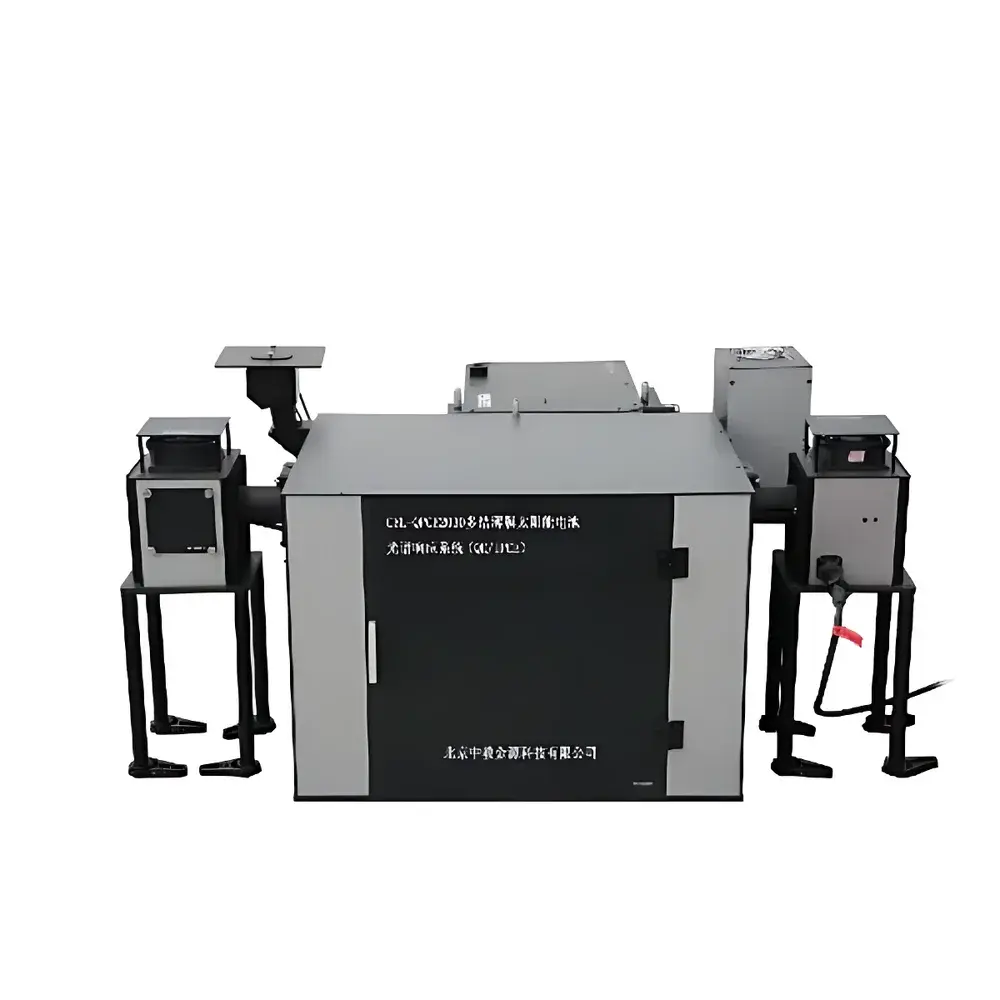
CEL-QPCE2030 Multi-Junction Thin-Film Solar Cell Quantum Efficiency / Incident Photon-to-Current Efficiency (QE/IPCE) Measurement System
| Brand | CEA-Light (Zhongjiao Jinyuan) |
|---|---|
| Origin | Beijing, China |
| Manufacturer Type | OEM/ODM Manufacturer |
| Product Category | Domestic |
| Model | CEL-QPCE2030 QE/IPCE System for Multi-Junction Thin-Film Photovoltaics |
| Light Source Type | Broadband Continuous Xenon Arc Lamp with Spectral Homogenization |
| Illumination Mode | External Illumination Configuration |
| Spectral Range | 200–1700 nm |
| Wavelength Resolution | ≥1 nm adjustable step size |
| Scan Mode | Fully Automated Monochromator-Based Sequential Scanning |
| Repeatability | <0.3% (short-circuit current, J<sub>sc</sub>) |
| Bias Light Options | Up to Two Independent Bias Sources (Xenon or Halogen), Each with Motorized Filter Wheel (3 Short-Pass + 4 Long-Pass Imported Interference Filters) |
| Bias Voltage Range | ±3 V, Setting Accuracy: ±1 mV |
| Chopping Frequency | 5–1000 Hz |
| Temperature-Controlled Stage | 5–40 °C (±0.5 °C stability, optional) |
| Monochromator Focal Length | 300 mm (standard), 150 mm (optional) |
| Detection Method | Lock-in Amplifier-Coupled Low-Noise Current Measurement with Background Subtraction and Drift Compensation |
| Sample Compatibility | Single-, Dual-, Triple-, and Multi-Junction Thin-Film PV Devices (including GaInP/GaAs/Ge, Perovskite/Si, CIGS-based tandems) |
| Compliance | Designed to support ASTM E1021, IEC 60904-8, IEC 60904-9, and ISO 18592 test protocols |
Overview
The CEL-QPCE2030 is a fully automated, high-precision quantum efficiency (QE) and incident photon-to-current efficiency (IPCE) measurement system engineered specifically for multi-junction thin-film photovoltaic devices. It operates on the principle of monochromatic photocurrent spectroscopy, where a tunable light source—comprising a stabilized xenon arc lamp coupled with a high-fidelity 300 mm focal length monochromator—delivers discrete wavelength bands across the ultraviolet–visible–near-infrared spectrum (200–1700 nm). The system measures the spectral responsivity (A/W) of each subcell independently by applying spectrally selective bias illumination to maintain adjacent junctions in forward conduction, thereby isolating the photocurrent contribution of the target junction. This enables accurate determination of absolute external quantum efficiency (EQE), internal quantum efficiency (IQE), and subcell-specific current density (Jsc) under AM1.5G reference conditions. Its optical architecture eliminates higher-order diffraction artifacts via patented grating dispersion management and low-stray-light optics, ensuring traceable wavelength accuracy and long-term measurement reproducibility (<0.3% Jsc repeatability).
Key Features
- Stabilized broadband xenon arc source with spectral smoothing optics—eliminates emission line interference and ensures flat spectral irradiance for high-fidelity QE mapping.
- Dual independent bias illumination channels (optional upgrade), each equipped with motorized filter wheels containing three short-pass and four long-pass interference filters (imported), enabling precise spectral matching to subcell bandgaps in triple- and quadruple-junction architectures.
- Patented monochromator design with selectable 300 mm or 150 mm focal length—optimized for resolution vs. throughput trade-off depending on sample sensitivity and measurement speed requirements.
- Low-noise lock-in detection with real-time background subtraction, drift compensation, and AC/DC measurement modes (chopping frequency 5–1000 Hz) to resolve weak photocurrent signals from low-absorptance thin-film layers.
- Modular temperature-controlled stage (5–40 °C, ±0.5 °C stability, optional) for thermal-dependent QE characterization under controlled ambient conditions.
- Custom-designed sample holder with spring-loaded, low-resistance contact probes—minimizes series resistance artifacts and electromagnetic interference during microamp-level current measurement.
Sample Compatibility & Compliance
The CEL-QPCE2030 supports quantitative spectral response analysis of single-junction (Si, CIGS, CdTe, perovskite), dual-junction (a-Si/µc-Si, GaInP/GaAs), and multi-junction thin-film solar cells (e.g., GaInP/GaAs/Ge, perovskite/Si tandems). Its mechanical and electrical interface accommodates standard PV test coupons (up to 50 × 50 mm) and custom substrates with edge or busbar contacts. The system is designed to comply with international photovoltaic metrology standards including ASTM E1021 (Standard Test Method for Spectral Response of Photovoltaic Cells), IEC 60904-8 (Reference Spectra Defined for Solar Cell Testing), IEC 60904-9 (Classification of Solar Simulators), and ISO 18592 (Photovoltaic Devices — Measurement of Spectral Responsivity of Multijunction Devices). Software features include configurable calibration workflows traceable to NIST-traceable reference cells and built-in uncertainty propagation modules.
Software & Data Management
The dedicated QEScan v4.x software provides full instrument orchestration—including monochromator positioning, bias light activation, chopping synchronization, voltage biasing, current acquisition, and real-time signal averaging. All measurement parameters are stored with metadata (timestamp, operator ID, environmental conditions, calibration history) in encrypted SQLite databases. Audit trails record every parameter change, file export, and user login event, satisfying FDA 21 CFR Part 11 requirements for electronic records and signatures. Export formats include CSV, MATLAB .mat, and industry-standard PV data interchange formats (e.g., EQE-XML schema). Batch processing supports comparative analysis across multiple samples, subcell deconvolution, and AM1.5G-weighted Jsc integration with integrated atmospheric transmission modeling.
Applications
- Process development and failure analysis of multi-junction thin-film solar cells—identifying spectral losses due to interfacial recombination, parasitic absorption, or current mismatch.
- Validation of bandgap engineering strategies in tandem and triple-junction architectures through subcell-resolved EQE decomposition.
- Temperature-dependent quantum efficiency studies for thermal stability assessment and module-level performance modeling.
- Calibration of solar simulators and reference cells using spectral mismatch correction factors derived from measured EQE curves.
- Research on emerging photovoltaic materials (e.g., organic PV, quantum dot solar cells, perovskite–Si hybrids) requiring high-sensitivity, wide-spectrum responsivity mapping.
FAQ
What is the minimum detectable photocurrent resolution of the CEL-QPCE2030?
The system achieves sub-picoamp current resolution using lock-in amplification with optimized time constants and low-noise transimpedance stages—typical noise floor: <10 fA/√Hz at 100 Hz chop frequency.
Can the system measure both EQE and IQE simultaneously?
Yes—internal quantum efficiency (IQE) is calculated automatically when reflectance/transmittance data (measured separately using the same monochromator and detector configuration) are imported into the software.
Is spectral calibration traceable to national standards?
Yes—wavelength calibration uses NIST-traceable mercury–argon emission lines; irradiance calibration is performed using a factory-calibrated silicon photodiode with ±1.5% uncertainty (k=2) across 300–1100 nm.
Does the software support automated Jsc calculation under AM1.5G spectrum?
Yes—integrated spectral integration engine applies the ASTM G173-03 AM1.5G reference spectrum and computes weighted Jsc values for each subcell and the full device with uncertainty quantification.
Can third-party temperature controllers be integrated with the stage?
The system provides analog and digital I/O ports (RS-232, USB-TTL) for bidirectional communication with external PID controllers, enabling custom thermal ramping profiles and closed-loop stabilization beyond the standard 5–40 °C range.




