CEL-RCCO Polycrystalline Reference Solar Cell
| Brand | CEL |
|---|---|
| Origin | Beijing, China |
| Manufacturer Type | Direct Manufacturer |
| Origin Category | Domestic (China) |
| Model | CEL-RCCO |
| Price | USD 2,800 (FOB Beijing) |
| Active Area | 20 mm × 20 mm |
| Spectral Response Range | 400–1100 nm |
| Calibration Irradiance | 1000 W/m² (AM1.5G) |
| Calibration Temperature | 25 °C ± 0.1 °C |
| Temperature Sensor | Calibrated Pt100 (4-wire Kelvin connection) |
| Window Material | Space-grade radiation-hardened glass |
| Encapsulation | Hermetic epoxy-sealed aluminum housing with optical-grade UV-curable adhesive |
| Output Connectors | Dual LEMO FGG.0B.304.CLAD series (Isc/Voc + Pt100) |
| Short-Circuit Current Temperature Coefficient (α) | Typically −0.05 to −0.07 mA/°C |
| Open-Circuit Voltage Temperature Coefficient (β) | Typically −1.8 to −2.2 mV/°C |
| Stability | < ±0.5% Isc drift over 1,000 h under continuous 1-sun illumination |
| Traceability | NIST-traceable calibration via accredited ISO/IEC 17025 laboratory (certificate included) |
Overview
The CEL-RCCO Polycrystalline Reference Solar Cell is a primary-standard photovoltaic reference device engineered for high-accuracy irradiance monitoring and spectral mismatch correction in solar simulation systems, PV module testing labs, and R&D environments. Based on space-qualified polycrystalline silicon technology, it operates on the fundamental photovoltaic principle: photon absorption generates electron-hole pairs, producing a short-circuit current (Isc) linearly proportional to incident irradiance under stable thermal conditions. Its calibrated responsivity—expressed as the calibration value (CV) in A/(W·m−2)—is determined traceably to national standards under AM1.5G (1000 W/m2, 25 °C) using a Class AAA solar simulator and spectroradiometric reference chain compliant with IEC 60904-2, IEC 60904-3, and ISO 9001-certified calibration protocols. The device serves not as a power-generating component but as a metrological transfer standard—enabling quantitative validation of light source uniformity, temporal stability, and spectral fidelity across photovoltaic testing platforms.
Key Features
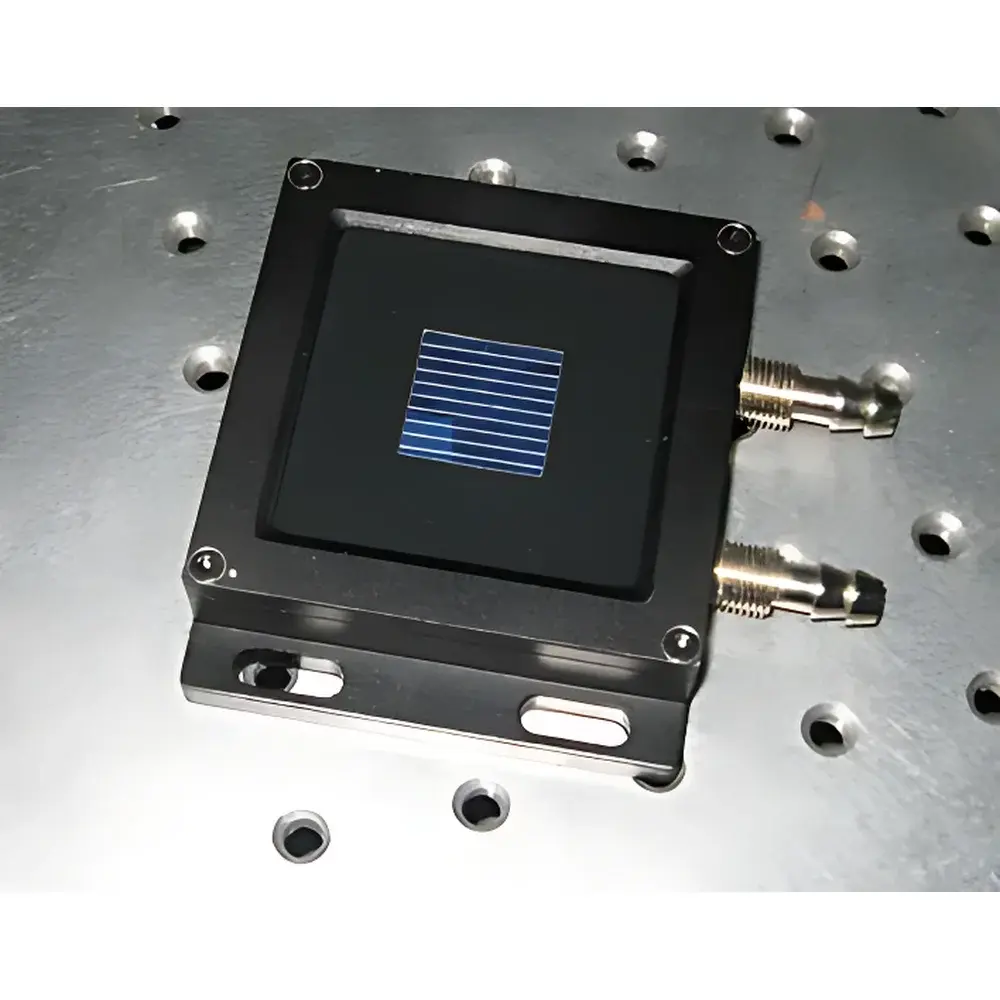
- Hermetically sealed aluminum housing (70 mm × 70 mm × 20 mm) with integrated thermal mass for minimized temperature gradients during operation.
- Radiation-hardened anti-reflective cover glass optimized for broadband transmission (400–1100 nm) and long-term UV stability; refractive index matched to encapsulant to reduce Fresnel losses.
- Pt100 platinum resistance thermometer embedded beneath the active cell, pre-calibrated to ±0.05 °C uncertainty and connected via 4-wire Kelvin configuration to eliminate lead resistance error.
- Dual LEMO connectors (FGG.0B.304.CLAD) provide galvanically isolated, low-noise signal paths for Isc/Voc and temperature—ensuring compatibility with precision electrometers and data acquisition systems supporting IEEE 488 or USB-TMC interfaces.
- Active area precisely defined at 20 mm × 20 mm (400 mm²), with edge exclusion zone conforming to IEC 60904-2 aperture definition requirements.
- Stability verified per IEC 60904-4: post-burn-in drift < ±0.5% in Isc over 1,000 hours at 25 °C and 1-sun equivalent irradiance.
Sample Compatibility & Compliance
The CEL-RCCO is compatible with all Class A, B, and C solar simulators (xenon, metal halide, LED-based) operating within the 400–1100 nm spectral band. It meets the geometric, electrical, and thermal specifications required for use in accordance with IEC 61215-2 (crystalline silicon PV module qualification), IEC 61646 (thin-film PV module testing), and ASTM E927-22 (standard specification for solar simulation devices). Each unit ships with an individual calibration certificate issued by an ISO/IEC 17025-accredited laboratory, documenting CV value, expanded uncertainty (k=2), temperature coefficients (α, β), spectral responsivity curve, and traceability path to NIST SRM 2231 or equivalent primary standard. Certificates comply with GLP documentation requirements and support FDA 21 CFR Part 11 audit readiness when paired with validated data logging software.
Software & Data Management
While the CEL-RCCO operates as a passive transducer requiring no embedded firmware, its integration into automated test systems is facilitated through standardized analog output protocols. When used with commercial IV tracers (e.g., Keysight B1500A, Keithley 2450) or custom LabVIEW/Python DAQ architectures, real-time Isc and Pt100 voltage signals are converted to irradiance (W/m²) using the equation: E = Isc / CV × [1 + α(T − 25)]−1. Temperature-compensated CV lookup tables and uncertainty propagation models are provided in CSV and MATLAB formats. All calibration metadata—including date, operator ID, environmental conditions, and measurement repeatability statistics—is embedded in XLSX certificate files, enabling full digital audit trail generation aligned with ISO/IEC 17025 clause 7.8.
Applications
- Irradiance monitoring and feedback control in solar simulator intensity regulation loops.
- Spectral mismatch correction for non-ideal light sources using measured responsivity curves and reference cell spectral mismatch factors (MMF).
- Periodic verification of flash tester and steady-state solar simulator output stability per IEC 60904-9.
- Calibration transfer between primary standards and working reference cells in PV manufacturing QA labs.
- Temperature-dependent performance characterization of concentrator optics and secondary optical elements.
- Validation of radiometric sensors (pyranometers, spectroradiometers) in outdoor and indoor solar resource assessment setups.
FAQ
What is the difference between CEL-RCCO and CEL-RCCN reference cells?
The CEL-RCCO uses polycrystalline silicon with broader spectral response and higher tolerance to spatial non-uniformity; CEL-RCCN employs monocrystalline silicon offering marginally higher CV and lower temperature coefficients—selected based on application-specific spectral match requirements.
Is the calibration certificate valid for international accreditation?
Yes—the certificate conforms to ISO/IEC 17025:2017 and references NIST-traceable irradiance standards; it is accepted by TÜV Rheinland, UL, and JET for PV lab accreditation audits.
Can the CEL-RCCO be used outdoors?
It is designed for controlled indoor use only; prolonged exposure to ambient humidity, thermal cycling, or particulate contamination voids calibration validity and violates IEC 60904-2 handling guidelines.
How often should recalibration be performed?
Annual recalibration is recommended per IEC 61215-2 Annex A; however, if operated continuously under stable thermal conditions with periodic stability checks (< ±0.3% Isc drift), recalibration intervals may extend to 18 months subject to internal QA approval.
Does the device require bias voltage or external power?
No—it operates passively in short-circuit mode; only low-impedance ammeter connections are needed for Isc measurement.