
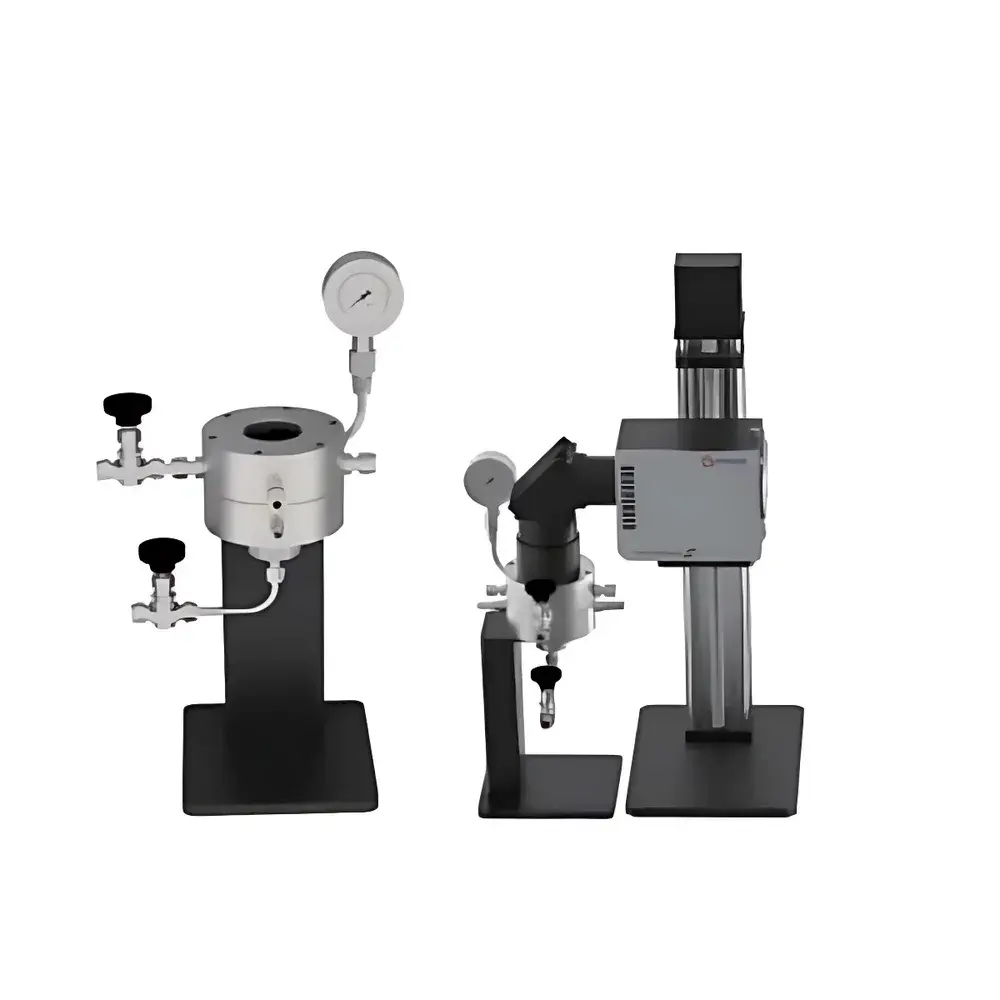
CEL-STU100 Microscale Photo-Thermal Reactor by CEAULIGHT
| Brand | CEAULIGHT |
|---|---|
| Model | CEL-STU100 |
| Light Source Type | High-Intensity Xenon Arc Lamp |
| Irradiation Mode | External Illumination |
| Max Operating Temperature | 800 °C |
| Optical Window Material | Fused Silica (Quartz) |
| Window Transmittance | >95% (200–2500 nm) |
| Construction Material | ASTM A240 Grade 316L Stainless Steel |
| Sealing Method | Metal-Gasketed Flanged Interface |
| Thermal Insulation | Multi-Layer Ceramic Fiber Blanket (Surface Temp. <60 °C at 800 °C Internal) |
Overview
The CEL-STU100 Microscale Photo-Thermal Reactor is an engineered platform for controlled solid-phase photocatalytic and photo-thermal catalytic studies under high-flux visible–NIR illumination. Unlike conventional photoreactors relying solely on photon-driven electron–hole pair generation, the CEL-STU100 leverages concentrated xenon arc irradiation to induce localized thermal activation on catalyst surfaces—enabling synergistic photoexcitation and rapid thermal response in heterogeneous gas–solid reactions. Its design adheres to fundamental principles of radiative heat transfer, Lambert–Beer absorption modeling, and convective mass transport optimization. The reactor operates within a defined thermal envelope (up to 800 °C internal temperature), where incident optical power (typically 150–300 W/cm² at focal point) is converted to surface heat via broadband absorption by catalytically active materials (e.g., plasmonic oxides, doped carbides, or metal–support interfaces). This dual-mode operation bridges the gap between low-temperature photocatalysis and high-temperature thermocatalysis—making it particularly suitable for mechanistic investigations of light-assisted CO₂ hydrogenation, methane dry reforming, ammonia synthesis, and selective oxidation pathways.
Key Features
- High-temperature capable reaction chamber fabricated from ASTM A240 316L stainless steel—resistant to chloride-induced stress corrosion cracking and compatible with H₂, CO, NH₃, and acidic gas streams under elevated thermal load.
- Fused silica optical viewport (Ø25 mm standard) with certified transmittance >95% across 200–2500 nm—ensuring minimal spectral distortion for accurate actinometric calibration and in situ spectroscopic coupling (e.g., DRIFTS, Raman).
- Externally mounted high-intensity xenon short-arc lamp (300–1000 W, optional ellipsoidal or parabolic reflector) enabling precise collimation and spatial control of irradiance without internal lamp heating or quartz envelope degradation.
- Integrated radial gas distribution manifold ensuring uniform laminar flow across the catalyst bed—minimizing channeling effects and enhancing residence time distribution (RTD) reproducibility.
- Multi-layer ceramic fiber insulation jacket (rated to 1260 °C) maintaining external housing surface temperature below 60 °C during sustained 800 °C operation—meeting IEC 61000-4-2 touch-safety requirements.
- Double-cone flanged interface with Helicoflex® metal gasket seal—validated per ASME B16.5 Class 150 pressure rating and leak-tested to ≤1×10⁻⁹ mbar·L/s He (helium mass spectrometry).
Sample Compatibility & Compliance
The CEL-STU100 accommodates powdered, pelletized, or monolithic solid catalysts (0.1–2.0 g loading, bed height 5–20 mm) in inert or reactive atmospheres (N₂, Ar, H₂, CO, CO₂, O₂, CH₄, NH₃) up to 0.5 MPa gauge pressure. Catalyst supports—including TiO₂, Al₂O₃, SiO₂, CeO₂, carbon nanotubes, and MOF-derived frameworks—are fully compatible. All wetted parts comply with USP Class VI biocompatibility standards and meet ASTM G155 accelerated weathering protocols for UV stability. The system conforms to ISO/IEC 17025 documentation requirements for method validation and supports GLP-compliant audit trails when integrated with certified data acquisition hardware.
Software & Data Management
While the CEL-STU100 operates as a standalone hardware module, it is designed for seamless integration with third-party process control systems (e.g., LabVIEW, MATLAB, or DeltaV via 4–20 mA analog I/O or Modbus RTU). Real-time monitoring of thermocouple signals (K-type, ±0.5 °C accuracy), mass flow controllers (MFCs), and pressure transducers is supported. When paired with CEAULIGHT’s optional CEL-SPR100 control console, users gain access to time-stamped irradiance logging (via calibrated photodiode sensor), temperature ramp profiling, and automated sequence execution—all compliant with FDA 21 CFR Part 11 for electronic records and signatures (audit trail, user authentication, data integrity).
Applications
- Mechanistic deconvolution of photo- vs. thermo-activated reaction pathways in CO₂-to-methanol conversion over Cu/ZnO/Al₂O₃.
- In situ operando study of lattice oxygen mobility in perovskite oxides under pulsed xenon illumination.
- Quantitative assessment of plasmonic hot-carrier lifetime vs. local temperature rise in Au/TiO₂ nanocomposites.
- Accelerated aging tests of thermal barrier coatings under combined radiative–convective heating conditions.
- Development of solar-driven chemical looping processes using Fe₂O₃/Fe₃O₄ redox pairs.
FAQ
Can the CEL-STU100 be used with mercury lamps or LED arrays?
Yes—though optimized for xenon arc sources, the external illumination architecture permits substitution with medium-pressure Hg lamps (for UV-selective studies) or high-power LED modules (365 nm, 405 nm, 450 nm) via adjustable mounting brackets and collimating optics.
Is vacuum compatibility supported?
The flanged interface supports high-vacuum operation down to 1×10⁻⁶ mbar when equipped with all-metal seals and baked per UHV protocols; base pressure verification requires separate turbomolecular pumping infrastructure.
What catalyst geometries are validated for use?
Standard validation covers 13 mm diameter pressed pellets (5–10 MPa compaction), 20–40 mesh powders, and 1/8″ hexagonal monoliths with 200–400 cpsi cell density.
Does the system include temperature calibration certificates?
Each unit ships with NIST-traceable calibration reports for embedded K-type thermocouples and optical window transmittance spectra measured per ISO 9050.
How is light flux quantified and reproducible across experiments?
Irradiance is characterized using a calibrated silicon photodiode (±2% uncertainty) referenced to NIST SRM 2271; spatial uniformity is mapped via scanning pyroelectric detector array prior to shipment.





