
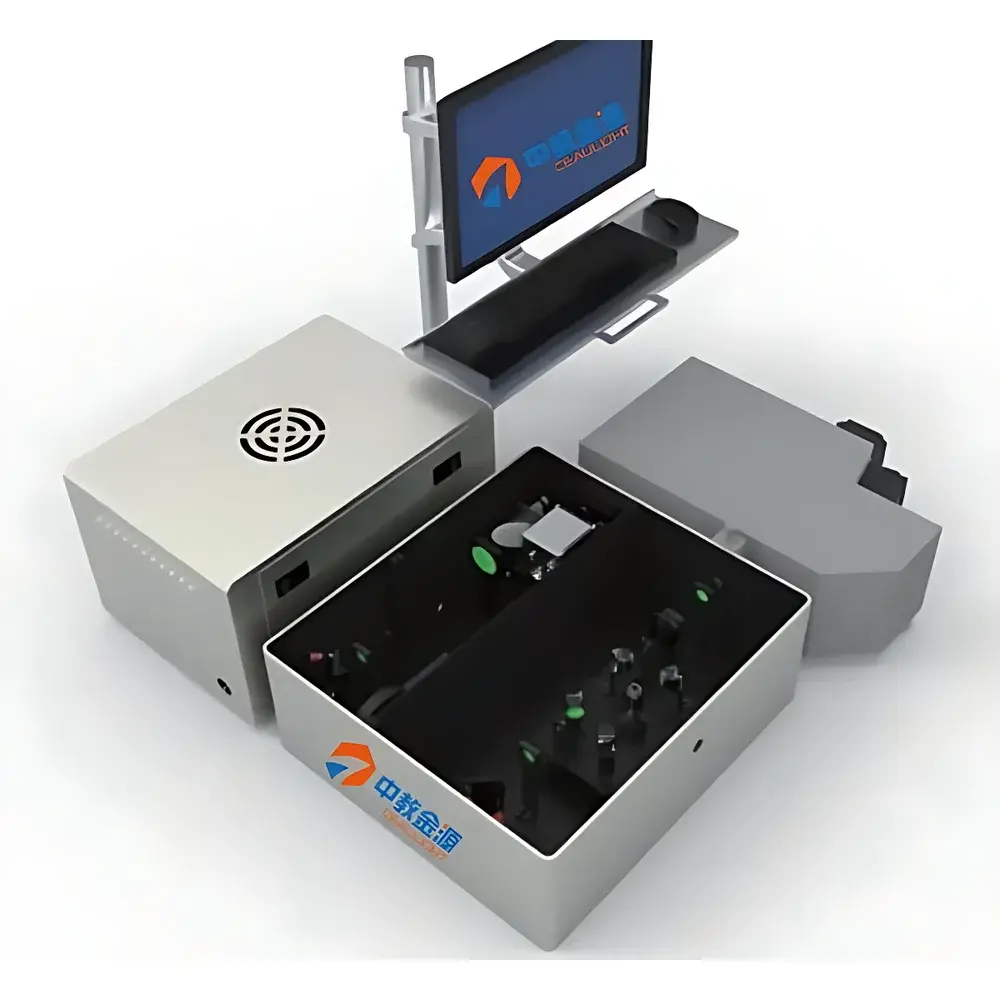
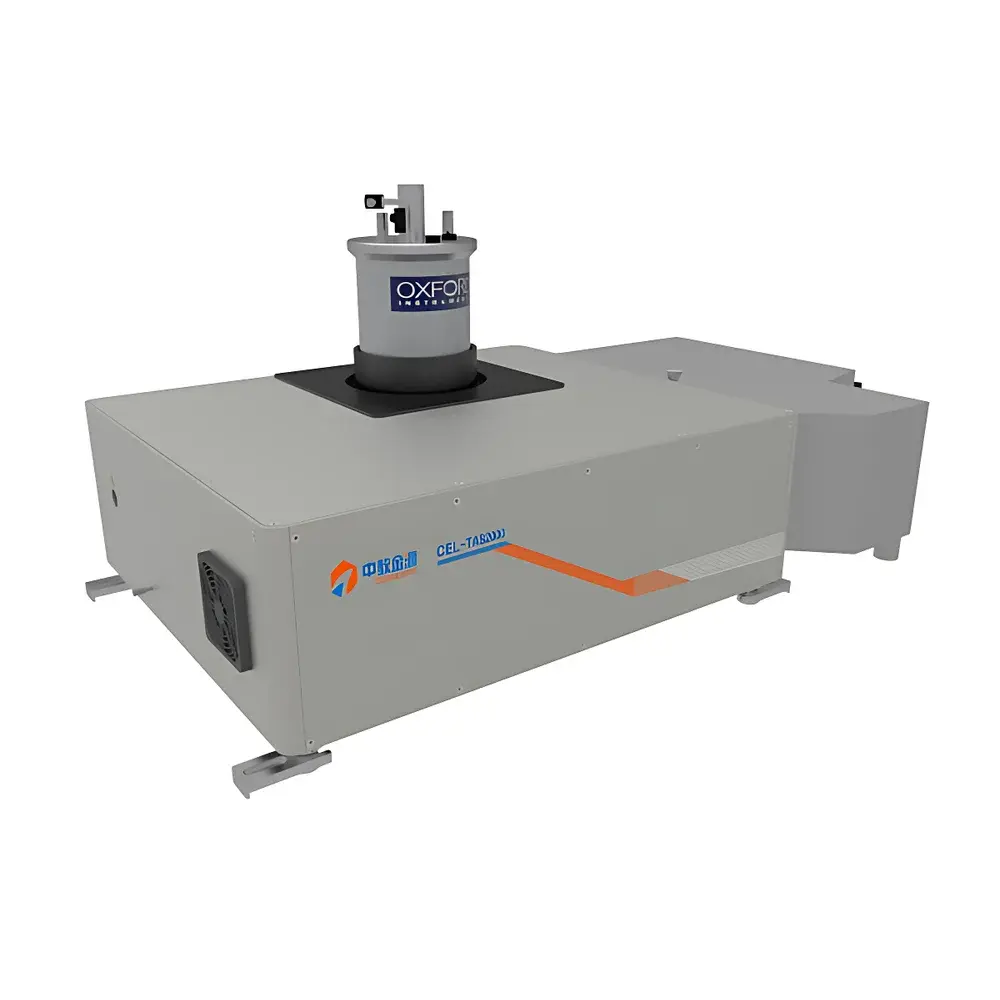
CEL-TAS2000 Nanosecond Transient Absorption Spectrometer (Laser Flash Photolysis System)
| Brand | CEAULIGHT |
|---|---|
| Model | CEL-TAS2000 |
| Origin | Beijing, China |
| Manufacturer Type | OEM Instrument Manufacturer |
| Product Category | Domestic Scientific Instrumentation |
| Pricing | Upon Request |
Overview
The CEL-TAS2000 Nanosecond Transient Absorption Spectrometer is a turnkey laser flash photolysis system engineered for time-resolved detection of short-lived photoinduced intermediates—including excited singlet and triplet states, radicals, radical ions, and charge-transfer species—across broad spectral and temporal domains. Based on the pump-probe transient absorption principle, the system employs a precisely synchronized nanosecond-pulsed OPO laser as the pump source and a high-brightness, spatially stable laser-driven plasma white-light continuum (LDLS) as the broadband probe. This configuration enables quantitative measurement of differential optical density (ΔOD) with sub-milliodensity resolution over 350–1700 nm, capturing kinetic decays from <5 ns to seconds. The instrument is designed for rigorous physical chemistry, photocatalysis, optoelectronic materials science, and ultrafast photobiology applications where detection sensitivity, spectral fidelity, and temporal reproducibility are critical under GLP-compliant experimental conditions.
Key Features
- Laser-driven plasma white-light continuum (LDLS) probe source: 190–2100 nm output, 100 × 100 µm beam spot, <1 µm spatial stability (centroid), 10,000 h operational lifetime, and <1% energy degradation after 1000 h
- Four-grating monochromator architecture: 350 mm focal length, motorized grating turret (3 gratings standard), automated entrance/exit slits, and CCD-coupled exit port—delivering 0.04 nm spectral resolution and superior stray light rejection (>106:1)
- Custom low-noise single-point detectors: Optimized Si photodiode (350–1000 nm) and optional InGaAs detector (900–1700 nm), both integrated with ultra-low-noise bias amplification circuitry
- High-fidelity signal acquisition: 12-bit or 16-bit programmable digital oscilloscope with >1 GS/s sampling rate, enabling ΔOD detection down to 5×10⁻⁵ without signal averaging or time-resolution compromise
- Modular sample environment support: Standard transmission/reflection cells; optional cryogenic integration (Oxford DN2, 77–300 K); compatibility with microscope-coupled microspectroscopy, high-field magnet setups, and in-situ catalytic reactors
- Fully automated operation: Motorized filter wheel for band-specific probe attenuation, software-controlled OPO wavelength tuning (210–2400 nm), and one-click transient spectrum acquisition with real-time kinetic fitting
Sample Compatibility & Compliance
The CEL-TAS2000 accommodates optically transparent, low-scattering liquid solutions (e.g., acetonitrile, toluene, aqueous buffers), solid thin films (metal oxides, perovskites, organic semiconductors), single crystals, and powdered catalysts. Fluorescent samples are fully compatible due to gated detection architecture and spectral separation capability. All optical components meet ISO 10110 surface quality standards; electronic subsystems comply with IEC 61326-1 (EMC for laboratory equipment). Data acquisition firmware supports audit-trail logging and user-access controls aligned with FDA 21 CFR Part 11 requirements for regulated laboratories. System calibration protocols reference NIST-traceable neutral density filters and certified spectral irradiance standards.
Software & Data Management
Control and analysis are executed via CEALight TAS Studio—a native Windows application supporting full instrument orchestration, real-time oscilloscope waveform visualization, multi-wavelength kinetic trace extraction, global spectral deconvolution, and nonlinear least-squares fitting (Levenberg-Marquardt algorithm). Raw binary data (.bin) and processed results (.csv, .txt, .mat) are stored with embedded metadata (timestamp, laser energy, grating position, slit width, detector gain). Export modules enable direct import into OriginLab, MATLAB, and Python (via NumPy/Pandas). Software architecture includes role-based user accounts, electronic signature capture for method validation, and exportable PDF reports compliant with ISO/IEC 17025 documentation frameworks.
Applications
- Photocatalytic mechanism studies: Quantifying charge carrier lifetimes, interfacial electron transfer rates, and trap-state dynamics in TiO2, g-C3N4, MOFs, and quantum dot systems
- Organic photovoltaic material characterization: Resolving polaron pair formation, geminate recombination, and triplet exciton diffusion in donor–acceptor blends
- Photochemical reaction kinetics: Mapping S1→T1 intersystem crossing, bond homolysis pathways, and proton-coupled electron transfer (PCET) in biomimetic complexes
- Ultrafast photophysics of emissive materials: Correlating transient absorption signatures with delayed fluorescence, thermally activated delayed fluorescence (TADF), and room-temperature phosphorescence (RTP)
- Time-resolved spectroelectrochemistry: Coupling with potentiostats to resolve redox-generated intermediates under controlled potential windows
FAQ
What is the minimum detectable ΔOD and under what conditions is it achieved?
The system achieves ≤0.1 mOD (5×10⁻⁵ OD) at optimal signal-to-noise ratio using 16-bit acquisition, single-shot probing, and LDLS illumination at 500–800 nm. Sensitivity remains ≥0.1 mOD across 350–1700 nm with appropriate detector selection.
Can the CEL-TAS2000 perform measurements under cryogenic conditions?
Yes—standard integration with Oxford Instruments DN2 continuous-flow cryostats (77–300 K) is supported, including vacuum-tight optical feedthroughs and temperature-stabilized sample mounts.
Is the system compatible with external synchronization to third-party lasers or electrochemical workstations?
Yes—the trigger I/O interface supports TTL-level sync input/output with <1 ns jitter, enabling seamless coupling to femtosecond amplifier systems, pulse generators, or potentiostats.
Does the software support batch processing of kinetic datasets from multiple wavelengths?
Yes—TAS Studio includes automated multi-wavelength kinetic extraction, singular value decomposition (SVD), and target analysis modeling with constrained global fitting across up to 1024 wavelength channels.
What maintenance is required for the LDLS probe source?
The LDLS lamp requires no routine maintenance beyond periodic cleaning of front optics; its >10,000 h lifetime eliminates lamp replacement during typical instrument service cycles. No consumables or gas refills are needed.



