
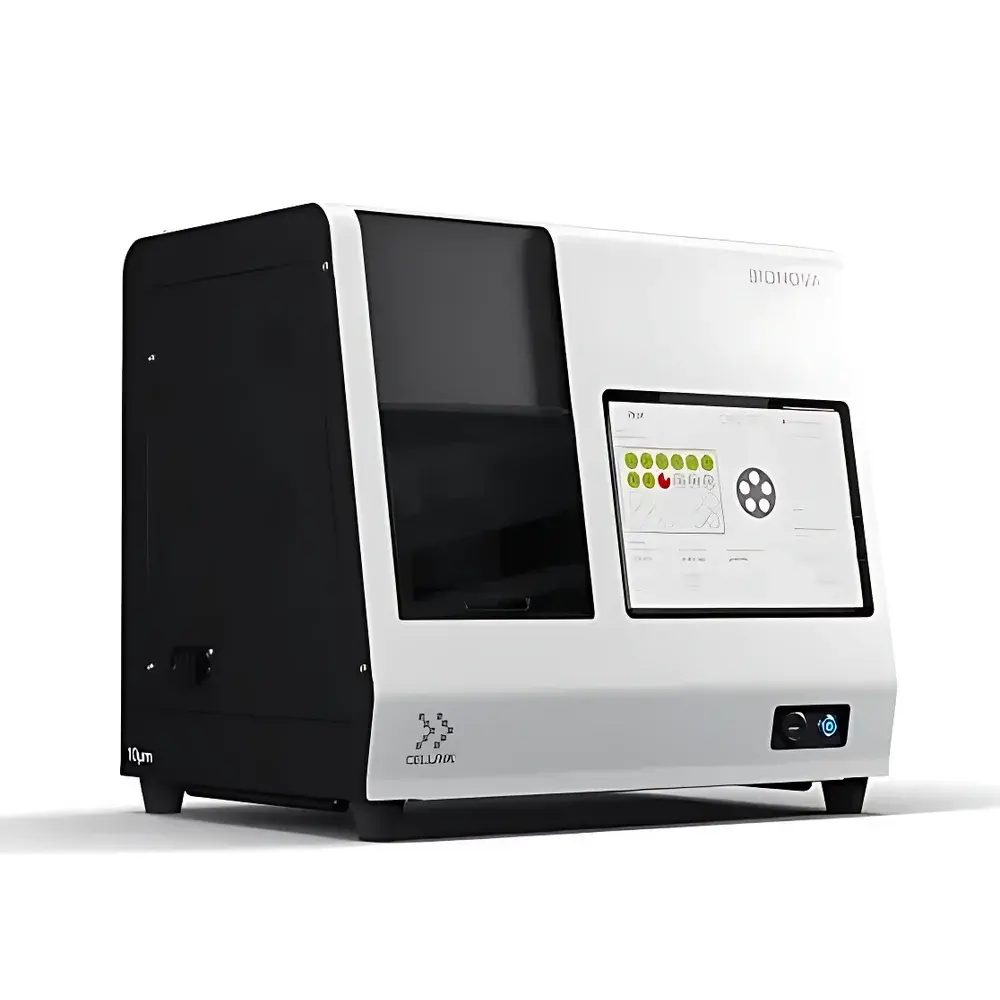
CELLINK BIONOVA X High-Resolution, High-Throughput DLP-Based Biological 3D Printer
| Brand | CELLINK |
|---|---|
| Origin | Sweden |
| Model | BIONOVA X |
| XY Resolution | 10 µm |
| Z-Axis Precision (Motor-Driven) | 4 µm |
| LED Wavelength | 405 nm (FWHM ±7.5 nm) |
| Light Intensity Range | 4–16 mW/cm² |
| Heater Temperature Range | Ambient to 60 °C |
| Compatible Well Plate Formats | 24-well, 12-well, and 6-well plates |
| Build Volume (per well) | 24-well: 63.6 mm² × 6.5 mm (X×Y×Z) |
| 12-well | 9.0 × 9.0 × 9.0 mm |
| 6-well | 19.2 × 10.8 × 9.0 mm |
| Connectivity | 1× USB-A port |
| Supported File Formats | .stl, .png, .bmp, .jpg |
| Dimensions | 515 × 380 × 441 mm (W×D×H) |
| Weight | 41 kg |
| Power Input | 100–240 VAC, 50–60 Hz, 200 W |
Overview
The CELLINK BIONOVA X is the world’s first digital light processing (DLP)-based biological 3D printer engineered for direct, high-fidelity fabrication of living tissue constructs within standard multi-well plates. Unlike conventional extrusion-based or laser-assisted bioprinters, the BIONOVA X employs visible-light photopolymerization—specifically 405 nm UV-A light—to initiate rapid, spatially controlled crosslinking of photosensitive bioinks. This mechanism enables sub-10 µm lateral resolution and 4 µm axial precision, supporting the fabrication of anatomically accurate, microarchitecturally complex structures directly from CAD models or segmented medical imaging data (e.g., CT, MRI). Its integrated thermal control (ambient to 60 °C), UVC chamber sterilization (270 ±10 nm), and glove-compatible touchscreen interface ensure operational robustness in ISO Class 5–7 cleanroom environments and GLP-compliant laboratories. Designed for reproducible, scalable biofabrication, the system bridges preclinical tissue engineering workflows with high-throughput functional assay readiness.
Key Features
- Sub-10 µm XY resolution and 4 µm motor-driven Z-axis precision for faithful replication of microvascular networks, neural tracts, and epithelial stratification.
- Multi-well plate compatibility (6-, 12-, and 24-well formats) enabling parallel fabrication of up to 24 independent tissue constructs per print run—ideal for dose-response screening and patient-derived model libraries.
- Glove-compatible 10″ capacitive touchscreen with onboard firmware for real-time parameter adjustment, layer-by-layer preview, and print queue management—no external PC required.
- Programmable 405 nm LED illumination (4–16 mW/cm² intensity range, FWHM ±7.5 nm) optimized for cytocompatible photoinitiators (e.g., LAP, Irgacure 2959) and low-phototoxicity printing protocols.
- Automated optical alignment and platform calibration routine ensures consistent voxel fidelity across all wells and repeated instrument use—critical for longitudinal studies and inter-laboratory reproducibility.
- In-chamber UVC sterilization (270 ±10 nm) validates sterility prior to each print cycle, reducing contamination risk without compromising hydrogel integrity or cell viability.
Sample Compatibility & Compliance
The BIONOVA X supports a broad spectrum of clinically relevant bioinks—including gelatin methacryloyl (GelMA), hyaluronic acid methacrylate (HAMA), fibrinogen–thrombin systems, and nanocellulose–alginate composites—provided they exhibit appropriate photocrosslinking kinetics under 405 nm irradiation. All printed constructs maintain ≥85% post-printing cell viability (measured via Calcein-AM/PI staining at 24 h) when using validated protocols. The system complies with ISO 13485:2016 design controls for medical device manufacturing support, and its audit-ready logging architecture meets FDA 21 CFR Part 11 requirements for electronic records and signatures. Routine performance verification aligns with ASTM F3284-22 (Standard Guide for Characterizing Bioink Printability) and ISO/ASTM 52900:2021 (Additive Manufacturing—General Principles).
Software & Data Management
The embedded firmware supports native import of STL, PNG, BMP, and JPG files—enabling direct conversion of segmented histological or radiographic datasets into printable layer stacks. Gray-scale DLP modulation permits regional stiffness modulation (e.g., 20–100 kPa gradients within a single construct) via pixel-wise light dose control—a capability essential for modeling heterogeneous tissue interfaces (e.g., osteochondral junctions). All print logs—including exposure time, intensity profile, temperature history, and calibration timestamps—are stored locally with SHA-256 hashing and exportable in CSV/JSON format. Optional integration with CELLINK’s BIOX software suite enables DICOM-to-STL pipeline automation, batch parameter optimization, and LIMS-compatible metadata tagging (e.g., donor ID, passage number, matrix lot).
Applications
- Regenerative Medicine: Fabrication of patient-specific scaffolds from clinical CT scans; generation of biomimetic osteochondral or cardiac patches with spatially graded mechanical properties.
- Precision Oncology: High-throughput printing of 24-well tumor spheroid arrays embedded in stromal matrices for chemosensitivity profiling and immune-cell infiltration assays.
- Vascularized Tissue Engineering: Co-printing of endothelial-laden lumens with pericyte-coated walls using dual-material grayscale projection—achieving perfusable microvessels (>50 µm lumen diameter) within 72 h.
- Disease Modeling: Recapitulation of fibrotic stiffening gradients in liver or lung models; printing of amyloid-β–laden neural tissues with tunable synaptic density for Alzheimer’s drug screening.
- Long-Term Maturation Studies: Stable culture of printed constructs over 28+ days via integrated environmental monitoring (temperature, humidity feedback loop optional via external sensor integration).
FAQ
What bioink formulations are validated for use with the BIONOVA X?
CELLINK provides technical documentation for GelMA (7–15% w/v), HAMA (2–5% w/v), and fibrinogen–thrombin systems. Third-party bioinks must demonstrate ≥90% crosslinking efficiency under 405 nm, 10 mW/cm² exposure for ≤15 s per layer.
Can the system be integrated into an automated cell culture workflow?
Yes—the USB-A port supports connection to robotic liquid handlers and incubator-integrated environmental controllers via Modbus RTU or ASCII command protocols.
Is remote monitoring or cloud-based data backup supported?
Local storage is mandatory per ISO 27001-aligned data governance policies; however, encrypted CSV/JSON exports may be transferred manually to institutional HIPAA- or GDPR-compliant repositories.
How frequently does the optical path require recalibration?
The auto-alignment routine executes before every print job; full optical recalibration is recommended quarterly or after transport, using the included NIST-traceable calibration slide.
Does the system support grayscale lithography for mechanical property gradients?
Yes—pixel-level intensity modulation enables continuous variation of crosslink density, permitting Young’s modulus gradients of up to 1:5 across a single 6-mm construct.



