
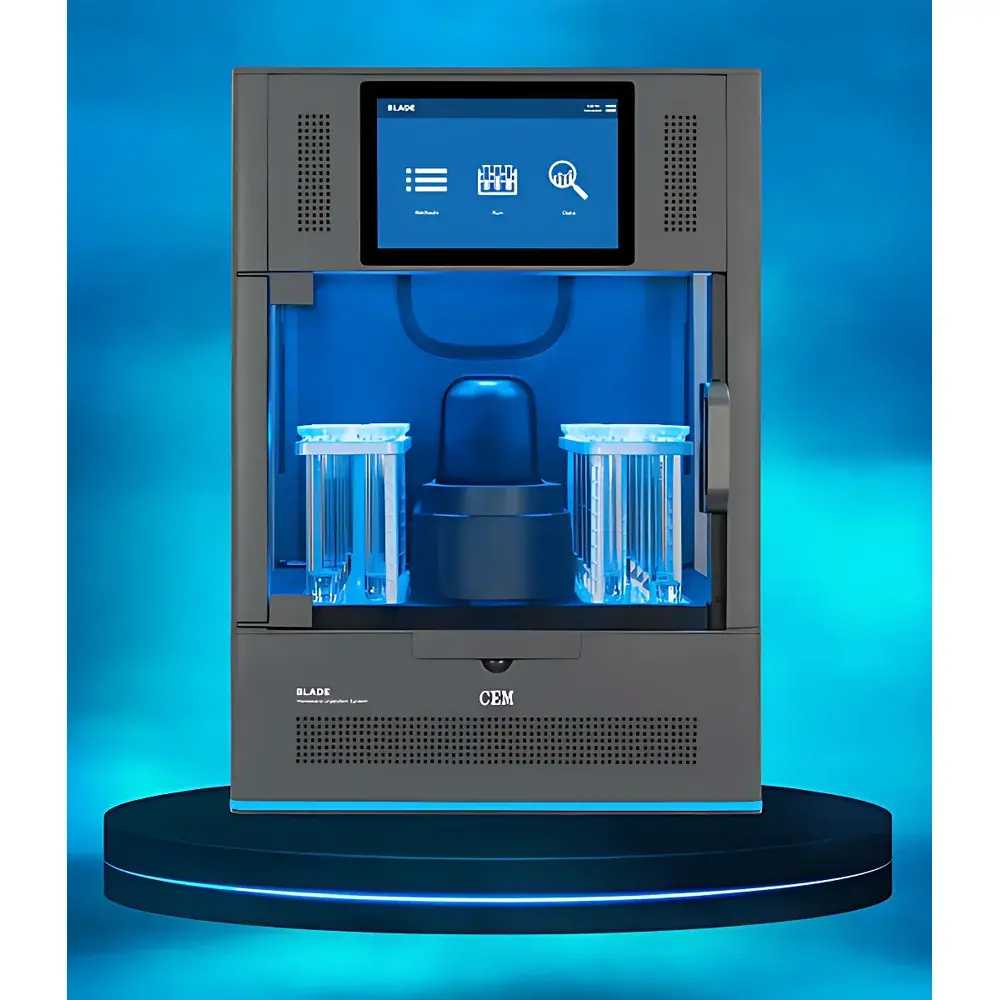
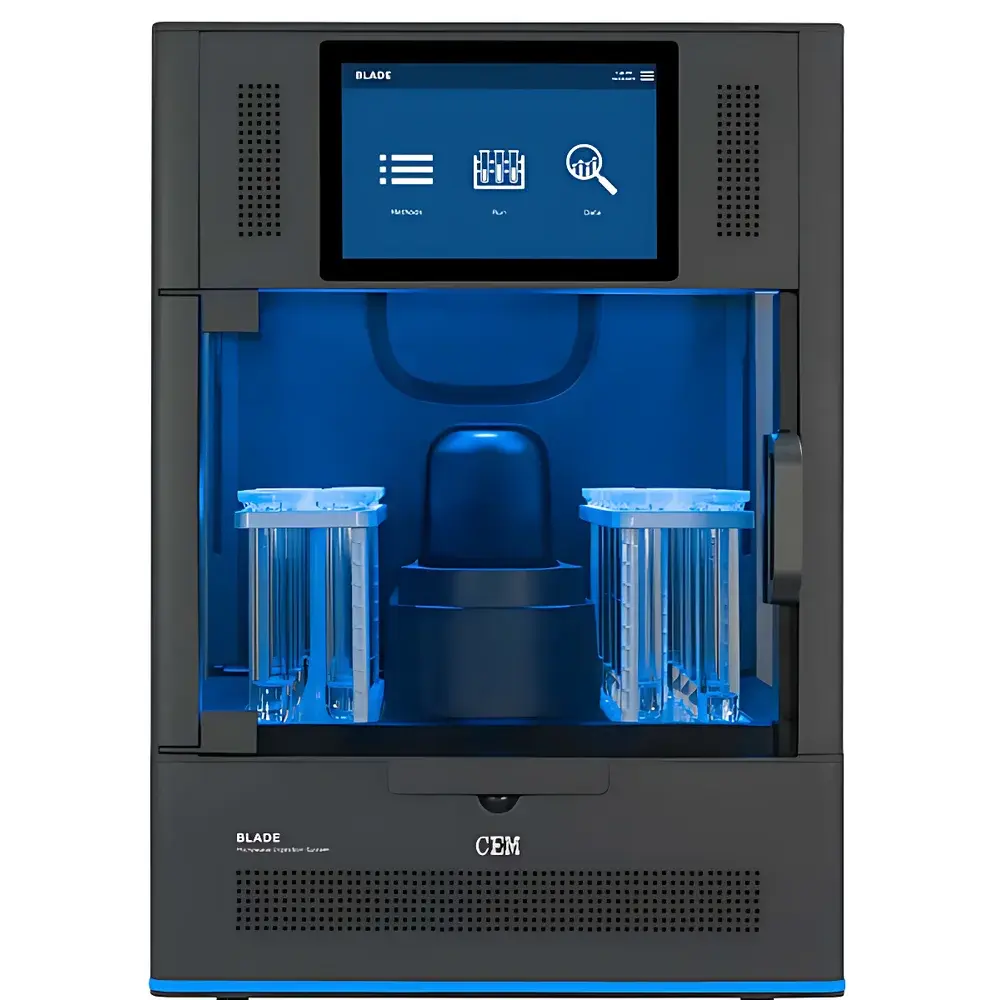
CEM BLADE Advanced Microwave Digestion System
| Brand | CEM |
|---|---|
| Origin | Beijing, China |
| Manufacturer Status | Authorized Distributor |
| Product Origin | Domestic (China) |
| Model | BLADE |
| Quotation | Upon Request |
| Cavity Class | Industrial-Grade |
| Batch Capacity | 24 Samples |
| Microwave Source | Single Magnetron |
| Max Temperature | 310 °C |
| Temp Measurement Accuracy | ±0.1 °C |
| Temp Control Stability | ±0.1 °C |
| Temp Uniformity | 0.01 °C |
| Max Pressure | Not Applicable |
Overview
The CEM BLADE Advanced Microwave Digestion System represents a paradigm shift in closed-vessel microwave-assisted sample preparation for elemental analysis. Engineered on the principle of kinetic energy enhancement via directional microwave coupling and vortex-driven molecular excitation, BLADE departs from conventional multimode cavity designs by employing a patented toroidal high-energy focusing cavity—termed the Single-Mode Cavity (SMC)—that generates localized microwave field intensities up to数十-fold higher than standard systems. This architecture enables rapid, controlled thermal activation of polar solvent molecules (e.g., HNO₃, HF, HCl), accelerating acid–matrix reactions through enhanced dipole alignment and rotational kinetic transfer. Unlike pressure-limited digestion platforms, BLADE operates under atmospheric or near-atmospheric conditions without pressurized vessels, eliminating pressure-related safety constraints while maintaining precise thermal control up to 310 °C. Its design targets laboratories requiring trace-metal analysis (ICP-MS, ICP-OES, AAS) where reproducibility, low blank levels, and minimal acid consumption are critical.
Key Features
- Directional Coupling Microwave Technology: Enables sub-second energy delivery directly into reaction mixtures, achieving 310 °C in ≤60 seconds with no overshoot or thermal lag.
- Toroidal Vortex Cavity Architecture: Generates a stable energy potential well that confines and concentrates microwave flux, ensuring uniform volumetric heating across all 24 sample positions.
- Integrated Hydraulic Sample Loading/Unloading System: Fully automated, pressure-independent sealing and release mechanism; each quartz vessel is individually sealed upon insertion and depressurized post-digestion without manual intervention.
- QV Quartz Vessels with Snap-Fit TFM Liners: Chemically inert, high-purity fused quartz construction rated for continuous operation >1000 °C; standardized dimensions eliminate inventory complexity; TFM liners compatible with hydrofluoric acid and aggressive chemistries.
- Self-Contained Operation: Requires no external cooling water, compressed air, or auxiliary chillers—reducing footprint, installation time, and operational overhead.
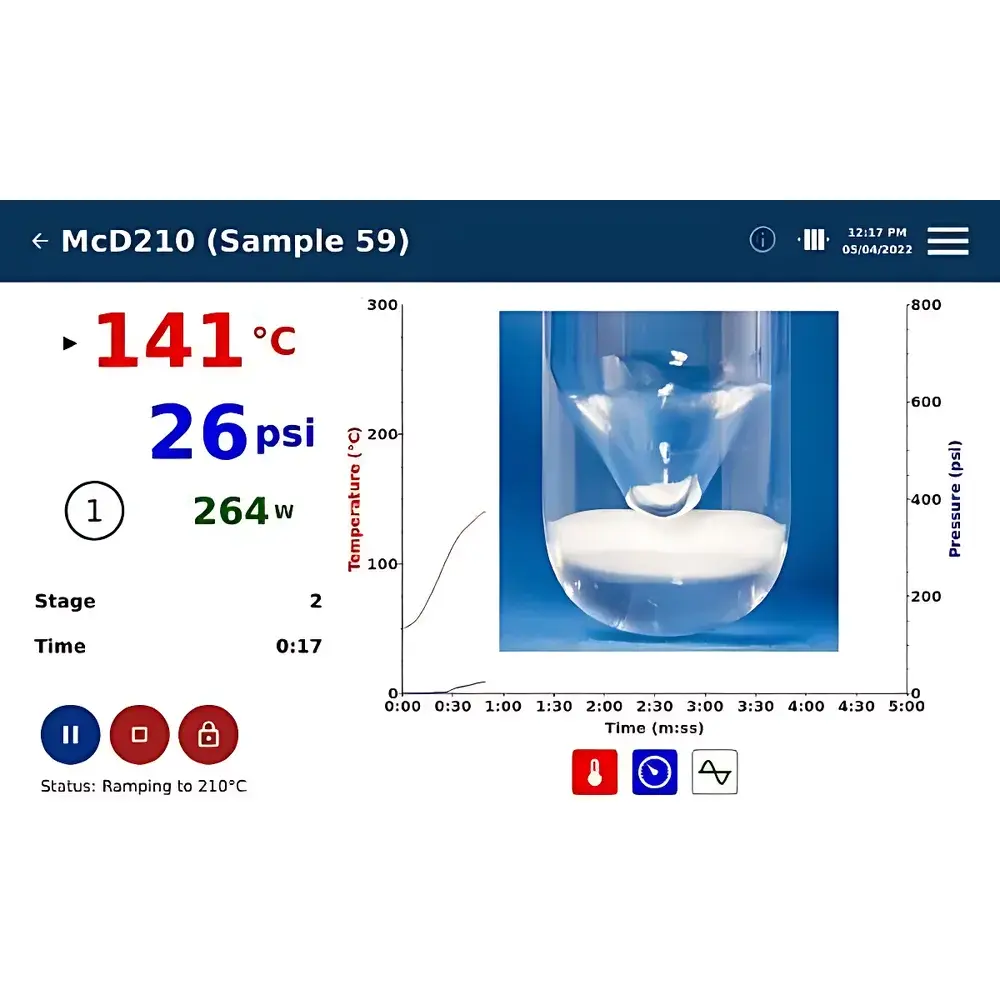
- Onboard 10-inch HD Touchscreen Interface with Visual Light Indicator (VLI): Real-time graphical display of temperature profiles, run status, and system diagnostics; VLI provides at-a-glance operational awareness across laboratory environments.
Sample Compatibility & Compliance
BLADE accommodates a broad spectrum of solid and semi-solid matrices—including geological samples (soils, sediments), biological tissues (plant, animal), polymers, ceramics, and environmental filters—without requiring pre-grinding or dilution. The absence of pressure-rated vessels removes compatibility limitations associated with volatile or gas-evolving samples (e.g., carbonates, organic-rich sludges). All digestion protocols comply with EPA Methods 3051A, 3052, and ASTM D5686 for trace metal determination. Temperature and time parameters are electronically recorded per-sample with timestamped audit trails, supporting full compliance with FDA 21 CFR Part 11 (when CFR Mode is enabled), ISO/IEC 17025:2017 clause 7.7 (result reporting), and GLP/GMP documentation requirements. Data integrity is preserved via role-based user access, electronic signatures, and immutable log files exportable in CSV or PDF format.
Software & Data Management
The BLADE Control Suite provides integrated instrument management, method development, and data archiving. It supports barcode scanning for unambiguous sample identification linked to balance interfaces for automatic mass registration. Each digestion cycle logs individual vessel temperature history, ramp rate, hold time, and final cooling profile. The software includes customizable method templates compliant with USP , EN 13656, and DIN 38405-16. Audit trail functionality meets ALCOA+ principles (Attributable, Legible, Contemporaneous, Original, Accurate, Complete, Consistent, Enduring, Available), enabling direct integration into LIMS environments via OPC UA or ASCII file export. CFR Mode enforces electronic signature workflows, session lockout after inactivity, and automatic backup to network drives or cloud storage endpoints.
Applications
- Routine heavy metal quantification in food safety testing (Cd, Pb, As, Hg per EU Commission Regulation (EC) No 1881/2006)
- Geochemical mapping of rare earth elements (REEs) in mineral exploration samples
- Pharmaceutical excipient screening for catalyst residues (Pd, Pt, Ni)
- Waste incineration ash analysis per EN 14385 and TCLP protocols
- High-temperature digestion of refractory oxides (Al₂O₃, SiO₂, ZrO₂) prior to ICP-MS analysis
- Low-acid, high-salt matrix digestion (e.g., seawater particulates, brine concentrates) with minimized polyatomic interferences
FAQ
Does BLADE require pressurized digestion vessels?
No. BLADE operates without pressure containment—eliminating risks associated with vessel rupture, gasket failure, or pressure-related method deviations.
Can BLADE handle hydrofluoric acid (HF) digestion?
Yes. QV quartz vessels with optional TFM liners are fully compatible with HF-based protocols for silicate and glass matrix dissolution.
Is method validation support available?
CEM provides application notes, certified reference material (CRM) digestion protocols, and IQ/OQ documentation packages aligned with ISO/IEC 17025 and GxP expectations.
How is temperature measured and controlled across all 24 positions?
Each vessel is monitored via fiber-optic temperature sensors embedded in the cavity floor; feedback loops adjust microwave output dynamically to maintain ±0.1 °C stability and 0.01 °C uniformity across the batch.
What regulatory standards does the CFR Mode satisfy?
CFR Mode implements full 21 CFR Part 11 Subparts A–C requirements including electronic signatures, audit trail generation, user authentication, and data integrity safeguards for regulated pharmaceutical and clinical laboratories.



