
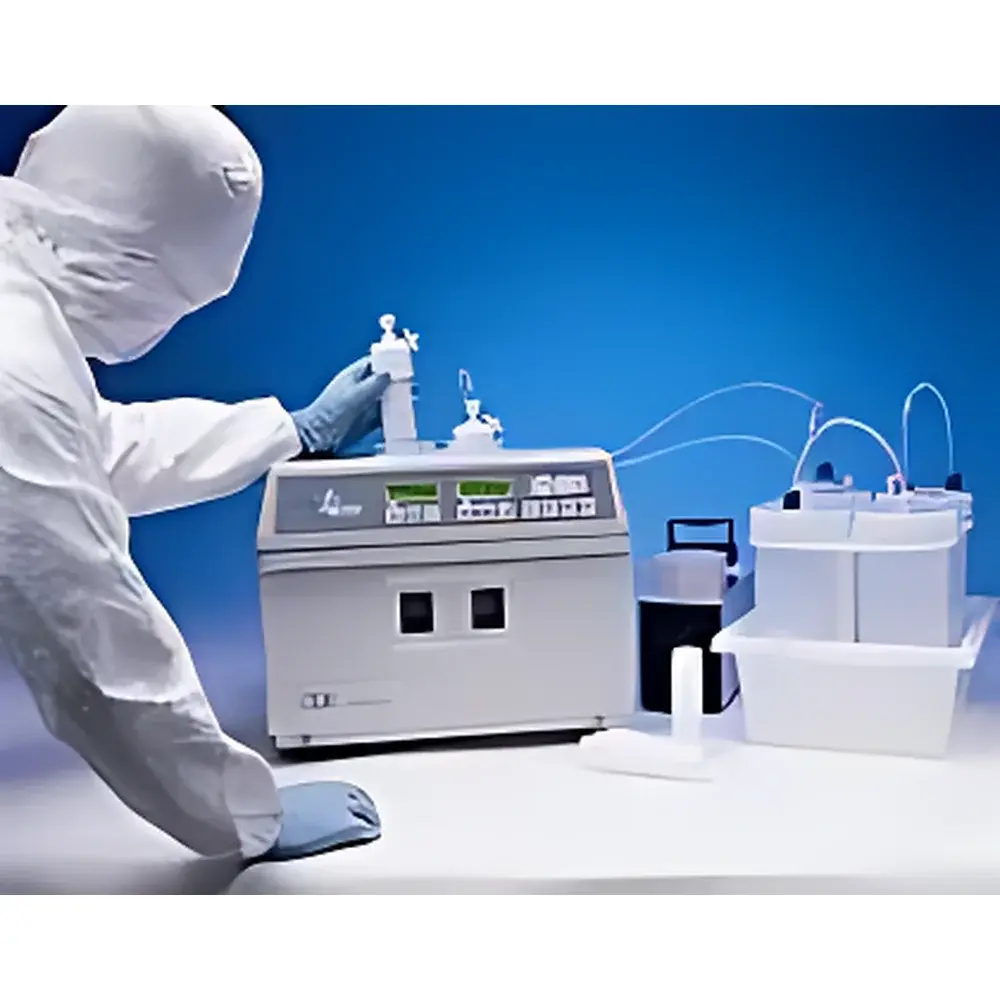
CEM Clean-STAR Ultra-Trace Sample Evaporation and Concentration System
| Brand | CEM |
|---|---|
| Origin | USA |
| Manufacturer Status | Authorized Distributor |
| Product Origin | Imported |
| Model | Clean-STAR |
| Chamber Class | Industrial-Grade |
| Sample Capacity | 2–6 positions |
| Microwave Source | Single or Dual Magnetron |
| Max Temperature | 500 °C |
| Operating Pressure | Ambient (Atmospheric) |
| Vessel Options | PTFE (30 mL, 70 mL), Quartz (100 mL) |
| Software | STAR LINK™ PC Interface, 20 Predefined Methods, Real-Time Temp/Time Curve Visualization, Endpoint Detection via Moisture/Volatility Sensing, Integrated Gas Absorption Module |
| Safety | Automated Interlock, Overtemperature & Overpressure Monitoring, HEPA-Filtered Inert Gas Purge (N₂ or Clean Air) |
Overview
The CEM Clean-STAR Ultra-Trace Sample Evaporation and Concentration System is a purpose-engineered platform for the controlled, contamination-free evaporation and concentration of ultra-trace analytical samples. Unlike conventional hotplate or nitrogen blow-down systems, the Clean-STAR employs precisely modulated microwave energy in an inert, particle-controlled environment to accelerate solvent removal while preserving volatile analytes—critical for trace metal analysis, isotopic ratio determination, and high-purity matrix characterization. Its core architecture integrates sealed, independent reaction channels with real-time thermal feedback, programmable gas purging (HEPA-filtered air or high-purity nitrogen), and vacuum-assisted vapor extraction—enabling reproducible sub-nanogram-level recoveries in semiconductor-grade cleanroom-compatible workflows. Designed specifically for laboratories adhering to ASTM D5683 (trace metals in high-purity chemicals), ISO 17025 method validation requirements, and USP / elemental impurities testing, the Clean-STAR bridges the gap between sample preparation robustness and metrological integrity.
Key Features
- Independent microwave channel control for 2–6 samples, each with dedicated temperature monitoring and power modulation via auto-shutter magnetron focusing
- Programmable thermal ramping from ambient to 500 °C with ±1 °C process stability, supported by embedded thermocouple feedback in each vessel position
- Atmospheric-pressure operation eliminates pressure-related safety constraints while maintaining full thermal control and vapor containment
- Dual-gas inlet system delivering either HEPA-classified clean air or 99.999% nitrogen, with flow rate regulation per channel to suppress oxidation and cross-contamination
- Integrated vacuum manifold with individual condensate traps and vapor extraction lines—designed to remove acidic fumes, organic vapors, and aerosols before they contact adjacent vessels
- Endpoint detection algorithm that monitors dielectric shift and thermal inertia to determine completion of solvent removal without over-drying or analyte loss
- Comprehensive software safeguards including door interlock verification, real-time fault logging, and automatic power cutoff on thermal excursion or gas-flow interruption
Sample Compatibility & Compliance
The Clean-STAR accommodates chemically inert, ultra-clean consumables essential for sub-part-per-trillion (ppt) analysis: PTFE vessels (30 mL and 70 mL) for aggressive acid matrices (e.g., HF/HNO₃ digests) and fused quartz vessels (100 mL) for high-temperature alkaline or borosilicate-incompatible applications. All wetted surfaces meet ASTM F51 specifications for extractables in semiconductor process chemicals. The system supports GLP-compliant data integrity through STAR LINK™ software, which enforces audit-trail generation per FDA 21 CFR Part 11 requirements—including user authentication, electronic signatures, and immutable method versioning. It complies with IEC 61000-6-3 (EMC) and UL 61010-1 (safety), and its gas-handling architecture meets ISO 8573-1 Class 1 particulate and Class 2 moisture specifications when operated with certified nitrogen supply.
Software & Data Management
STAR LINK™ is a validated Windows-based application enabling full method development, execution, and post-run review. It stores up to 20 user-defined protocols with multi-step temperature/power/gas profiles, each timestamped and digitally signed. During operation, the software acquires second-by-second temperature and power data, rendering dynamic time–temperature curves with overlay capability for inter-method comparison. All raw and processed data are exported in CSV or ASTM E1382-compliant format for LIMS integration. The built-in gas absorption module logs purge gas consumption, trap saturation status, and vacuum decay rates—providing traceable evidence of environmental control throughout the run. Audit trails include operator ID, method revision history, calibration event timestamps, and any manual override actions—fully compliant with ISO/IEC 17025 clause 7.7 and EU Annex 11 expectations.
Applications
- Pre-concentration of ultrapure water, electronic-grade solvents, and etchants prior to ICP-MS or HR-ICP-OES analysis
- Residue isolation from wafer rinse solutions in semiconductor fab QC labs
- Volatile element preservation (e.g., Hg, As, Se, Tl) during EPA Method 200.8 and 6020B sample prep
- Matrix simplification for nuclear fuel cycle materials (U/Pu isotopic ratio standardization)
- Low-background geochemical reference material preparation under Class 100 cleanroom conditions
- Pharmaceutical excipient purity screening per ICH Q3D guidelines using trace metal digestates
FAQ
Does the Clean-STAR require external cooling water or compressed air?
No—operation is self-contained; only standard 230 V AC power and optional high-purity nitrogen supply are required.
Can the system be integrated into an automated sample prep line?
Yes, STAR LINK™ supports OPC UA and Modbus TCP protocols for bidirectional communication with LIMS and robotic liquid handlers.
Is quartz vessel use limited to specific temperature ranges?
Quartz vessels are rated for continuous operation up to 500 °C but must avoid rapid thermal shock; recommended ramp rates ≤10 °C/min above 400 °C.
How is method validation documented for regulatory submissions?
STAR LINK™ generates IQ/OQ-ready reports including temperature uniformity mapping, endpoint repeatability statistics (n = 6), and gas-purge efficiency validation against ISO 8573-1 test certificates.
What maintenance intervals are recommended for long-term trace-level performance?
HEPA filters require replacement every 6 months under continuous use; magnetron output is verified annually via calibrated calorimetric load testing per CEM Service Bulletin SB-STAR-04.



