
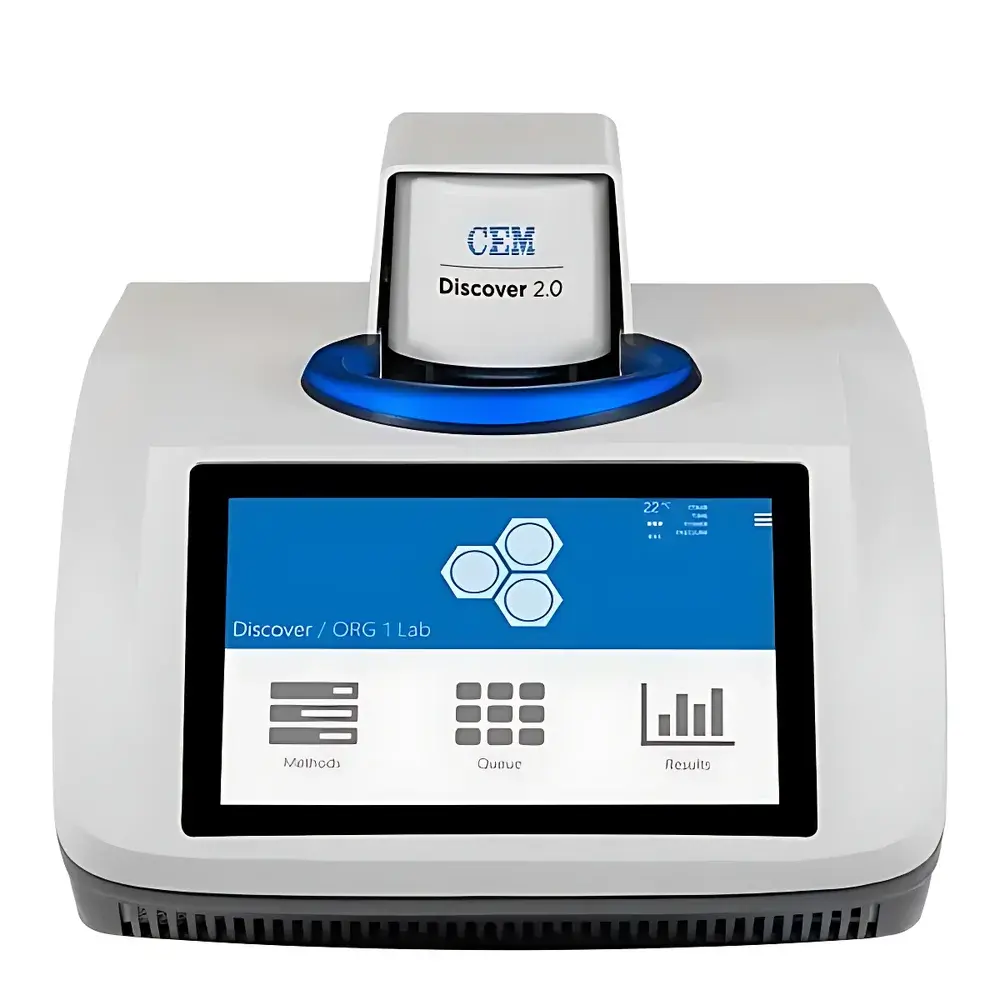
CEM Discover 2.0 Ring-Focused Single-Mode Microwave Synthesis System (300 mL Cavity)
| Brand | CEM |
|---|---|
| Origin | USA |
| Model | Discover 2.0 (Single-Mode) |
| Temperature Range | 0–300 °C |
| Pressure Range | 0–35 bar (500 psi) |
| Microwave Power Output | 0–900 W |
| Magnetron Frequency | 2450 MHz |
| Stirring Modes | Electromagnetic + Optional Mechanical Stirring |
| Reaction Volume Capacity | 300 mL |
| Cavity Type | Ring-Focused Single-Mode |
| Cooling Technology | PowerMAX Synchronized Active Cooling |
| Control Interface | 10.1" Touchscreen with TimeWave Embedded OS |
| Camera Integration | 5 MP Real-Time Imaging Module |
| Compliance | ISO 9001, CE, ETL, FDA 21 CFR Part 11 Ready (via Synergy PC Software) |
Overview
The CEM Discover 2.0 Ring-Focused Single-Mode Microwave Synthesis System represents the third generation of microwave-driven chemical synthesis technology. Engineered for precision and reproducibility in modern synthetic laboratories, it employs a proprietary ring-focused single-mode cavity architecture—distinct from conventional standing-wave single-mode systems—to deliver uniform, high-density microwave energy distribution across a 300 mL reaction volume. This design enables deterministic coupling of electromagnetic energy into reaction mixtures, minimizing thermal gradients and maximizing control over kinetic and thermodynamic reaction pathways. Unlike multimode systems, which rely on statistical field distribution, the Discover 2.0’s resonant cavity operates at 2450 MHz with active auto-tuning across 11 frequency channels, ensuring consistent impedance matching regardless of solvent polarity, sample volume, or vessel geometry. Its core function is to accelerate reaction kinetics through selective dielectric heating while maintaining strict boundary condition control—critical for mechanistic studies, catalyst screening, and structure–activity relationship (SAR) development in pharmaceutical and materials research.
Key Features
- Ring-focused single-mode cavity (300 mL volume) with 900 W/L energy density and synchronized PowerMAX active cooling for simultaneous high-power irradiation and precise temperature regulation.
- Dual stirring capability: integrated electromagnetic stirring (variable speed) with optional mechanical stirring for heterogeneous or viscous reaction media.
- Real-time process monitoring via built-in 5 MP camera system with time-lapse imaging and video capture, fully synchronized with temperature/pressure logging.
- High-fidelity closed-loop control: bottom-contact IR temperature sensing (±0.1 °C accuracy) and piezoresistive pressure transduction (±1 psi accuracy) across 0–35 bar range.
- ActiVent intelligent pressure management system with automatic venting sequence, fail-safe locking, and programmable ramp-hold profiles for safe high-pressure chemistry.
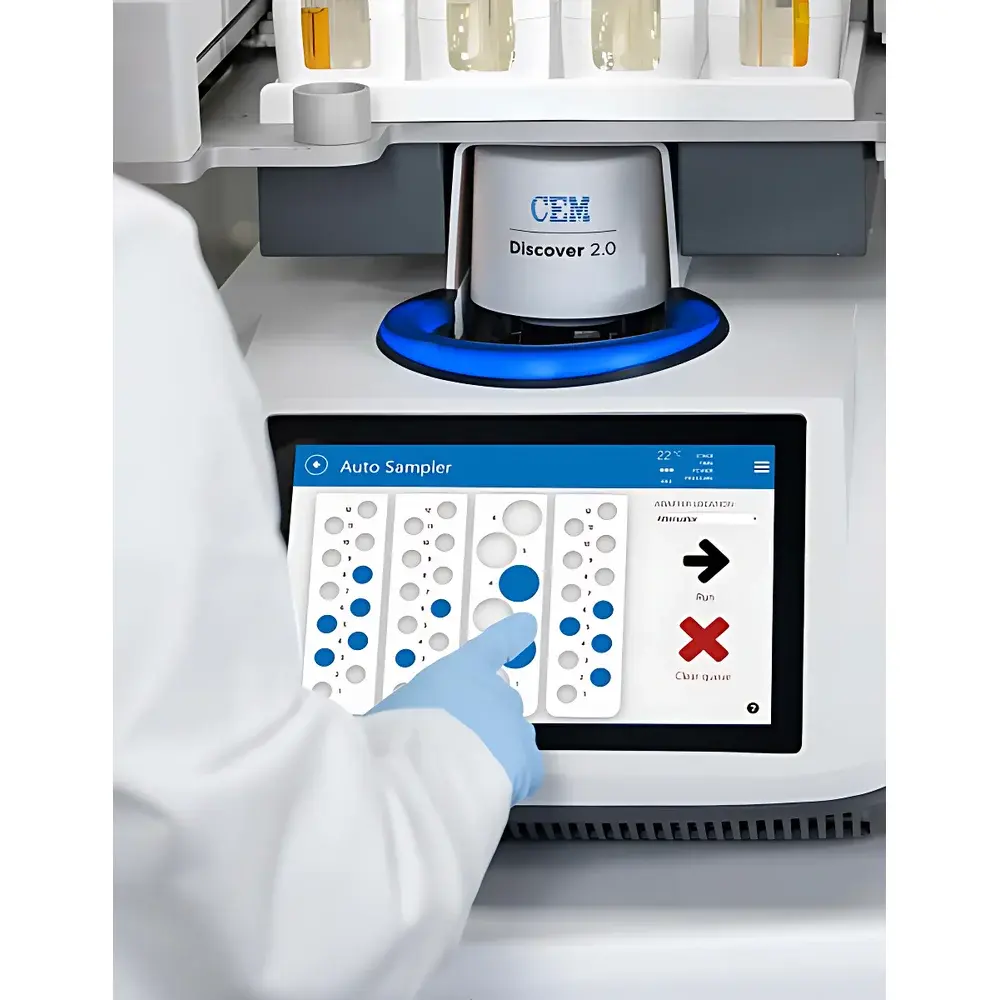
- Modular expansion architecture supporting automated sample handling (12- or 48-position autosamplers), gas-phase reagent introduction (vacuum-purge-refill cycle), low-temperature operation (–80 °C via CoolMate cryo-attachment), and in situ Raman spectroscopy integration.
- Embedded TimeWave operating system with intuitive touchscreen interface and seamless data export to Synergy PC software for audit-trail-compliant reporting.
Sample Compatibility & Compliance
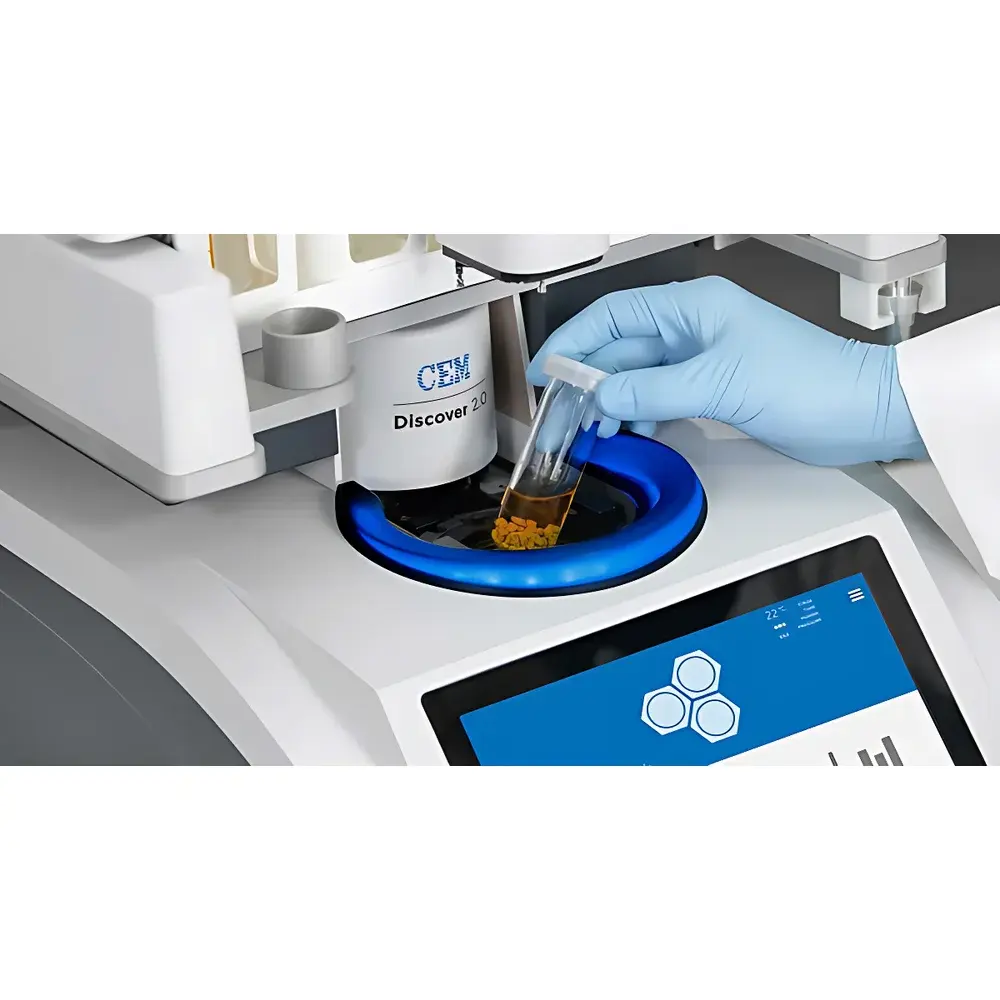
The Discover 2.0 accommodates a broad spectrum of reaction formats—including sealed-vessel high-pressure synthesis (10 mL, 35 mL, 100 mL vessels), open-vessel reflux (125 mL with condenser, addition funnel, and stirrer ports), and gas-compatible configurations. Vessels are constructed from reinforced PEEK, quartz, or borosilicate glass with chemically resistant seals rated for aggressive reagents (e.g., HF, HNO₃, anhydrous AlCl₃). The system complies with ISO 9001 quality management standards and meets CE and ETL safety certifications for electrical and electromagnetic compatibility. When operated with Synergy PC software, it supports ALCOA+ data integrity principles and provides full 21 CFR Part 11 compliance features—including electronic signatures, audit trails, user access controls, and immutable raw data archiving—making it suitable for GLP and GMP-regulated environments.
Software & Data Management
TimeWave firmware delivers real-time visualization of temperature, pressure, power, and stirring speed on the 10.1″ capacitive touchscreen. All parameters are logged at ≥1 Hz resolution and timestamped to microsecond precision. Synergy PC software extends functionality with advanced method scripting, multi-variable optimization (DoE-ready), comparative reaction analytics, and PDF report generation with embedded images and metadata. Raw data files (.csv, .tdms) retain full traceability to instrument ID, operator login, calibration history, and environmental logs. Data export protocols support LIMS integration via OPC UA or direct SQL database push, enabling centralized laboratory informatics deployment.
Applications
The Discover 2.0 serves as a platform for diverse synthetic workflows: small-molecule medicinal chemistry (Suzuki, Heck, Buchwald–Hartwig couplings), peptide synthesis under controlled moisture conditions, nanomaterial nucleation (metal oxides, MOFs, perovskites), polymerization kinetics studies, biomass depolymerization, and natural product extraction (e.g., accelerated solvent-assisted phytochemical isolation). Its ability to sustain sub-ambient temperatures during microwave irradiation expands utility to organolithium chemistry, glycosylation, and enantioselective catalysis where thermal decomposition is a limiting factor. Academic and industrial labs leverage its modularity for high-throughput reaction screening, scale-up feasibility assessment, and process analytical technology (PAT) development.
FAQ
What distinguishes ring-focused single-mode technology from conventional single-mode systems?
Ring-focused architecture generates a toroidal electromagnetic field pattern that uniformly envelops the reaction vessel, eliminating nodal nulls and enabling stable energy coupling across variable load conditions—unlike linear standing-wave cavities limited to fixed focal points.
Can the system perform reactions under inert or reactive gas atmospheres?
Yes—the optional Gas Addition Module enables vacuum-purge-refill cycles with programmable gas flow rates and pressure hold steps, supporting hydrogenation, carbonylation, and anaerobic biocatalysis.
Is the Discover 2.0 compatible with existing CEM accessories and software updates?
All Discover 2.0 instruments support backward compatibility with legacy CEM reaction vessels, cooling manifolds, and firmware upgrades via secure online portal; Synergy PC software maintains version parity across the Discover platform family.
How is temperature measured and controlled during microwave irradiation?
Temperature is monitored continuously via calibrated bottom-contact infrared pyrometry with real-time feedback to the magnetron power controller, ensuring ±0.1 °C stability even during rapid exothermic events.
What safety mechanisms prevent over-pressurization or thermal runaway?
The ActiVent system integrates redundant pressure sensors, hardware-based emergency venting triggers, and dynamic power throttling algorithms that respond within 50 ms to deviations exceeding user-defined thresholds.



