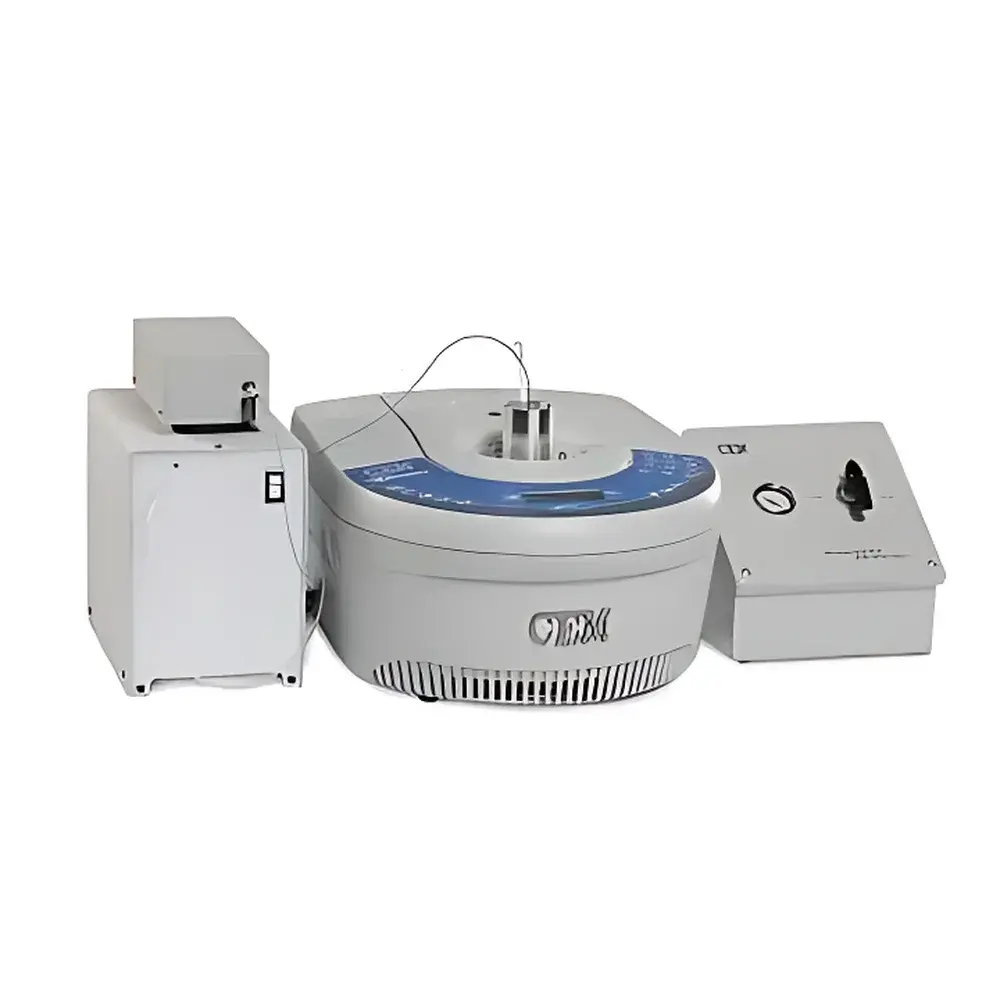
CEM Discover Hydrolysis Single-Mode Microwave Protein Hydrolysis System
| Brand | CEM |
|---|---|
| Origin | USA |
| Manufacturer Status | Authorized Distributor |
| Origin Category | Imported |
| Model | Discover Hydrolysis |
| Quotation | Upon Request |
| Reaction Method | Single-Mode Microwave |
| Reaction Time | 10 minutes |
| Sample Volume per Vial | 300 µL (up to 10 vials) |
| Temperature Control Range | 0–300 °C |
| Hydrolysis Scale | 1 pmol – 1 fmol |
| Vial Format | HPLC-compatible glass autosampler vials (100–300 µL) |
| Temperature Sensor | In-situ fiber-optic probe (RT–300 °C) |
| Vacuum Level | 25 mmHg |
| Stirring Mechanism | Magnetic stirring |
| Atmosphere Control | Alternating vacuum/N₂ purging via integrated valve panel |
Overview
The CEM Discover Hydrolysis Single-Mode Microwave Protein Hydrolysis System is an engineered platform for controlled, reproducible acid hydrolysis of proteins and peptides under inert, oxygen-free conditions. Leveraging focused single-mode microwave energy, the system delivers rapid, uniform thermal activation directly to the reaction medium—enabling precise kinetic control over cleavage of peptide bonds without thermal degradation or oxidative side reactions. Unlike conventional conductive heating methods, which suffer from slow ramp rates and heterogeneous temperature distribution, the Discover Hydrolysis employs a resonant cavity architecture that couples microwave energy efficiently into small-volume sealed vials (100–300 µL), ensuring high reproducibility across replicate samples. The core application is quantitative amino acid analysis (AAA), where complete and unbiased hydrolysis is critical for accurate stoichiometric determination—particularly for challenging analytes such as hydrophobic proteins, membrane-associated peptides, and sequences rich in proline or branched-chain residues.
Key Features
- Single-mode microwave cavity optimized for 10-position parallel processing with independent thermal monitoring per vial via integrated fiber-optic probes
- Inert atmosphere management through automated valve panel: sequential vacuum evacuation (25 mmHg) followed by nitrogen purge to eliminate residual O₂ prior to and during hydrolysis
- Direct in-vial hydrolysis in standard HPLC autosampler vials—eliminating post-hydrolysis transfer, minimizing adsorption loss, contamination risk, and manual handling error
- Temperature-controlled ramp-and-hold profiles (0–300 °C) with real-time feedback, enabling method development for labile residues (e.g., Ser, Thr, Trp) without deamination or racemization
- Compatibility with standard hydrolysis reagents (6 M HCl, phenol additives, thioglycolic acid) and derivatization chemistries used in pre- or post-column AAA workflows
- Magnetic stirring within each sealed vial ensures homogeneous acid contact and prevents localized charring or incomplete solubilization
Sample Compatibility & Compliance
The Discover Hydrolysis accommodates diverse biological matrices including purified recombinant proteins, immunoglobulins, gel-excised bands, and tissue homogenates—provided they are pre-digested or denatured to expose peptide backbone accessibility. Its 1 pmol–1 fmol dynamic range supports both high-abundance biomarkers and low-yield clinical or proteomic isolates. All hardware and operational protocols align with GLP-compliant laboratory practices: audit-trail-capable software logging (time-stamped temperature, pressure, power, and gas cycle events), traceable calibration records for fiber-optic sensors, and documentation-ready validation templates for IQ/OQ/PQ execution. While not FDA-cleared as a diagnostic device, the system meets essential requirements for ISO/IEC 17025-accredited testing laboratories performing amino acid quantification per USP <621>, AOAC 982.30, and ASTM E2677 standards.
Software & Data Management
Operation is managed via CEM’s proprietary Discover Control Suite, a Windows-based interface supporting method creation, real-time monitoring, and export of raw sensor data (CSV/TXT). Each run generates a timestamped log file containing full thermodynamic history—including microwave power modulation, vacuum/N₂ cycle timing, and temperature deviation from setpoint—enabling retrospective root-cause analysis and regulatory submission readiness. Data files comply with 21 CFR Part 11 requirements when deployed on validated networked workstations with electronic signature and role-based access controls. Optional integration with LIMS platforms is supported via OPC UA or custom API endpoints for automated result ingestion into QA/QC dashboards.
Applications
- Routine amino acid composition analysis for biopharmaceutical characterization (e.g., monoclonal antibody batch release)
- Validation of protein sequence integrity following expression, purification, or storage stress studies
- Quantitative assessment of hydrolysis efficiency in method optimization for novel proteases or chemical cleavage agents
- Supporting bottom-up proteomics workflows where complete primary structure coverage requires orthogonal digestion strategies
- Stability-indicating assays for oxidized or deamidated variants in forced degradation studies
FAQ
What types of amino acid residues are most susceptible to degradation during conventional hydrolysis—and how does Discover Hydrolysis mitigate this?
Serine, threonine, tyrosine, and tryptophan are prone to partial destruction under prolonged 110 °C acid reflux. Discover Hydrolysis reduces exposure time to ≤10 min at precisely controlled temperatures (typically 130–160 °C), significantly suppressing deamination and oxidation while maintaining bond cleavage efficiency.
Can the system accommodate custom vial formats beyond standard 300-µL HPLC vials?
Only certified CEM-supplied vials with calibrated microwave coupling properties and pressure-rated septa are supported; third-party vials may compromise safety interlocks or thermal uniformity.
Is nitrogen purity specification required for optimal inerting performance?
Instrument performance is validated using ≥99.998% N₂ (oxygen content <2 ppm); lower-grade gas may introduce measurable oxidative artifacts in cysteine/methionine quantitation.
How is calibration of the fiber-optic temperature sensor verified?
CEM provides NIST-traceable calibration certificates with each probe; field verification against a reference thermocouple in glycerol bath (±0.5 °C at 150 °C) is recommended semiannually.
Does the system support unattended overnight operation?
No—hydrolysis runs are intentionally limited to ≤15 min duration and require operator-initiated start; automatic shutdown occurs after completion to ensure sample integrity and safety compliance.