
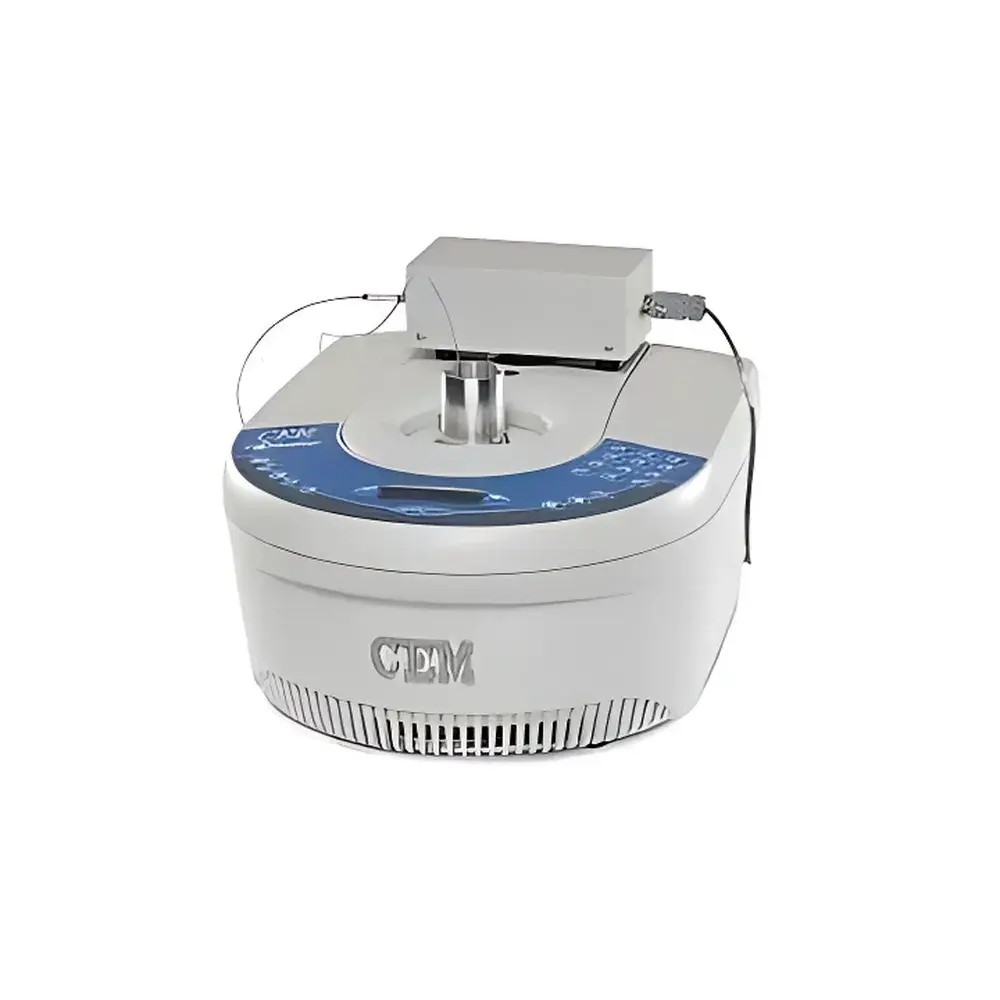
CEM DISCOVER SPS Single-Mode Microwave Protein Hydrolysis System
| Brand | CEM |
|---|---|
| Origin | USA |
| Model | DISCOVER SPS |
| Reaction Mode | Single-Mode Microwave |
| Max. Reaction Volume | 300 mL |
| Sample Throughput | 14 samples per run |
| Temperature Range | 0–300 °C |
| Typical Enzymolysis Temperature | 55 °C |
| Temperature Accuracy | ±1 °C |
| Temperature Sensing | In-situ Fiber-Optic Probe |
| Mixing | Magnetic Stirring |
| Cooling | 5 PSI Forced Air |
| Sample Vial Format | 1.5 mL Microcentrifuge Tubes |
| Minimum Sample Volume | 30 µL |
| Hydrolysis Time (Typical) | 10–15 min |
| Enzyme-to-Protein Ratio Range | 1:100 to 1:10 |
Overview
The CEM DISCOVER SPS Single-Mode Microwave Protein Hydrolysis System is an engineered platform designed for rapid, reproducible, and controlled enzymatic digestion of proteins under precisely regulated microwave irradiation. Unlike conventional multimode microwave reactors, the DISCOVER SPS employs a focused single-mode cavity that delivers uniform, high-field-strength microwave energy directly to the sample—enabling precise thermal and non-thermal activation of proteolytic enzymes such as trypsin. This system leverages microwave-induced conformational destabilization of protein secondary structure (particularly α-helices), while preserving disulfide bond integrity, thereby enhancing enzyme accessibility to cleavage sites without denaturation-induced aggregation. The result is accelerated hydrolysis kinetics: gel-based or solution-phase digestions are completed in ≤15 minutes—reducing typical overnight protocols (16+ hours) by >98%—while maintaining peptide sequence fidelity required for downstream LC-MS/MS, amino acid analysis, and quantitative proteomics.
Key Features
- Single-mode microwave architecture ensures spatially homogeneous energy distribution and deterministic power coupling—critical for inter-run reproducibility in enzymatic workflows.
- Real-time, in-situ fiber-optic temperature monitoring with ±1 °C accuracy eliminates thermal lag and enables closed-loop control at biologically relevant setpoints (e.g., 55 °C for optimal trypsin activity).
- Parallel processing of up to 14 samples in standard 1.5 mL microcentrifuge tubes—no transfer steps, no cross-contamination, and full compatibility with common labware.
- Integrated magnetic stirring ensures homogeneous mixing during digestion, mitigating concentration gradients and improving enzyme–substrate collision frequency.
- Forced-air cooling (5 PSI) enables rapid post-digestion quenching and supports temperature ramping protocols with sub-minute thermal transitions.
- SPS (Smart Programming System) control mode allows user-defined time–temperature–power profiles optimized for diverse enzyme classes (e.g., Lys-C, Glu-C, Asp-N) and challenging substrates including membrane-associated or hydrophobic proteins.
Sample Compatibility & Compliance
The DISCOVER SPS accommodates both solution-phase and SDS-PAGE gel slice digestion protocols, supporting input volumes from 30 µL to 300 mL depending on configuration. It accepts native, reduced, and alkylated protein samples—including those with high lipid content or low solubility—without requiring organic solvent pre-treatment. The system complies with laboratory quality frameworks: temperature logs and method parameters are timestamped and exportable for GLP/GMP documentation; audit trails meet FDA 21 CFR Part 11 requirements when used with validated software interfaces. All hardware components adhere to IEC 61000-6-3 (EMC) and UL 61010-1 safety standards.
Software & Data Management
Operation is managed via the Discover touchscreen control panel or optionally through CEM’s PC-based software suite, which supports method library creation, parameter locking, electronic signature capture, and CSV/TXT data export. Each run generates a complete metadata record—including power profile, temperature history, stir speed, and cooling event timestamps—structured for integration into LIMS environments. Software validation packages (IQ/OQ/PQ) are available for regulated laboratories performing clinical proteomics or biotherapeutic characterization.
Applications
- Routine bottom-up proteomics sample preparation for LC-MS/MS identification and label-free/SILAC quantitation.
- Amino acid composition analysis requiring complete hydrolysis prior to ion-exchange or HPLC detection.
- High-throughput biomarker discovery workflows where digestion consistency directly impacts statistical power.
- Structural biology support: rapid generation of overlapping peptides for epitope mapping or hydrogen-deuterium exchange (HDX) follow-up.
- QC testing of recombinant proteins, including verification of cleavage site fidelity and detection of incomplete digestion artifacts.
FAQ
What distinguishes single-mode microwave digestion from conventional heating or multimode microwave systems?
Single-mode cavities deliver coherent, standing-wave microwave fields with defined electric field vectors—enabling predictable energy deposition at the molecular level. This contrasts with multimode systems, where field heterogeneity causes hot/cold spots and poor inter-batch repeatability.
Can the DISCOVER SPS be used for non-enzymatic acid hydrolysis?
Yes—though optimized for enzymatic digestion, the system supports sealed-vessel acid hydrolysis (e.g., 6 M HCl at 110 °C) when configured with appropriate corrosion-resistant vessels and pressure-rated caps.
Is method transfer from literature-based overnight protocols straightforward?
Method translation is supported by CEM’s application database, which includes validated time–temperature equivalents for >20 proteases across matrix types (cell lysates, plasma, FFPE tissue). Empirical optimization typically requires ≤3 runs.
How is carryover prevented between runs?
The system uses disposable polypropylene vials and a dedicated cleaning cycle with ethanol vapor purge; no internal wetted surfaces contact samples.
Does the instrument support remote monitoring or integration with automated liquid handlers?
Yes—RS-232 and Ethernet interfaces enable bidirectional communication with third-party automation platforms (e.g., Hamilton STAR, Tecan Freedom EVO) via Modbus TCP or ASCII command sets.




