
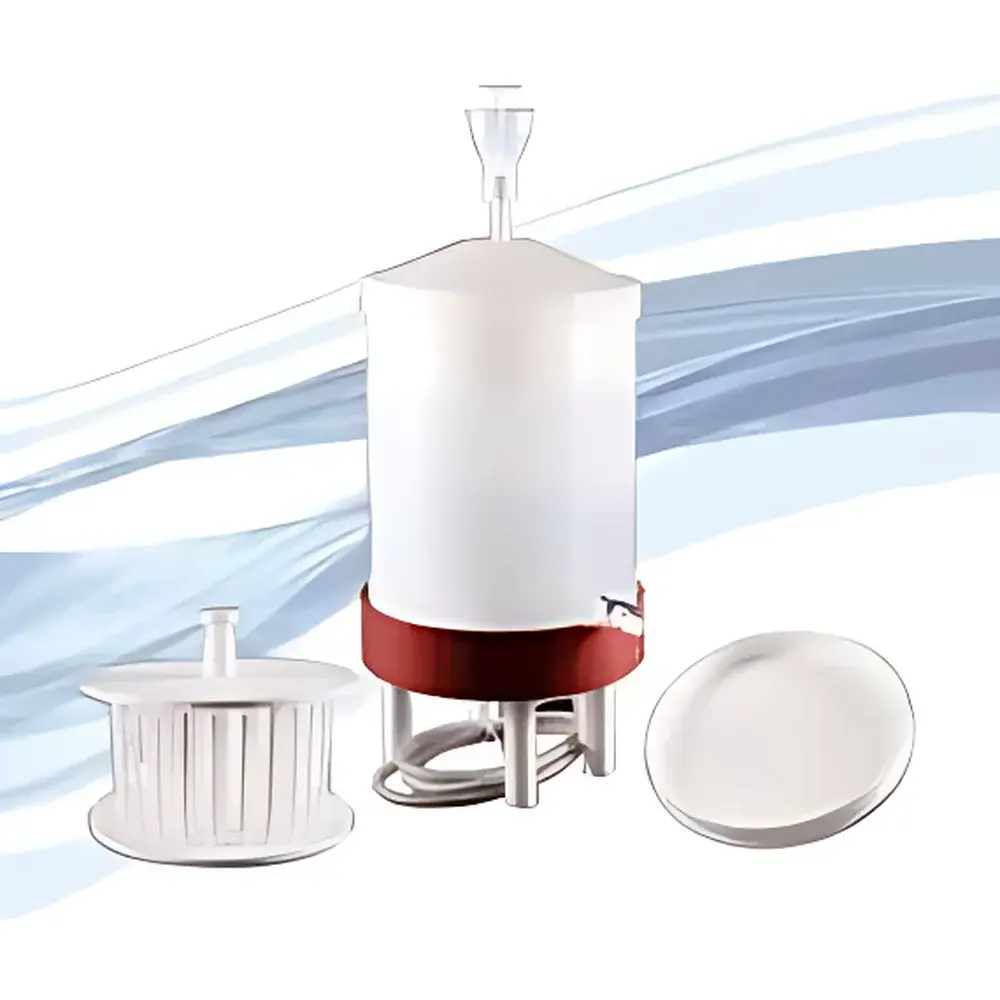
CEM ETC EasyTraceCleaner Acid Vapor Ultra-Clean System for Laboratory Vessels
| Brand | CEM |
|---|---|
| Origin | USA |
| Model | ETC |
| Cleaning Agents | HNO₃, HCl, HF, H₂SO₄ |
| External Dimensions | Ø330 mm × 400 mm (H) |
Overview
The CEM ETC EasyTraceCleaner System is an engineered acid vapor ultra-cleaning platform designed specifically for trace- and ultratrace-level analytical laboratories. It operates on the principle of controlled, low-pressure acid vapor distillation within a fully sealed, inert PFA-lined chamber—eliminating liquid-phase immersion and minimizing both reagent consumption and operator exposure. Unlike conventional acid soak or reflux methods, the ETC system delivers purified, condensate-free acid vapors (e.g., HNO₃, HCl, HF, H₂SO₄) directly onto the inner and outer surfaces of labware, achieving molecular-level removal of metal contaminants—including Al, Cr, Cu, Fe, Pb, and rare earth elements—without leaching or surface etching. The system is purpose-built for post-digestion cleaning of high-purity vessels used in ICP-MS, ICP-OES, and HR-ICP-MS workflows, where background contamination at sub-ppt levels can compromise method detection limits and data integrity.
Key Features
- Sealed, inert vapor-phase cleaning chamber constructed entirely from high-purity PFA and Teflon® components—no metallic or glass contact surfaces to introduce contamination.
- Integrated, PID-controlled heating module ensuring uniform temperature distribution (±0.5 °C) across the chamber; remote digital temperature setpoint and real-time monitoring via front-panel interface.
- Low-acid-consumption operation: typical cycle uses ≤15 mL concentrated acid per batch; spent acid condensate is collected separately and can be reused for up to 5–8 cycles without performance degradation.
- No external cooling water required—natural convective air cooling post-cycle prevents cross-contamination from tap water or chiller systems.
- High-throughput capacity: accommodates up to 48 CEM MARS Xpress digestion vessels (or equivalent TFM/PFA vials, quartz crucibles, borosilicate tubes) in a single run.
- Automated cycle sequencing with programmable hold times, vapor generation ramp rates, and cooldown phases—fully repeatable and auditable.
Sample Compatibility & Compliance
The ETC system is validated for cleaning vessels fabricated from fluoropolymer materials (TFM, PFA), fused quartz, high-borosilicate glass, and selected quartz-fiber composites. It supports all standard CEM digestion vessel formats—including EasyPrep, MARS Xpress, and Discover SP—without dimensional modification. All wetted parts comply with ASTM D4382 (specifications for high-purity fluoropolymers) and meet USP Class VI biocompatibility requirements. The system’s closed-loop operation satisfies GLP and ISO/IEC 17025 laboratory quality management criteria for contamination control; acid vapor exposure protocols align with EPA Method 6020B and ISO 17294-2 recommendations for trace metal analysis sample preparation equipment qualification.
Software & Data Management
The ETC operates via embedded firmware with non-volatile cycle logging: each run records timestamp, set temperature, acid type, duration, and chamber pressure profile. Data export is supported via USB port in CSV format for integration into LIMS or ELN platforms. While no cloud connectivity or proprietary software suite is included, the system’s event log meets FDA 21 CFR Part 11 requirements for electronic records when paired with institutional audit-trail policies (user ID tagging, password-protected access, and immutable log archiving). Cycle validation reports can be generated manually using exported logs and verified against internal SOPs for cleaning efficacy (e.g., blank rinse analysis by ICP-MS).
Applications
- Routine decontamination of microwave digestion vessels prior to ultratrace metal analysis (e.g., NIST SRM 1575a, BCR-723, or geological reference materials).
- Restoration of PFA vials and quartz boats used in cleanroom semiconductor metrology or nuclear forensics sample handling.
- Preparation of high-sensitivity calibration standards where acid blanks must remain below 0.5 ppt for As, Cd, Pb, and U isotopes.
- Reconditioning of used reaction vessels following high-salt or organic-rich digestions that leave persistent carbonaceous residues undetectable by visual inspection.
- Supporting ISO 14001 environmental labs requiring documented reduction of hazardous acid waste volume and disposal frequency.
FAQ
Can the ETC system safely handle hydrofluoric acid (HF)?
Yes—the entire vapor path, including heater block gasketing, condenser liner, and collection tray, is fabricated from HF-resistant PFA. Standard operating procedures include dedicated HF-only cycles and mandatory post-HF neutralization rinses with dilute ammonium hydroxide vapor.
What is the typical blank level achieved after ETC cleaning?
When processing MARS Xpress vessels with 4-hour HNO₃/HF vapor cycles, typical ICP-MS blanks show ≤3 ppt Al, ≤0.8 ppt Pb, and ≤0.5 ppt Cr—representing a 100–1000× improvement over hotplate reflux cleaning.
Is third-party validation data available for regulatory submissions?
CEM provides application notes compliant with ISO/IEC 17025 Annex A.2, including interlaboratory recovery studies (n=6 labs) and long-term stability testing of cleaned vessel batches over 12 months.
Does the system require exhaust ducting or fume hood installation?
Yes—a dedicated acid-rated exhaust line (minimum 100 cfm flow) connected to a corrosion-resistant scrubber is mandatory per OSHA 1910.1200 and local chemical hygiene plans.
How often must the PFA chamber liner be replaced?
Under normal use (≤5 cycles/week), the liner maintains structural integrity and purity performance for ≥24 months; replacement is indicated only upon visible microcracking or measurable increase in procedural blanks (>10% RSD across three consecutive runs).



