
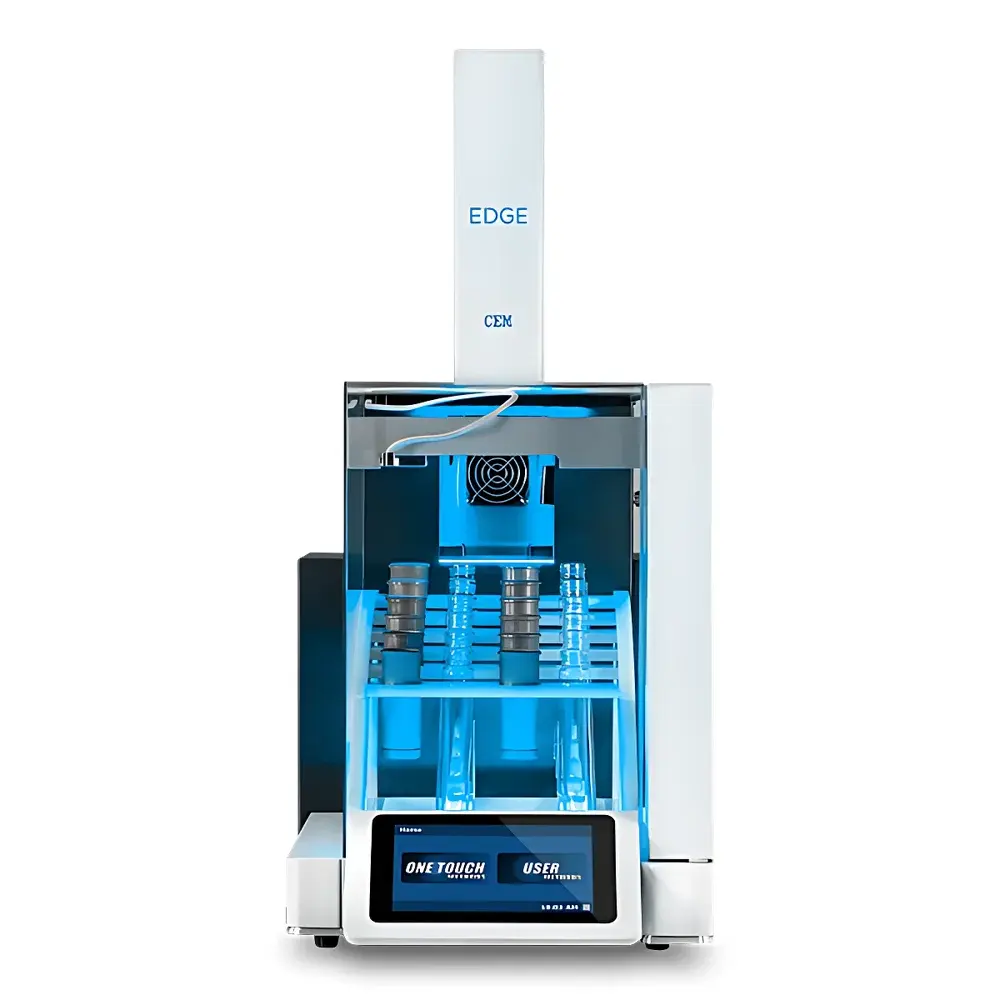
CEM EDGE Automated Accelerated Solvent Extractor
| Brand | CEM |
|---|---|
| Origin | USA |
| Manufacturer Type | Authorized Distributor |
| Origin Category | Imported |
| Model | EDGE |
| Instrument Type | Liquid–Solid Extraction |
| Temperature Range | 100–200 °C |
| Pressure Range | 13.8 MPa |
| Extraction Cell Volumes | 11 / 22 / 34 / 66 mL |
| Extraction Time | 5 min per sample |
| Instrument Dimensions | 360 mm (W) |
| Sample Capacity | 24 positions (dual rack, 12 per run) |
Overview
The CEM EDGE Automated Accelerated Solvent Extractor is an engineered solution for high-throughput, thermally and pressure-assisted liquid–solid extraction. It operates on the principle of Pressurized Fluid Extraction (PFE), enhanced by CEM’s proprietary Q-Cup technology—a dual-mechanism approach integrating dynamic pressure oscillation with discrete solid-phase dispersion. Unlike conventional static PFE or Soxhlet-based methods, the EDGE system subjects samples to controlled, bidirectional solvent flow under elevated temperature and pressure (up to 13.8 MPa and 200 °C), inducing rapid matrix disruption and analyte desorption. This physical–mechanical synergy enables complete recovery of thermolabile and polar compounds—including PAHs, PCBs, pesticides, pharmaceutical residues, and polymer additives—while preserving molecular integrity. Designed for regulatory compliance and laboratory efficiency, the EDGE delivers full automation from solvent delivery and cell pressurization to inline filtration, rapid cooling, and residue wash—all within a single 5-minute cycle per sample.
Key Features
- Q-Cup extraction cells constructed from corrosion-resistant, high-thermal-conductivity aluminum alloy—enabling rapid heating (≤2 min to 180 °C) and uniform thermal distribution across the sample bed.
- Dual-directional solvent introduction: simultaneous top and bottom solvent infusion ensures complete sample wetting and eliminates channeling effects common in column-based PFE systems.
- Dynamic pressure oscillation (0–2000 psi): cyclic pressure modulation forces solvent penetration into micro-pores and interstitial spaces, significantly enhancing mass transfer kinetics without mechanical agitation.
- Integrated 3-meter stainless steel condenser coil: achieves immediate post-extraction cooling of extract streams to ambient temperature, minimizing thermal degradation and volatility losses.
- Modular Q-Disc™ filter discs: disposable polypropylene or PTFE membranes (0.45 µm standard) installed at the base of each Q-Cup ensure inline particulate removal prior to collection—eliminating off-line centrifugation or syringe filtration.
- Automated dual-rack carousel: accommodates 24 samples (12 per batch); programmable method sequencing supports up to six independent solvents for multi-analyte workflows.
Sample Compatibility & Compliance
The EDGE system is validated for heterogeneous matrices including soil, sediment, sludge, food composites, biological tissues, pharmaceutical tablets, and polymer pellets—regardless of moisture content (up to 30% w/w). Its open-cell architecture and pressure-driven dispersion mitigate matrix interference, enabling robust recovery from high-fat, high-clay, or fibrous samples without pre-drying or extensive cleanup. Methodologically, the instrument conforms to US EPA Methods 3545 and 3545A (PFE for organic contaminants), as well as Chinese environmental standards HJ 782–2016 and HJ 783–2016 for pesticide and PAH analysis in soil and sediment. All extraction protocols support GLP-compliant documentation when paired with audit-trail-enabled software; system operation meets requirements for traceability under FDA 21 CFR Part 11 when configured with electronic signatures and secure user access controls.
Software & Data Management
The EDGE is operated via CEM’s intuitive touchscreen interface with embedded method library management. Each extraction sequence logs timestamped parameters—including actual temperature/pressure profiles, solvent volume dispensed, oscillation frequency, and cooling curve data—for full process traceability. Raw logs are exportable in CSV format for integration into LIMS or ELN platforms. Optional PC-based software provides advanced scheduling, remote monitoring, and automated report generation compliant with ISO/IEC 17025 documentation standards. All user actions—including method edits, calibration entries, and maintenance logs—are recorded with operator ID and timestamp, satisfying audit requirements for regulated laboratories conducting environmental, food safety, or pharmaceutical QC testing.
Applications
- Environmental analysis: rapid extraction of semivolatile organics (SVOCs), organochlorine pesticides, dioxins/furans, and petroleum hydrocarbons from contaminated soils and dredged sediments.
- Food safety: determination of mycotoxins, veterinary drug residues, and plasticizer migration (e.g., phthalates, bisphenols) in meat, dairy, grains, and packaging materials.
- Pharmaceutical R&D: isolation of active pharmaceutical ingredients (APIs) and degradation products from solid dosage forms and excipient blends.
- Materials science: leaching studies of flame retardants (e.g., PBDEs, HBCDD) and stabilizers from polymers, textiles, and electronic components.
- Forensic toxicology: efficient recovery of synthetic cannabinoids, opioids, and stimulants from biological matrices prior to LC–MS/MS quantification.
FAQ
What extraction mechanisms does the EDGE employ beyond standard PFE?
It combines pressurized fluid extraction with dynamic solid-phase dispersion via bidirectional solvent flow and cyclic pressure oscillation—enhancing analyte release from complex matrices without grinding or derivatization.
Can the EDGE handle moist or high-water-content samples?
Yes—its open-cell design and pressure-driven dispersion accommodate samples with up to 30% moisture; optional Na₂SO₄ drying discs can be integrated directly into the Q-Cup assembly.
Is method validation support available for regulatory submissions?
CEM provides application notes aligned with US EPA 3545A and HJ 782/783, including spike-recovery data, LOD/LOQ assessments, and inter-laboratory reproducibility reports upon request.
How is carryover prevented between runs?
Each Q-Cup is single-use or rigorously cleaned in situ; the system performs a full solvent flush of all fluidic pathways—including the cooling coil and collection line—after every extraction cycle.
What maintenance is required for long-term operational stability?
Routine tasks include quarterly verification of pressure transducer calibration, annual replacement of O-rings and Q-Disc filters, and biannual inspection of the heating block thermal uniformity per ASTM E2550 guidelines.



