
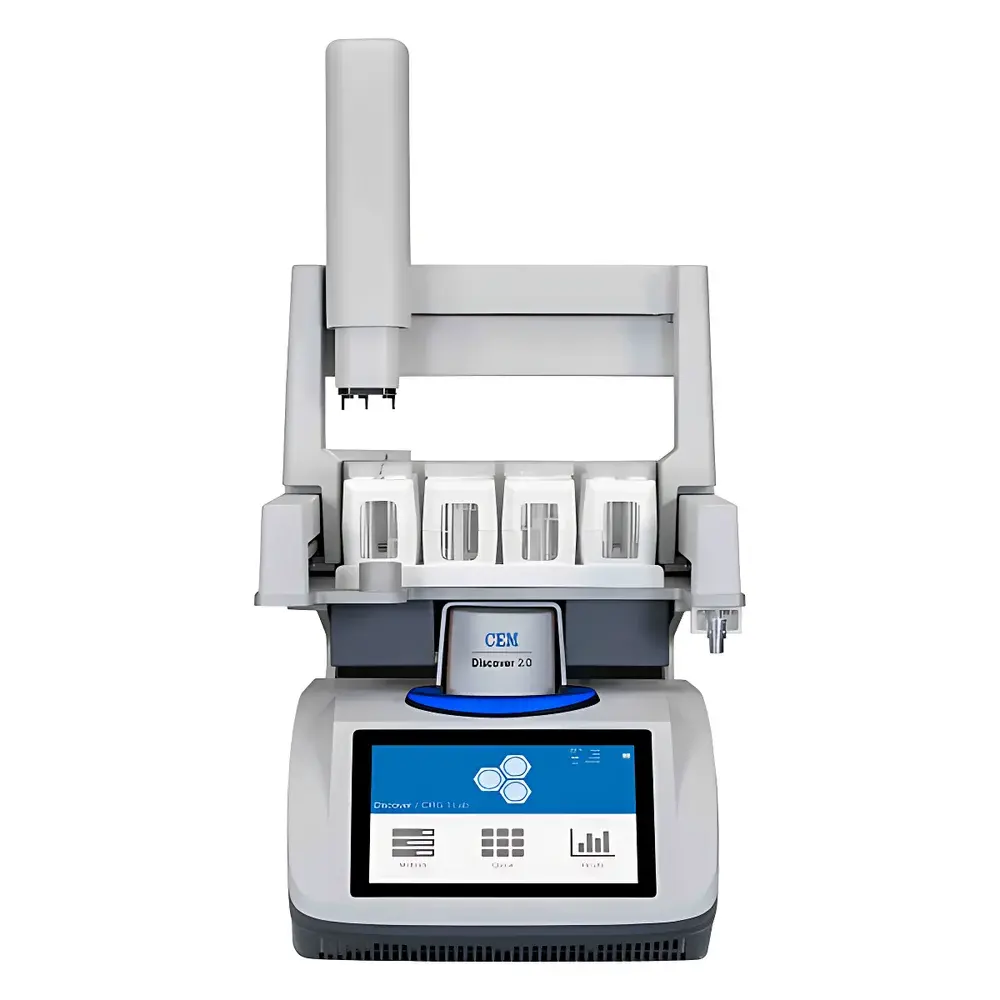
CEM Explorer Automated Sample-Loading Single-Mode Microwave Synthesizer
| Brand | CEM |
|---|---|
| Origin | USA |
| Model | Explorer (Single-Mode) |
| Temperature Range | 0–350 °C |
| Pressure Range | 0–500 psi |
| Microwave Power | 900 W |
| Magnetron Frequency | 2450 MHz |
| Stirring Method | Electromagnetic |
| Reaction Vessel Volume | 300 mL |
| Cavity Type | Circular Single-Mode |
| Real-Time Pressure Monitoring | 0–35 bar |
| Low-Temperature Capability | Down to –80 °C |
| Automation | XYZ Robotic Arm with 12/24/48-Position Auto-Sampler |
Overview
The CEM Explorer Automated Sample-Loading Single-Mode Microwave Synthesizer is an engineered platform for high-precision, reproducible microwave-assisted organic synthesis, built upon the proven architecture of the CEM Discover 2.0 system. Unlike multimode cavity instruments, the Explorer employs a circular single-mode resonant cavity that delivers focused, homogeneous microwave energy directly into the reaction vessel—enabling rapid, uniform heating with exceptional control over thermal and pressure profiles. This design supports kinetic acceleration of reactions while maintaining molecular integrity, particularly for thermally sensitive or heterogeneous systems. The instrument operates across a validated temperature range of –80 °C to 350 °C and pressure range of 0–500 psi (0–35 bar), accommodating cryogenic protocols, high-boiling solvents, and sealed-vessel high-pressure transformations. Its fully automated sample handling—driven by a programmable XYZ robotic arm—allows unattended execution of multi-step synthetic sequences, method screening, and parameter optimization in compliance with GLP and GMP-aligned laboratory workflows.
Key Features
- Single-mode microwave cavity with field-stabilized 2450 MHz magnetron delivering 900 W continuous power output for precise energy coupling and minimal thermal lag
- Integrated ActiVent active pressure management system: real-time pressure sensing with automatic venting above user-defined thresholds, backed by redundant mechanical and electronic safety interlocks
- Electromagnetic in-situ stirring ensuring homogeneous mixing without shaft seals or moving parts inside the cavity—critical for viscous, precipitating, or gas-evolving reactions
- Modular auto-sampling configurations supporting 12-, 24-, or 48-position reaction racks; compatible with standard CEM Xpress™ and MARS™ vials (up to 300 mL volume)
- Compact footprint requiring only a single fume hood slot, minimizing lab space utilization without compromising thermal isolation or EMI shielding
- Remote operation via Ethernet or Wi-Fi: full instrument control, live parameter streaming, and audit-trail-enabled session logging from any networked workstation
Sample Compatibility & Compliance
The Explorer accommodates a broad spectrum of reaction formats—including open-vessel reflux, sealed-vessel high-pressure synthesis, and low-temperature microwave activation—using chemically resistant borosilicate glass, quartz, or reinforced PEEK vessels. It supports solvent systems ranging from polar protic (e.g., water, alcohols) to low-dielectric media (e.g., toluene, hexanes) through adaptive power modulation. All pressure and temperature sensors are NIST-traceable and calibrated per ISO/IEC 17025 requirements. The system complies with IEC 61000-6-3 (EMC), UL 61010-1 (electrical safety), and meets essential requirements of the EU Machinery Directive 2006/42/EC. Data integrity features—including electronic signatures, time-stamped audit trails, and immutable method storage—support adherence to FDA 21 CFR Part 11 and EU Annex 11 for regulated environments.
Software & Data Management
ChemDriver software serves as the unified interface for method development, automation scripting, and data capture. It includes four purpose-built wizards: (1) Method Conversion Wizard—guides translation of conventional heating protocols into microwave equivalents using empirical dielectric loss and thermal inertia models; (2) Optimization Wizard—implements sequential or statistical experimental designs (e.g., DoE) for systematic variation of temperature, pressure, hold time, and power ramping; (3) Batch Processing Wizard—orchestrates parallel execution of heterogeneous reaction sets with independent parameter sets per position; and (4) Reporting Wizard—generates PDF or CSV outputs compliant with internal SOPs or external regulatory submissions. All raw sensor data (T, P, power, stir rate) are timestamped at 100 ms intervals and stored in encrypted SQLite databases with SHA-256 hash verification.
Applications
The Explorer is routinely deployed in medicinal chemistry for rapid SAR library synthesis, in materials science for controlled nanoparticle nucleation (e.g., metal oxides, MOFs), and in process R&D for scalable route scouting under non-isothermal conditions. Typical use cases include Suzuki-Miyaura couplings at 95% yield in <10 min, esterifications under Dean-Stark conditions with real-time water removal monitoring, and solid-phase peptide couplings with minimized racemization. Its low-temperature capability enables photochemical co-activation (e.g., Ru(bpy)₃²⁺-mediated C–H functionalization at –40 °C), while high-pressure operation supports hydrothermal carbonization and supercritical fluid-mediated catalysis.
FAQ
What distinguishes single-mode from multimode microwave synthesis?
Single-mode cavities deliver spatially coherent, standing-wave fields with precisely defined electric field maxima—ideal for consistent, scalable reaction outcomes. Multimode systems rely on mode stirring and exhibit inherent hot/cold spot variability, limiting reproducibility across vessel positions.
Can the Explorer be integrated into existing LIMS or ELN platforms?
Yes—via RESTful API and OPC UA protocol support, enabling bidirectional data exchange with major laboratory informatics systems including LabWare LIMS, Benchling ELN, and Dotmatics.
Is calibration documentation provided for audit readiness?
Each unit ships with a Certificate of Conformance, factory calibration reports (temperature, pressure, power), and a traceability matrix linking all sensors to NIST standards—fully aligned with ISO/IEC 17025 internal audit requirements.
How does ActiVent differ from passive pressure release mechanisms?
ActiVent is an active, closed-loop system that continuously measures cavity pressure and initiates controlled venting *before* mechanical failure thresholds are approached—unlike spring-loaded burst disks or manual relief valves, which respond only after overpressure occurs.
What maintenance intervals are recommended for long-term reliability?
CEM recommends quarterly verification of magnetron output power, biannual recalibration of RTD and piezoresistive transducers, and annual inspection of waveguide integrity and robotic arm positional accuracy—all documented in the included Preventive Maintenance Logbook.



