
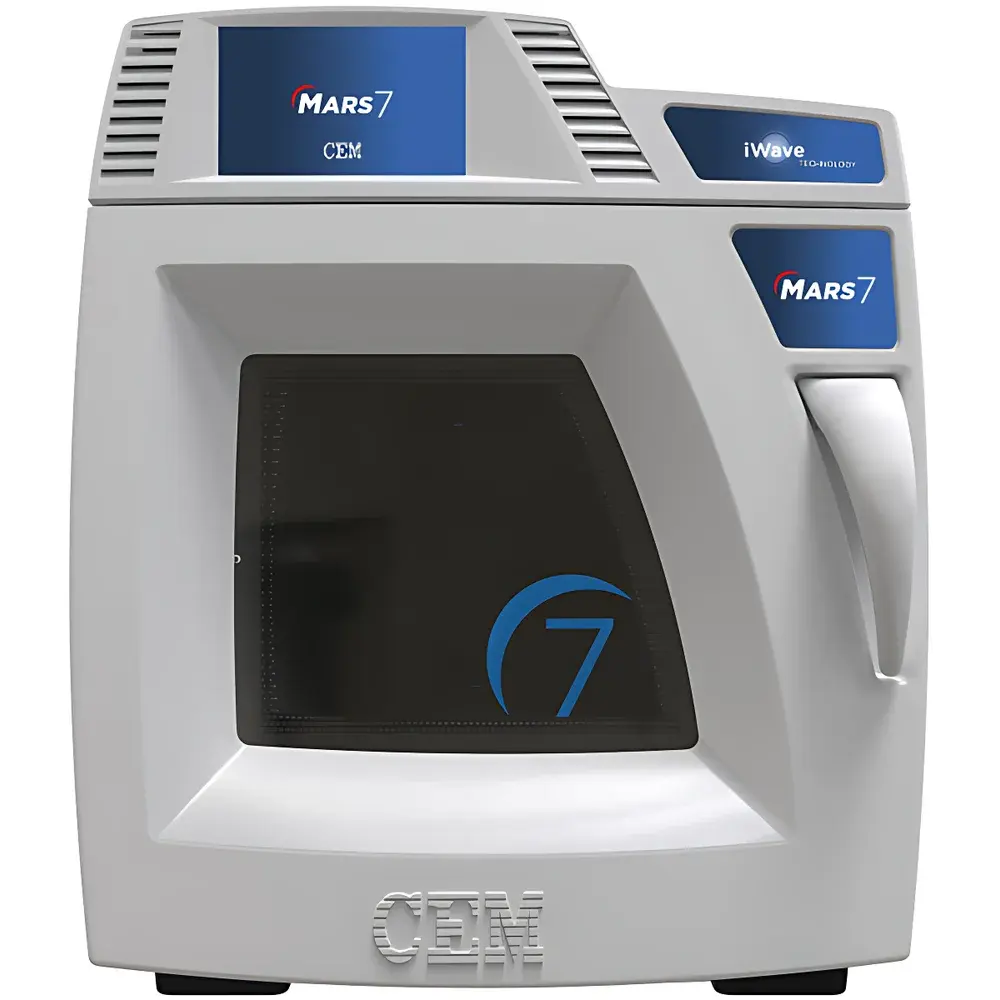
CEM MARS 7 Flash Microwave Digestion System
| Brand | CEM |
|---|---|
| Origin | USA |
| Model | MARS 7 |
| Chamber Class | Industrial-Grade |
| Batch Capacity | 40 samples |
| Microwave Source | Dual Magnetron |
| Max Temperature | 350 °C |
| Temp Measurement Accuracy | ±0.1 °C |
| Temp Control Stability | ±0.1 °C |
| Temp Uniformity | ±0.1 °C |
| Max Pressure | 3000 psi |
Overview
The CEM MARS 7 Flash Microwave Digestion System represents the culmination of over five decades of microwave chemistry innovation—originating with CEM’s foundational work in 1971, which established the scientific and procedural framework for modern closed-vessel microwave-assisted sample digestion. Engineered for precision, safety, and high-throughput elemental analysis preparation, the MARS 7 operates on a validated microwave energy delivery architecture compliant with U.S. EPA Methods 3015A, 3051A, 3052, and 3546—methods whose development and regulatory adoption were directly enabled by CEM instrumentation between 1978 and 2008. Its core functionality centers on controlled, rapid thermal decomposition of complex matrices—including geological samples (rocks, soils), biological tissues (plants, food), pharmaceuticals, polymers, and metallurgical specimens—under precisely regulated temperature and pressure conditions. Unlike conventional open-vessel or multi-step hotplate digestion, the MARS 7 employs a fully integrated, sealed-vessel approach that minimizes analyte loss, prevents contamination, and ensures stoichiometric acid-sample interaction. It serves as a critical front-end platform for ICP-OES, ICP-MS, and AAS workflows, delivering reproducible, low-blank digests compatible with GLP/GMP-compliant laboratories.
Key Features
- Flash Digestion Technology: Enables complete sample processing—from weighing and acid addition to digestion, dilution, and direct instrumental analysis—without intermediate transfer or cleaning steps.
- LET (Light Emission Thermometry) Wireless Full-Vessel Temperature Monitoring: Patented non-contact optical temperature sensing measures real-time sample temperature inside each vessel using emitted thermal radiation—eliminating fiber-optic probes and infrared calibration drift.
- ReactiGuard Wireless Pressure Monitoring: High-frequency resonant sensor array detects dynamic pressure changes across all vessels simultaneously; triggers automatic microwave cutoff upon reaching user-defined pressure thresholds (0–200 bar).
- PowerMAX Dynamic Energy Matching: Proprietary dual-magnetron control algorithm continuously adjusts microwave output to match instantaneous reaction kinetics—enabling deeper decomposition at lower nominal temperatures and reducing total cycle time by up to 70%.
- Auto-Recognition & Auto-Method Selection: Integrated RFID and spatial mapping identify vessel type, count, and position; cross-references sample class and mass against an embedded method library (EPA, AOAC, ASTM, ISO) to auto-select optimal acid composition, volume, ramp profile, and hold parameters.
- Flash Dual-Layer Vessel Design: Combines ultra-pure fused quartz inner liner with disposable PTFE thin-layer insert—meets EPA 3051A/3015A requirements, eliminates carryover, and supports batch-to-batch traceability without manual cleaning.
Sample Compatibility & Compliance
The MARS 7 is validated for digestion of heterogeneous solid and liquid matrices per U.S. EPA SW-846 Methods 3015A (microwave-assisted acid digestion for metals), 3051A (total recoverable elements), 3052 (siliceous and organically bound matrices), and 3546 (microwave extraction). It also aligns with AOAC Official Methods of Analysis (e.g., 999.10, 2007.01), ASTM D5511/D5512 (waste characterization), and ISO 11466 (soil heavy metal extraction). The system supports full audit trails required under FDA 21 CFR Part 11 and EU Annex 11 for electronic records and signatures, including timestamped method execution logs, parameter change history, and wireless sensor validation reports. All vessel materials comply with USP for extractables and leachables, ensuring compatibility with trace-level elemental quantification.
Software & Data Management
The MARS 7 runs on CEM’s iWave™ operating system—a Windows-based platform supporting role-based access control, electronic signature workflows, and automated report generation (PDF/CSV). Method libraries are pre-loaded with >200 EPA-, AOAC-, and ISO-validated protocols and support custom method creation with multi-stage ramp/hold profiles, power modulation curves, and conditional logic (e.g., “if pressure > 180 bar, reduce power by 20%”). All sensor data—including real-time LET temperature, ReactiGuard pressure, and PowerMAX power absorption—is logged at 100 ms intervals and stored with SHA-256 hash integrity verification. Data export complies with LIMS integration standards (ASTM E1482, HL7) and supports direct import into instrument control software for ICP-MS and AA platforms.
Applications
- Environmental testing labs performing PM2.5 filter digestion per EPA Method IO-4.5 and soil/sediment metal profiling per Method 3050B.
- Pharmaceutical QA/QC departments conducting residual catalyst screening (Pd, Pt, Rh) in APIs per ICH Q2(R2) guidelines.
- Food safety laboratories analyzing heavy metals (As, Cd, Pb, Hg) in infant formula and dietary supplements per FDA Elemental Impurities Guidance.
- Geochemical research facilities digesting silicate-rich rock powders and ore concentrates for REE and transition metal quantification.
- Materials science labs preparing polymer composites and battery cathode materials (NMC, LFP) for Li, Co, Ni, Mn speciation studies.
FAQ
What regulatory standards does the MARS 7 support for method validation?
The system meets U.S. EPA SW-846, AOAC 2020.01, ASTM D3682, and ISO 17294-2 requirements for method validation, including linearity, LOD/LOQ, recovery (85–115%), and within-lab reproducibility (RSD ≤5%).
Is the MARS 7 compatible with existing laboratory information management systems (LIMS)?
Yes—it supports ASTM E1482-compliant data exchange via ODBC and HL7 interfaces, enabling seamless integration with major LIMS platforms including LabWare, Thermo Fisher SampleManager, and Agilent OpenLab.
How does the Flash vessel design ensure compliance with EPA 3051A?
The disposable PTFE thin-layer insert maintains consistent acid-to-sample ratio and prevents wall adsorption effects, while the quartz liner ensures inertness and thermal stability—both critical for achieving the 90–110% spike recovery and ≤3% RSD mandated by EPA 3051A.
Can the MARS 7 be operated in unattended mode for overnight digestion runs?
Yes—its hardware-level safety interlocks (pressure rupture discs, redundant thermal fuses, cavity door microswitches) and software-controlled cooldown protocols enable secure unattended operation, fully auditable per GLP Annex 15 requirements.
Does the system provide documentation for 21 CFR Part 11 compliance?
Yes—the iWave™ software includes electronic signature modules, audit trail logging with immutable timestamps, and configurable user permission tiers—all validated and documented in the system’s IQ/OQ/PQ package.
Related Products



