
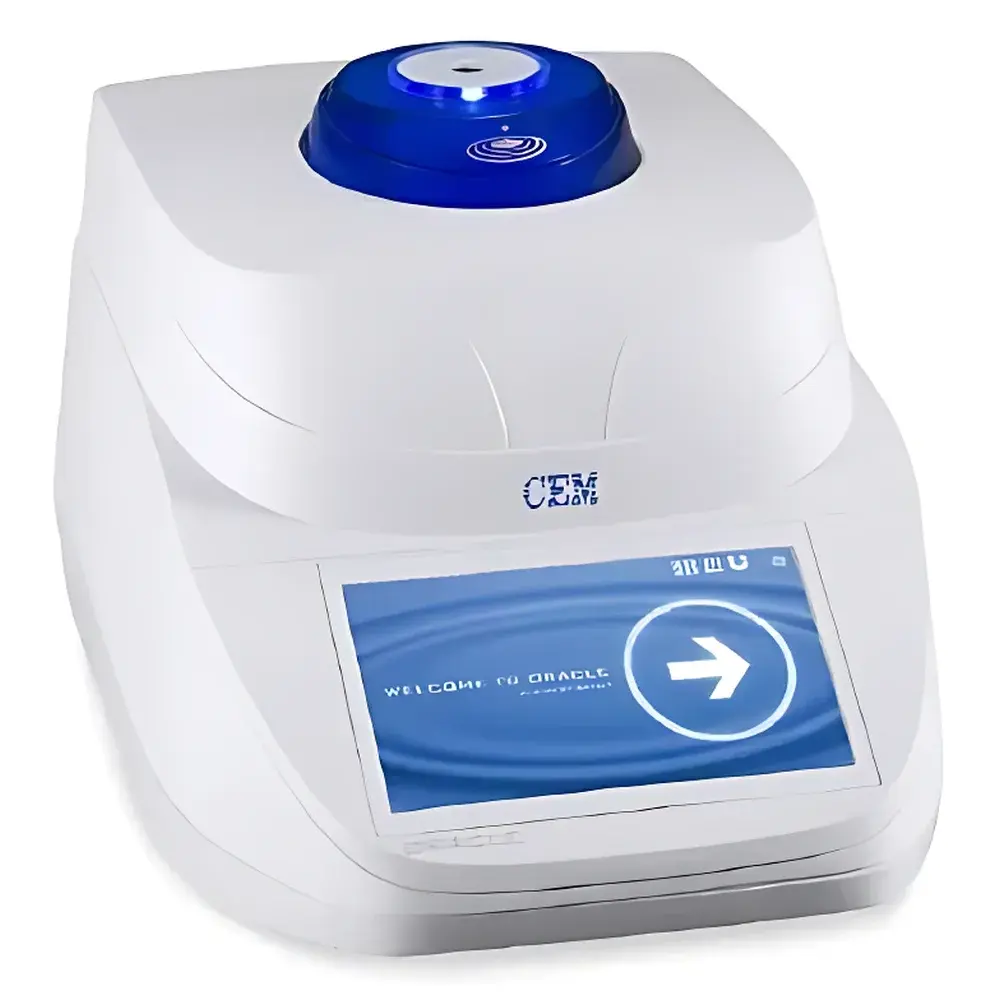
CEM ORACLE Universal Rapid Fat Analyzer
| Brand | CEM |
|---|---|
| Origin | USA |
| Manufacturer Type | Authorized Distributor |
| Origin Category | Imported |
| Model | ORACLE |
| Quotation | Upon Request |
| Extraction Chamber Volume | 10 mL |
| Receiving Bottle Volume | 110 mL |
| Temperature Range | Ambient |
| Temperature Control Accuracy | ±1°C |
| Number of Channels | 1 |
Overview
The CEM ORACLE Universal Rapid Fat Analyzer is an advanced benchtop instrument engineered for direct, non-destructive quantification of total fat content in food and agricultural samples using proprietary Intrinsic Fat Measurement (IFM™) technology. Unlike conventional methods—such as Soxhlet extraction, acid hydrolysis, or near-infrared (NIR) spectroscopy—the ORACLE exploits the unique nuclear magnetic resonance (NMR) signature of hydrogen nuclei bound exclusively to fatty acid chains. This selective detection eliminates interference from water, protein, carbohydrate, and other non-lipid protons, enabling true fat-specific signal isolation without chemical solvents, calibration curves, or sample homogenization. The system operates at ambient temperature with no cryogens or high-field magnets, delivering quantitative results in ≤30 seconds per sample across a dynamic range of 0.01–99.99% fat (w/w), validated against AOAC Official Methods of Analysis (PVM1:2003 for meat, PVM1:2004 for dairy), ASTM D4643, and FDA-compliant protocols.
Key Features
- Direct Fat-Specific NMR Detection: Patented IFM™ technology isolates resonant signals exclusively from –CH2– and –CH3 groups in triglycerides, bypassing reliance on empirical calibration or spectral deconvolution.
- No Solvent, No Digestion, No Calibration: Eliminates chloroform/methanol, sulfuric acid, or ether-based reagents; requires no method development, reference standards, or operator-dependent sample preparation.
- Robust Sample Tolerance: Accepts heterogeneous, frozen, pigmented, viscous, or particulate-laden matrices—including raw meat, cheese, infant formula, baked goods, and emulsified sauces—without loss of accuracy or reproducibility.
- Touchscreen-Driven Workflow: Intuitive 7-inch capacitive display guides users through measurement, data export, and QC checks with audit-trail-enabled session logging compliant with 21 CFR Part 11 requirements.
- Modular Integration Capability: Designed for seamless coupling with CEM Smart6 moisture analyzers (for concurrent moisture/fat analysis in <5 min) or vacuum ovens (for rapid dry-fat determination).
Sample Compatibility & Compliance
The ORACLE accommodates solid, semi-solid, liquid, and paste-like specimens up to 10 mL volume in standardized borosilicate glass sample tubes. It has been rigorously verified using >30 certified reference materials (CRMs) from NIST, LGC, and AOAC Proficiency Testing Programs. Method validation confirms compliance with AOAC 2008.06 (fat in dairy and meat), ASTM D4643 (fat in animal feed), and FDA Bacteriological Analytical Manual (BAM) Chapter 17 guidelines. Instrument performance meets GLP/GMP documentation standards, including full electronic records retention, user access controls, and tamper-evident audit trails for regulatory inspections.
Software & Data Management
ORACLE Control Software v3.x provides real-time spectrum visualization, automated peak integration, and batch reporting with customizable templates. Data export supports CSV, PDF, and XML formats via USB flash drive or Ethernet-connected LIMS interfaces. Barcode scanning integration enables auto-population of sample IDs, lot numbers, and operator metadata. All measurement parameters—including pulse sequence timing, RF gain, and signal averaging—are stored with each result. Software includes built-in statistical tools for repeatability assessment (RSD ≤ 0.5% for replicate analyses) and trend monitoring across shifts or production lines.
Applications
- Quality control of raw milk, cream, butter, and whey powders in dairy processing
- Routine fat profiling in beef, pork, poultry, and processed meats during slaughterhouse and further-processing operations
- Formulation verification of low-fat spreads, plant-based alternatives, and nutritional supplements
- Regulatory compliance testing for nutrition labeling (FDA 21 CFR 101.9, EU Regulation No. 1169/2011)
- Research applications in lipid oxidation kinetics, emulsion stability, and thermal degradation studies
FAQ
Does the ORACLE require daily recalibration?
No. The IFM™ platform is inherently self-referencing and does not rely on external standards; system stability is verified monthly using a factory-certified reference phantom.
Can it quantify bound or phospholipid-associated fat?
Yes. IFM™ detects all proton-bearing lipid moieties—including triglycerides, diglycerides, monoglycerides, free fatty acids, and phospholipids—provided they contain aliphatic CH2/CH3 groups.
Is method transfer between instruments feasible?
Yes. ORACLE systems maintain inter-unit consistency within ±0.05% absolute fat across global installations, supporting harmonized testing across multinational supply chains.
What maintenance is required?
Annual RF coil inspection and firmware updates; no consumables, lamps, or optical components are used in operation.
How is data integrity ensured for audit purposes?
All measurements generate immutable digital signatures, timestamped logs, and full parameter histories—fully traceable and exportable for FDA, EFSA, or ISO/IEC 17025 audits.



