
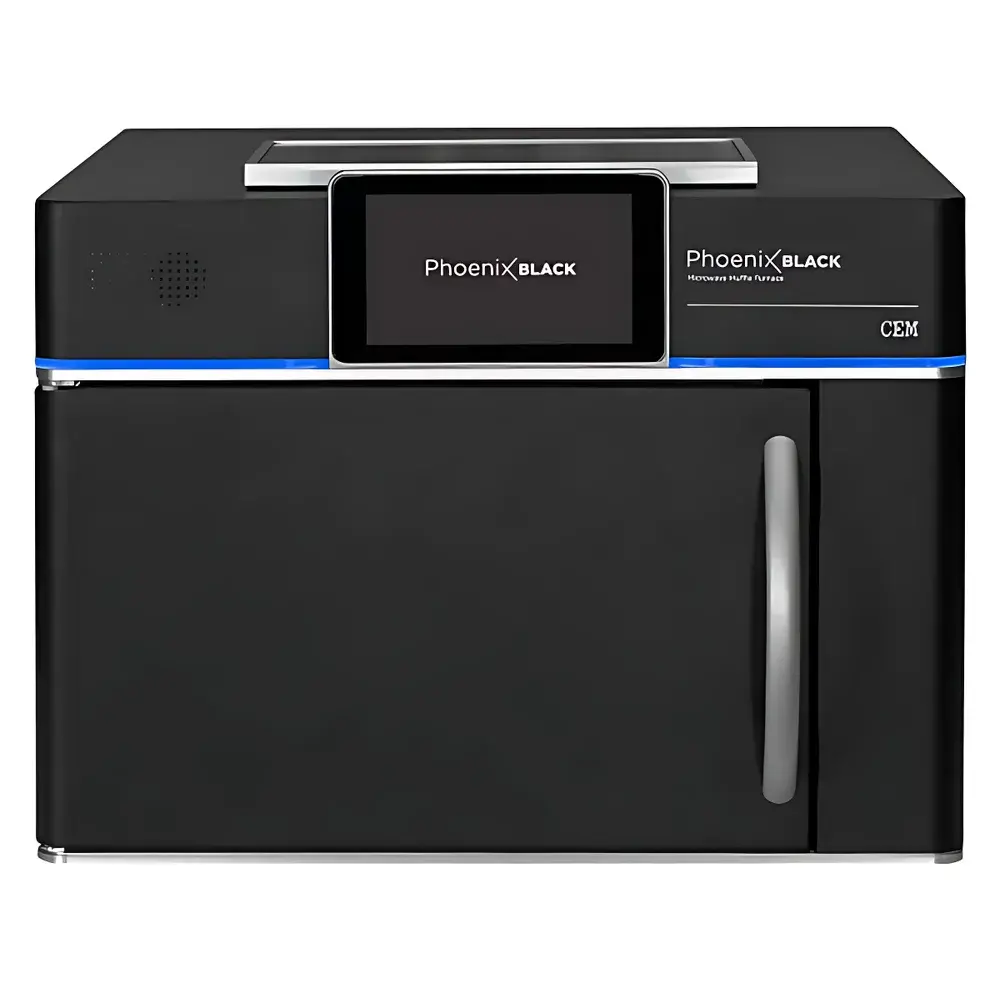
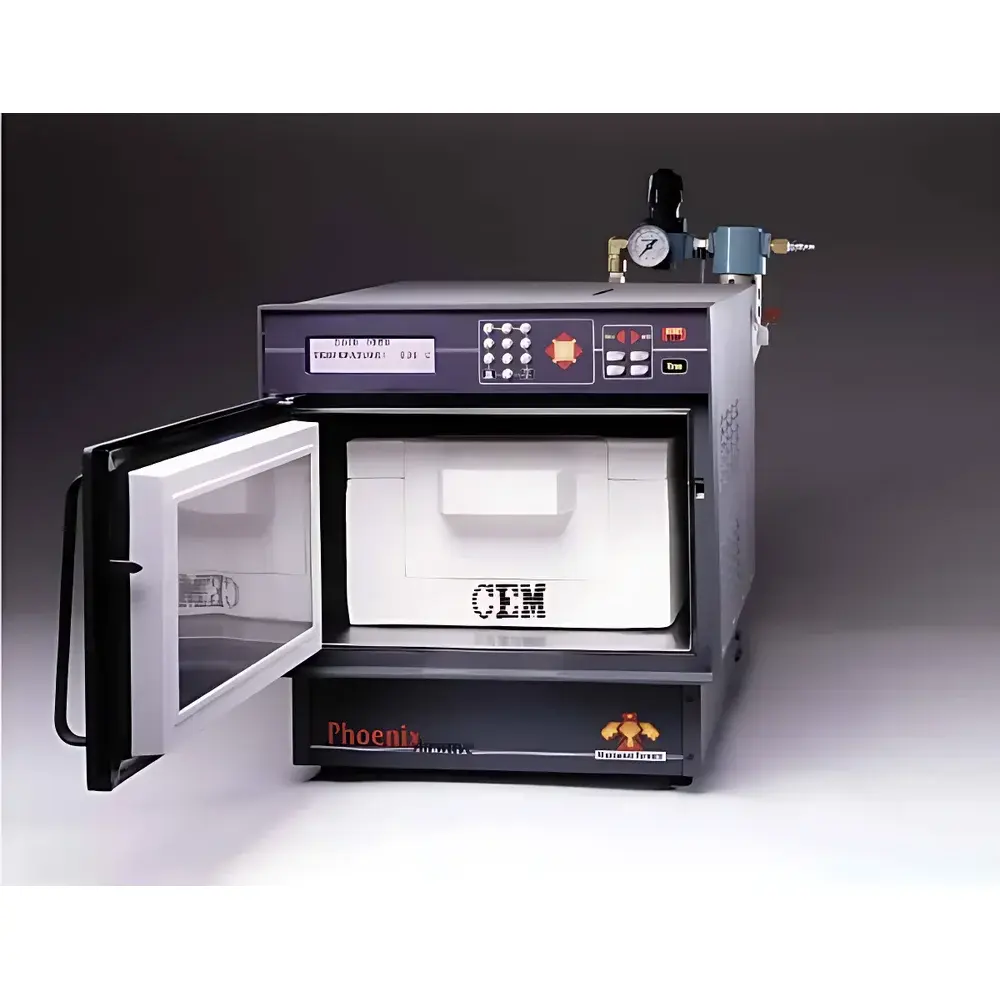
CEM PHOENIX Black Microwave Muffle Furnace for Ash Content Determination
| Brand | CEM |
|---|---|
| Origin | USA |
| Model | PHOENIX Black |
| Instrument Type | Box-Type Microwave Muffle Furnace |
| Max Temperature | 1200 °C |
| Temperature Control Accuracy | ±1 °C |
| Max Power Output | 1950 W |
| Ramp Time to Max Temperature | 10 min |
| Heating Method | Microwave |
| Internal Chamber Dimensions | 24.6 × 16.7 × 10.1 cm |
| Chamber Volume | 1.8 L (standard) / 5 L (optional) |
| Airflow Capacity | 100 CFM (standard), up to 130 CFM (with optional Airwave Amplifier) |
| Crucible Cooling Time | <30 s (1200 °C → ambient) |
Overview
The CEM PHOENIX Black Microwave Muffle Furnace is an engineered solution for rapid, controlled, and contamination-free ash content determination in compliance with international pharmacopeial and industrial standards—including USP (Residue on Ignition), USP (Loss on Ignition), ASTM D5630-94 (Ash Content of Plastics), and ASTM D1509-94b (Ash Content of Carbon Black). Unlike conventional resistive muffle furnaces, the PHOENIX Black employs solid-state microwave energy coupled with dynamic convective airflow to achieve uniform thermal processing without pre-charring. Its core principle relies on selective dielectric heating of polar components (e.g., water, organics) while maintaining precise temperature control via dual-mode feedback—real-time infrared thermometry and embedded NIST-traceable thermocouple arrays. This enables direct, single-step ashing of heterogeneous samples—eliminating intermediate drying, charring, or post-ashing cooling delays—while preserving volatile analytes and minimizing carryover or cross-contamination.
Key Features
- Patented Airwave™ forced-air exhaust system delivering up to 130 CFM, actively removing volatile byproducts (e.g., SOx, NOx, halogenated organics) before condensation or re-deposition occurs
- Quartz-fiber insulated cavity with radial thermal conductor architecture ensures spatial temperature uniformity ≤ ±1 °C across the full 1.8 L working volume
- Self-sealing, oxygen-limited quartz crucibles enable rapid carbon black analysis in under 5 minutes—no external nitrogen purge required
- Integrated infrared interlock and microwave leakage monitoring comply with IEC 61000-3-2 and FDA 21 CFR Part 1040.10 safety requirements
- BITS (Built-In Troubleshooting System) continuously monitors critical subsystems—including magnetron health, door integrity, thermocouple drift, and cooling fan RPM—to preemptively flag component degradation
- Programmable 8-stage temperature ramping with dwell capability; supports both gradient and stepwise protocols from ambient to 1200 °C
- Full thermal recovery in <30 seconds post-ash: chamber cools from 1200 °C to 12 samples/hour
Sample Compatibility & Compliance
The PHOENIX Black accommodates standard ceramic, platinum, and alumina crucibles (up to 200 g sample mass per run), as well as CEM’s proprietary low-mass quartz-fiber crucibles optimized for microwave coupling efficiency. It meets regulatory expectations for GLP/GMP environments through audit-ready data integrity features: time-stamped, user-logged method execution; electronic signatures; and 21 CFR Part 11–compliant data export via Ethernet or USB to LIMS or ELN platforms. Its gas-washing module captures acidic condensates (e.g., H2SO4, HF) generated during sulfonation or halogenated polymer ashing, ensuring operator safety and environmental compliance per OSHA 29 CFR 1910.1200 and EPA Method 29.
Software & Data Management
Control is managed via CEM’s PhoenixTouch™ interface—a touchscreen GUI supporting method library storage, real-time thermal profiling, and deviation alerts. All temperature, power, and airflow parameters are logged at 1-second intervals with metadata (user ID, timestamp, method name, calibration status). Raw data exports as CSV or XML; PDF reports include NIST-traceable calibration certificates, system diagnostics logs, and compliance annotations for USP/ASTM clauses. Remote monitoring and firmware updates are supported over secure HTTPS via the built-in Ethernet port.
Applications
- Routine ash content quantification in polymers, petrochemicals, pharmaceutical excipients, animal feed, pulp & paper, and specialty chemicals
- Loss-on-ignition (LOI) analysis for mineralogical characterization and catalyst residue screening
- Sulfonation and halogen digestion prior to ICP-MS/OES metal quantification
- Thermal stability assessment of battery cathode materials and flame-retardant composites
- Residue-on-ignition testing of sterile drug products per USP
- Carbon black assay in rubber formulations per ASTM D1509
FAQ
Does the PHOENIX Black require external cooling water or compressed air?
No—its active air-cooling system operates independently using ambient intake and high-CFM exhaust; no auxiliary utilities are needed.
Can it be validated for GMP use?
Yes—full IQ/OQ/PQ documentation packages, including 21 CFR Part 11 validation scripts and traceability matrices, are available upon request.
Is the quartz-fiber crucible reusable?
CEM’s quartz-fiber crucibles are designed for single-use in high-precision applications but may be reused up to 5 cycles for routine screening if inspected for microfractures and residual carbon.
How does microwave heating improve reproducibility versus resistive furnaces?
Microwave energy couples directly with sample dielectrics rather than relying on radiant/conductive transfer—reducing thermal lag, eliminating hot/cold spots, and yielding inter-run RSDs <1.2% for certified reference materials (CRM) like NIST SRM 1648a Urban Particulate Matter.
What maintenance is required beyond routine cleaning?
Annual verification of NIST-traceable calibration, magnetron output power measurement, and Airwave amplifier flow calibration—performed by CEM-certified field service engineers.



