
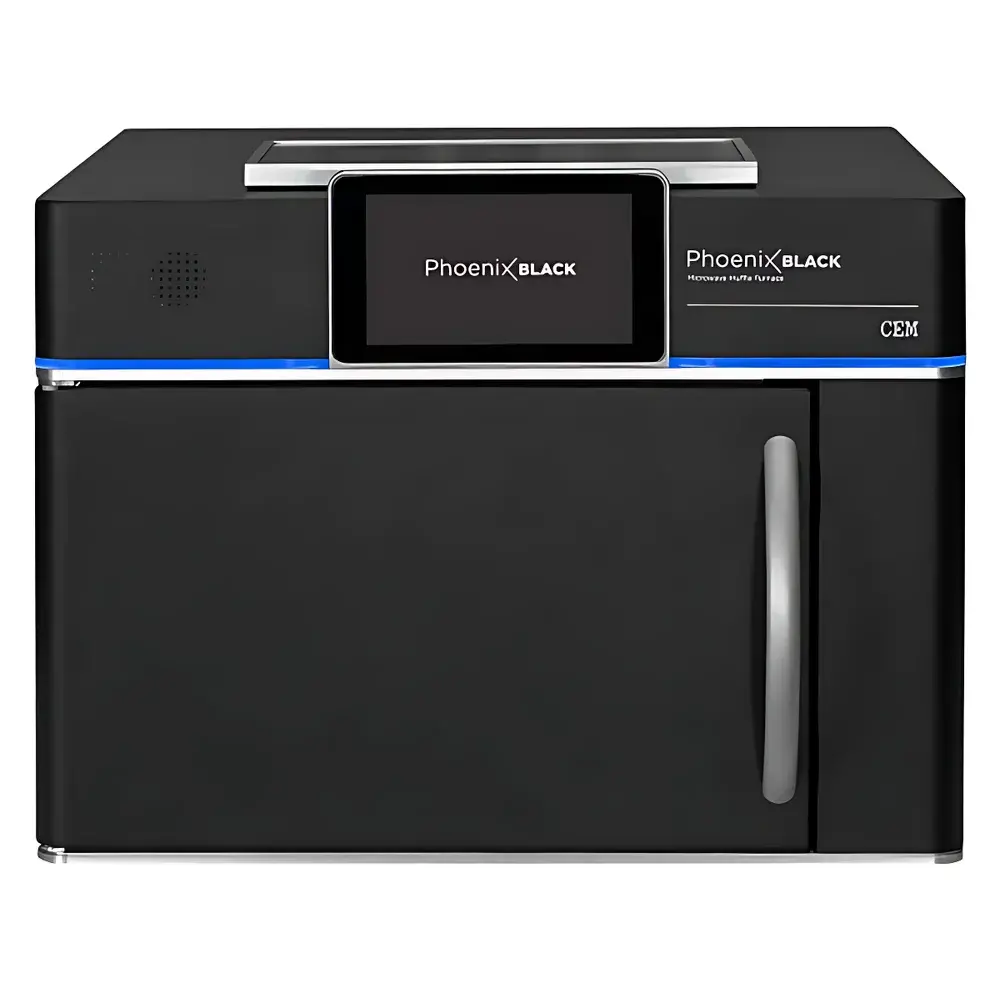
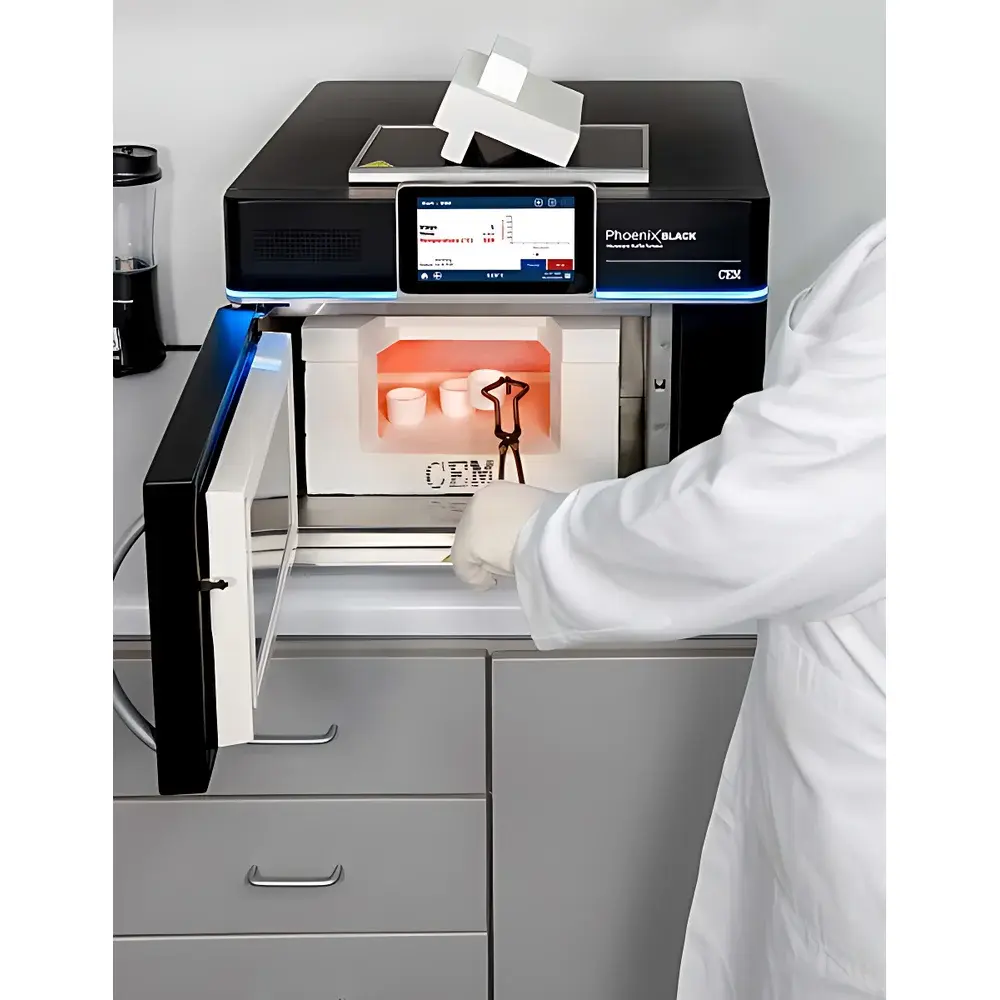
CEM PHOENIX BLACK Microwave Muffle Furnace for Ashing Analysis
| Brand | CEM |
|---|---|
| Origin | USA |
| Model | PHOENIX BLACK |
| Instrument Type | Box-Type Microwave Muffle Furnace |
| Max Temperature | 1200 °C |
| Temperature Control Accuracy | ±1 °C |
| Max Power Output | 1950 W |
| Ramp-to-Max-Temp Time | 10 min |
| Heating Method | Microwave |
| Internal Cavity Dimensions | 24.6 × 16.7 × 10.1 cm |
| Cavity Volume | 1.8 L (standard) / 5 L (optional) |
| Cooling Time (1200 °C → RT) | <30 s |
| Airflow Capacity | 100 CFM (standard), up to 130 CFM (with optional Airwave booster) |
| Compliance | ASTM D5630-94, ASTM D1509-94b, USP <281>, USP <733>, NIST-traceable temperature calibration |
Overview
The CEM PHOENIX BLACK Microwave Muffle Furnace is an advanced ashing system engineered for rapid, precise, and contamination-free thermal decomposition of organic and inorganic samples. Unlike conventional resistive-heated muffle furnaces—whose slow conduction-based heating induces prolonged exposure to oxidative intermediates—the PHOENIX BLACK employs high-efficiency microwave energy coupling directly into the sample and crucible, enabling volumetric, uniform heating with minimal thermal lag. This principle eliminates the need for pre-charring steps and reduces total ashing cycle time by up to 97% compared to standard furnace protocols. Designed for compliance-critical environments—including pharmaceutical QC labs, petrochemical testing facilities, and accredited environmental laboratories—the system delivers reproducible ash residue quantification, loss-on-ignition (LOI), sulfonation, fusion, and high-temperature thermal treatment across diverse matrices such as polymers, feedstocks, pulp & paper, pharmaceutical excipients, and specialty chemicals.
Key Features
- Ultra-Rapid Thermal Programming: Eight independent programmable temperature ramps support gradient or stepwise heating from ambient to 1200 °C in under 10 minutes; final hold temperatures maintain stability within ±1 °C over 24-hour continuous operation.
- Direct Ashing Workflow: Eliminates manual pre-drying and charring stages—samples are introduced dry or wet into the cavity and undergo complete organic matrix removal in a single automated sequence.
- Instant Post-Ashing Cooling: Integrated forced-air quenching cools crucibles from 1200 °C to ambient in less than 30 seconds, enabling immediate gravimetric analysis without waiting for passive cooldown.
- NIST-Traceable Calibration: Built-in infrared thermometry and factory-calibrated reference sensors conform to NIST SRM traceability requirements; full calibration documentation and certificate of conformity provided upon installation.
- Multi-Layer Safety Architecture: Includes real-time microwave leakage monitoring (IEC 61000-4-3 compliant), auto-shutoff on door interlock breach, BITS™ (Built-in Thermal Surveillance) diagnostics for thermocouple integrity and cooling fan performance, and pressure-relief venting for volatile byproduct management.
- Modular Airflow System: Standard 100 CFM exhaust is upgradeable to 130 CFM Airwave™ configuration with adjustable flow control—critical for high-volatility samples (e.g., lubricants, asphaltene fractions, halogenated polymers) per ASTM D5630-94 and D1509-94b.
Sample Compatibility & Compliance
The PHOENIX BLACK accommodates standard ceramic, platinum, and alumina crucibles (up to 200 g capacity), while its proprietary quartz-fiber crucibles enhance microwave coupling efficiency for low-mass or heterogeneous samples. The quartz-top SAS (Self-Aligning Sealed) chamber design minimizes atmospheric ingress during heating, preserving sample purity—especially vital for USP Residue on Ignition and Loss on Ignition assays. Exhaust gases generated during sulfonation or halogen-rich ashing are routed through an optional acid-gas scrubbing module, ensuring operator safety and regulatory alignment with OSHA PEL and EPA Method 29 emission controls. All firmware and operational logs comply with FDA 21 CFR Part 11 data integrity requirements when paired with validated LIMS interfaces via RS232 or optional Ethernet gateway.
Software & Data Management
Control is executed via CEM’s PhoenixTouch™ GUI, supporting method storage, audit-trail-enabled user authentication, and timestamped event logging (door open/close, power ramp, temperature plateau, cooling initiation). Raw thermal profiles and weight-change data (when integrated with METTLER TOLEDO or SARTORIUS analytical balances via RS232) are exportable in CSV or XML format for GLP/GMP reporting. Firmware updates preserve historical calibration records and support version-controlled method validation per ISO/IEC 17025 clause 5.9.2. Remote diagnostics via BITS™ generate predictive maintenance alerts for cooling fans, magnetron output decay, and cavity sensor drift—reducing unplanned downtime in high-throughput labs.
Applications
- Ash content determination in plastics, rubber, and composite materials (ISO 3451-1, ASTM D5630)
- Sulfated ash analysis of petroleum products and additives (ASTM D1509, IP 127)
- Residue on ignition testing of APIs and excipients (USP , Ph. Eur. 2.4.13)
- Loss on ignition for cement, fly ash, and mineral fillers (ASTM C114, EN 196-2)
- Thermal decomposition kinetics studies requiring controlled ramp rates and inert-atmosphere alternatives (via optional sealed crucible kits)
- Preparation of fused beads for XRF analysis of geological and metallurgical samples
FAQ
Does the PHOENIX BLACK require nitrogen purging for carbon black analysis?
No. Its patented self-sealing quartz crucible enables rapid, oxygen-limited pyrolysis—achieving complete carbon black quantification in ≤5 minutes without external gas supply or tube sealing.
Can it be used for USP Loss on Ignition assays?
Yes. The system meets all procedural and instrumentation requirements specified in USP , including temperature accuracy, dwell time control, and residual mass repeatability (RSD <0.5% across n=6 replicates).
Is the internal cavity material resistant to hydrofluoric acid vapors during sulfonation?
The standard cavity lining is quartz-fiber reinforced ceramic; for extended HF exposure, optional PTFE-coated exhaust ducting and borosilicate gas-wash bottles are available as part of the Acid Gas Management Kit.
How is temperature uniformity verified across the 1.8 L cavity?
CEM performs multi-point cavity mapping using NIST-traceable miniature thermocouples at nine spatial locations (center, corners, mid-walls) per IEC 61000-4-3 Annex B; maximum deviation is certified ≤±1 °C at 1200 °C.
What maintenance intervals are recommended for the magnetron and airflow system?
Magnetron output is monitored continuously via BITS™; replacement is advised after 5,000 hours of cumulative operation or if output drops >10% below nominal. Air filters require cleaning every 200 hours and replacement every 1,000 hours under continuous use.



