
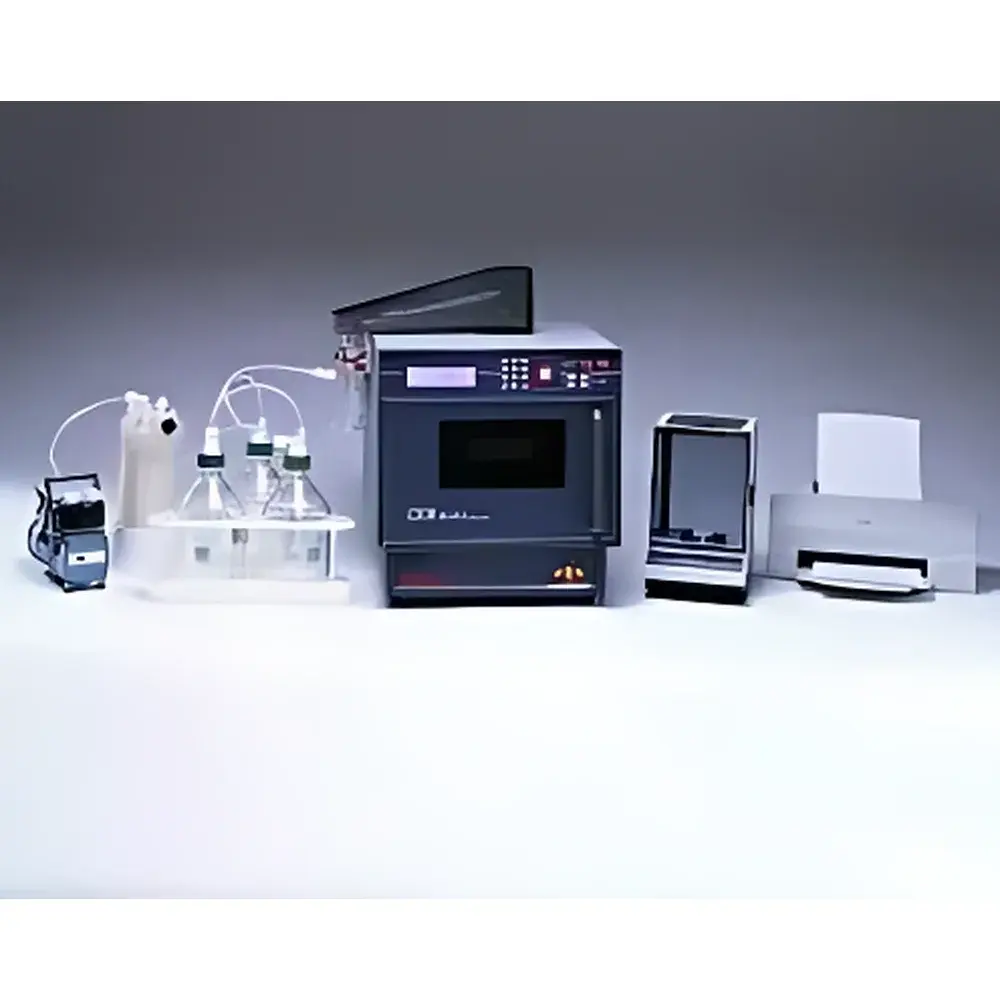
CEM PHOENIX SAS Microwave-Assisted Sulfonation and Ashing Muffle Furnace
| Brand | CEM |
|---|---|
| Origin | USA |
| Manufacturer Status | Authorized Distributor |
| Origin Category | Imported |
| Instrument Type | Box-Type Furnace |
| Max Temperature | 1200 °C |
| Temperature Control Accuracy | ±1 °C |
| Max Power | 1400 W |
| Ramp Time to Max Temp | 10 min |
| Heating Method | Microwave |
| Internal Chamber Dimensions | 24.6 × 16.7 × 10.1 cm |
| Chamber Volume | 1.8 L (standard) / 5 L (optional) |
| Cooling Time (1200 °C → RT) | <30 s |
| Exhaust Flow Rate | 100 CFM (standard), up to 130 CFM (with adjustable flow amplifier) |
| Safety | NIST-traceable internal temperature calibration, infrared microwave leakage monitoring, BITS real-time component diagnostics, RS232 interface for balance/printer integration |
Overview
The CEM PHOENIX SAS Microwave-Assisted Sulfonation and Ashing Muffle Furnace is a purpose-engineered thermal processing system designed for rapid, controlled, and chemically safe sample preparation in regulated analytical laboratories. Unlike conventional resistive-heated muffle furnaces, the PHOENIX SAS employs high-efficiency microwave energy coupling to achieve uniform volumetric heating—enabling simultaneous sulfonation and ashing within a single, closed-cycle process. Its operational principle leverages selective dielectric heating of polar molecules and ionic species, accelerating reaction kinetics while minimizing thermal lag and wall-effect artifacts. The furnace is specifically validated for USP <281> Residue on Ignition (ROI) and USP <733> Loss on Ignition (LOI) determinations, supporting pharmacopeial compliance in pharmaceutical quality control, raw material verification, and excipient characterization.
Key Features
- Microwave-driven thermal processing with programmable gradient or rapid ramp profiles (0–1200 °C, ±1 °C accuracy), enabling precise control over sulfonation kinetics and oxidative decomposition pathways.
- Quartz-lined chamber roof and corrosion-resistant exhaust ducting engineered to withstand aggressive acidic vapors (e.g., SO3, H2SO4, HF) generated during sulfonation of organic matrices.
- Integrated acid gas scrubbing system featuring neutralizing reagent cartridges (e.g., NaOH or Ca(OH)2) that capture and neutralize volatile acidic byproducts prior to atmospheric release—meeting OSHA PEL and EPA stack emission guidelines.
- Passive, no-moving-parts exhaust architecture with adjustable flow amplifier (100–130 CFM), eliminating maintenance-prone blowers and ensuring consistent vapor removal across variable sample loads.
- NIST-traceable internal thermometry with automated calibration validation; each unit ships with a certificate of traceability and optional annual recalibration service.
- BITS (Built-in Thermal Safety) diagnostic subsystem continuously monitors thermocouple integrity, door interlock status, magnetron output stability, and cooling fan performance—logging events for GLP/GMP audit trails.
- Infrared-based microwave containment monitoring ensures zero measurable leakage (<0.1 mW/cm² at 5 cm), compliant with IEC 61000-4-3 and FDA 21 CFR Part 1030.10 radiation safety requirements.
Sample Compatibility & Compliance
The PHOENIX SAS accommodates heterogeneous solid samples including polymers, petrochemical residues, animal feedstuffs, pulp and paper sludges, pharmaceutical tablets, and specialty chemical intermediates. Its dual-mode capability—supporting both open-crucible sulfonation (per ASTM D129, D2622) and closed-vessel ashing (per ISO 11885, EPA Method 3050B)—ensures broad method alignment. All operating protocols are preconfigured to satisfy USP <281>, <733>, and <271> (Sulfated Ash), as well as AOAC 990.12 and EN 13656 for halogenated organics. The instrument’s firmware supports 21 CFR Part 11-compliant electronic signatures and audit-ready data logging when paired with certified LIMS or ELN platforms.
Software & Data Management
Control is executed via a dedicated touchscreen HMI with embedded protocol library (≥50 pre-validated methods). Real-time temperature, power output, exhaust flow, and microwave duty cycle are logged at 1-second intervals and exported via RS232 to external balances or printers in ASCII-delimited format. Optional CEM Connect™ software enables remote monitoring, method synchronization across multi-unit labs, and automated report generation compliant with ISO/IEC 17025 documentation standards. All data files include embedded metadata: timestamp, operator ID, calibration status, and environmental ambient readings.
Applications
- Routine ROI/LOI testing of APIs, excipients, and dietary supplements per pharmacopeial monographs.
- Sulfated ash determination in silicone elastomers, flame-retardant plastics, and catalyst supports.
- Accelerated ashing of high-lipid or high-sugar matrices (e.g., dairy powders, cereal grains) without charring artifacts.
- Preparation of sulfate-rich residues for subsequent ICP-OES or ICP-MS analysis—reducing polyatomic interferences from chloride or phosphate carryover.
- Method development for regulatory submissions requiring full process transparency, including thermal profiling, gas evolution tracking, and mass balance reconciliation.
FAQ
Does the PHOENIX SAS require special ventilation or fume hood installation?
No—its integrated acid gas scrubber and passive exhaust design meet ANSI Z9.5 laboratory ventilation standards without requiring external ducting or dedicated hoods.
Can the furnace be used for traditional dry ashing without sulfonation chemistry?
Yes—microwave-only mode supports standard LOI protocols at temperatures up to 1200 °C, with identical temperature uniformity (±1 °C across chamber volume) and reproducibility (RSD <1.2% for triplicate CRM ashing).
Is NIST traceability provided for each unit at time of shipment?
Yes—each PHOENIX SAS includes an individual NIST-traceable calibration certificate issued by CEM’s ISO/IEC 17025-accredited metrology lab, with documented uncertainty budgets for all primary sensors.
What crucible materials are compatible with sulfonation conditions?
Quartz, high-purity alumina (99.8%), and platinum crucibles are validated; graphite and stainless steel are prohibited due to catalytic side reactions and corrosion risk.
How does the system ensure operator safety during high-temperature sulfonation?
Safety is enforced through triple-redundant interlocks: IR-based microwave cutoff on door opening, thermal runaway shutdown at >1220 °C, and real-time exhaust flow verification—any fault triggers immediate power termination and audible alarm.



