
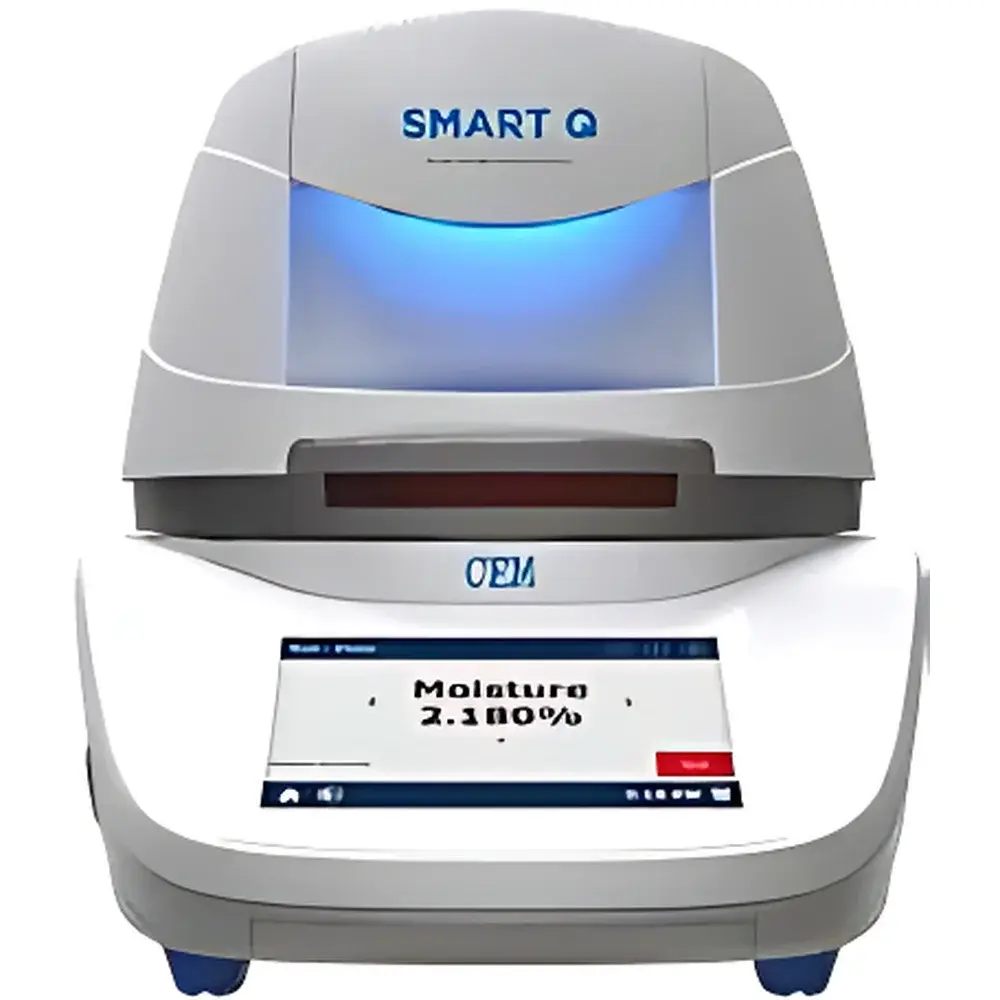
CEM SMART Q Infrared Moisture Analyzer
| Brand | CEM |
|---|---|
| Origin | USA |
| Manufacturer Status | Authorized Distributor |
| Product Origin | Imported |
| Model | SMART Q |
| Heating Method | Infrared |
| Measurement Range | 0.01–15% moisture content |
| Resolution | 0.001% |
| Balance Precision | 0.0001 g (4-digit analytical balance with 3-digit moisture display) |
| Sample Types | Solids, powders, slurries, non-polar solvents, low-moisture polymers, coatings, pharmaceuticals |
| Compliance | Designed for GLP/GMP environments |
Overview
The CEM SMART Q Infrared Moisture Analyzer is a high-performance, rapid-drying moisture determination system engineered for precision and operational robustness in regulated laboratory and industrial process environments. It employs near-infrared (NIR) radiation coupled with advanced thermal mass compensation to achieve direct, non-destructive moisture quantification via loss-on-drying (LOD) principle. Unlike conventional halogen or convection-based systems, the SMART Q utilizes proprietary pulsed infrared heating technology that delivers controlled, uniform energy absorption across heterogeneous sample matrices—minimizing thermal degradation, surface crusting, and measurement drift. This architecture enables repeatable, traceable results within seconds to minutes, depending on sample composition and initial moisture level. Its design targets applications requiring strict adherence to ASTM D4442, ISO 712, USP , and AOAC Official Methods, particularly where speed, repeatability, and minimal operator intervention are critical.
Key Features
- Proprietary pulsed infrared heating system delivering up to 3× faster drying cycles versus standard IR and halogen analyzers—reducing average analysis time from >5 min to <90 s for typical low-moisture solids.
- Integrated 4-digit analytical balance (0.0001 g readability) with automatic drift compensation and temperature-stabilized load cell—ensuring mass stability under dynamic thermal conditions.
- No pre-heating or post-cooling required: real-time moisture calculation begins immediately upon sample placement, eliminating idle cycle delays and improving throughput.
- Ruggedized stainless-steel housing rated IP54 for dust and splash resistance—suitable for QC labs, production floors, and cleanroom-adjacent environments.
- Pre-loaded method library covering >120 validated protocols for food powders (e.g., milk powder, flour), polymers (PET, PP), pharmaceutical excipients, coatings, and organic solvents.
- Real-time graphical display of mass loss curve, drying rate profile, and endpoint detection algorithm status—enabling method optimization and troubleshooting without external software.
Sample Compatibility & Compliance
The SMART Q accommodates solid, semi-solid, and viscous samples with moisture content ranging from 0.01% to 15%. It demonstrates consistent performance across diverse material classes—including hygroscopic powders (e.g., lactose, starch), thermally sensitive pharmaceutical actives, low-polarity solvents (ethanol, ethyl acetate), and engineering-grade thermoplastics (PET, PBT). All methods are developed and verified in accordance with ICH Q5C stability guidelines and aligned with regulatory expectations for method validation (ICH Q2(R2)). The instrument’s firmware supports electronic signatures, user access levels, and full audit trail logging—meeting baseline requirements for FDA 21 CFR Part 11 compliance when deployed with CEM’s validated SMART Connect software suite. Routine operation satisfies GLP documentation standards for moisture testing in contract laboratories and manufacturing QA departments.
Software & Data Management
Data acquisition, reporting, and instrument control are managed through SMART Connect—a Windows-based application certified for use in GxP-regulated settings. The software provides automated report generation (PDF/CSV), customizable templates compliant with internal SOPs, and secure database storage with timestamped metadata (operator ID, method version, calibration history, environmental logs). All raw mass/time datasets are retained with checksum verification to prevent tampering. Audit trail functionality records every user action—including method edits, result overrides, and calibration events—with immutable timestamps and justification fields. Export modules support LIMS integration via ASTM E1384-compliant HL7 or ODBC protocols.
Applications
The SMART Q serves as a primary moisture verification tool across multiple regulated sectors. In food manufacturing, it validates moisture specifications for infant formula, snack foods, and functional ingredients prior to packaging. Within polymer processing, it monitors residual moisture in PET resin prior to extrusion—preventing hydrolytic degradation during melt processing. In pharmaceutical development, it supports stability-indicating assays for lyophilized products and excipient qualification per USP . Coating formulators use it to verify solvent retention in architectural paints and automotive basecoats. Additionally, it supports environmental testing workflows for total suspended solids (TSS) and volatile suspended solids (VSS) in wastewater sludge per EPA Method 1684.
FAQ
What is the minimum detectable moisture level?
The instrument achieves reliable quantification down to 0.01% moisture content, supported by statistical validation using gravimetric reference standards.
Does the SMART Q require routine calibration with certified standards?
Yes—daily verification using NIST-traceable moisture standards (e.g., sodium tartrate dihydrate) is recommended; full calibration is performed annually or after major maintenance.
Can the SMART Q be integrated into an automated production line?
Yes—RS-232, USB, and optional Ethernet interfaces enable PLC communication and SCADA-level data streaming for real-time process control.
Is method transfer between SMART Q units straightforward?
All methods are stored in portable XML format and retain full parameter integrity—including ramp profiles, endpoint criteria, and sensor compensation coefficients—ensuring seamless cross-unit deployment.
How does the SMART Q handle samples prone to splattering or foaming?
The instrument includes programmable gentle-start heating modes and adjustable airflow suppression settings to minimize sample displacement during initial drying phases.



