
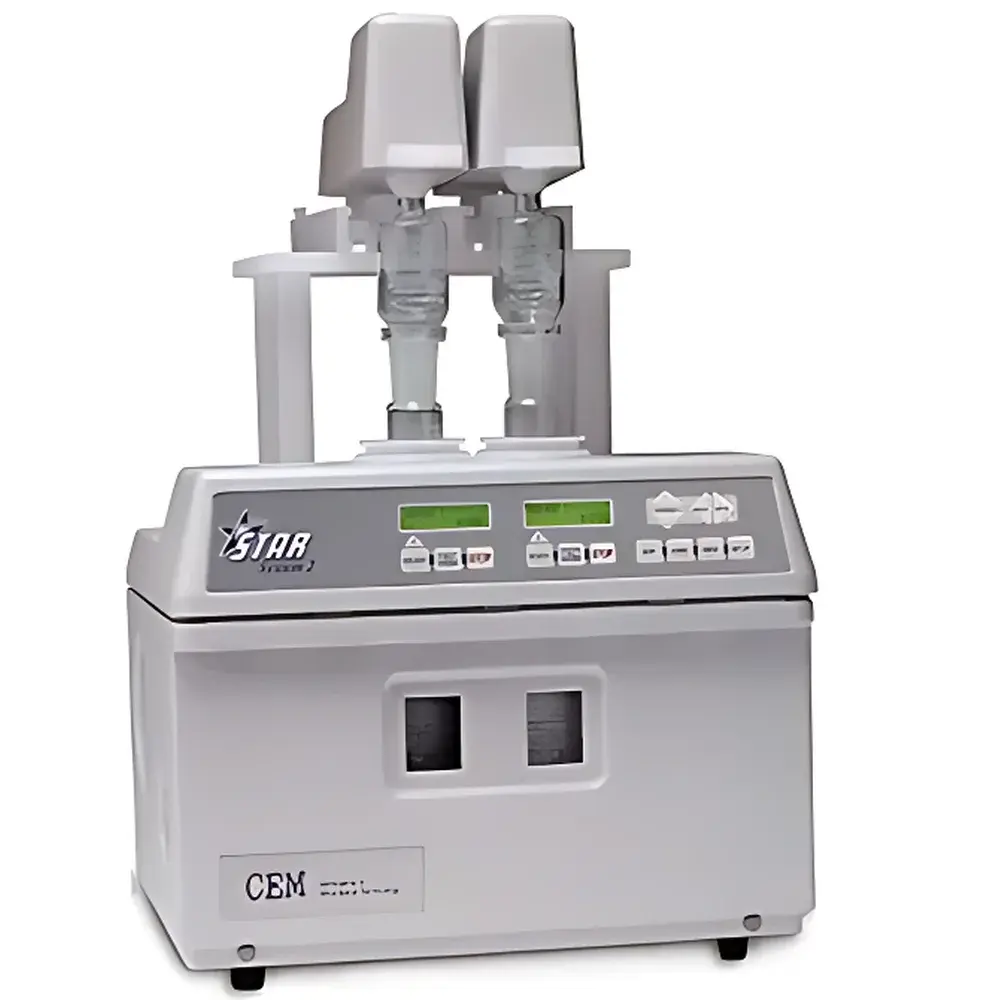
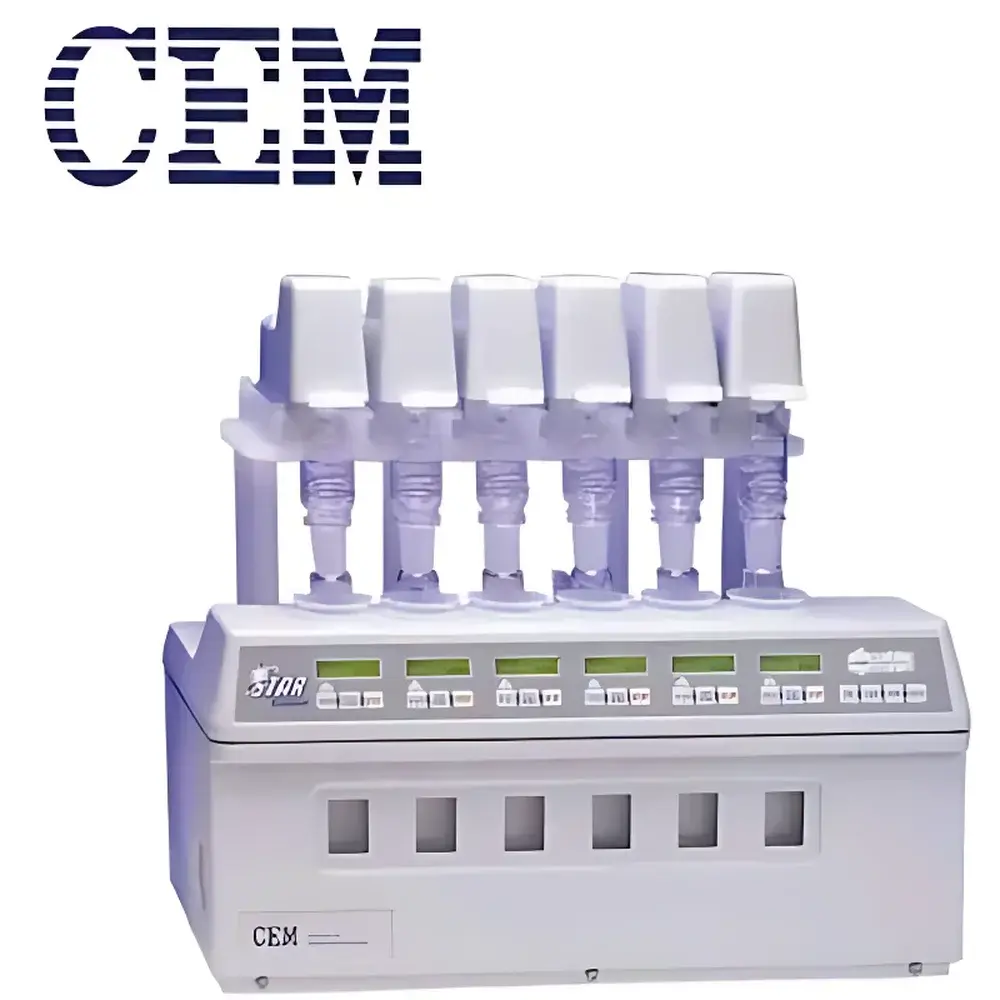
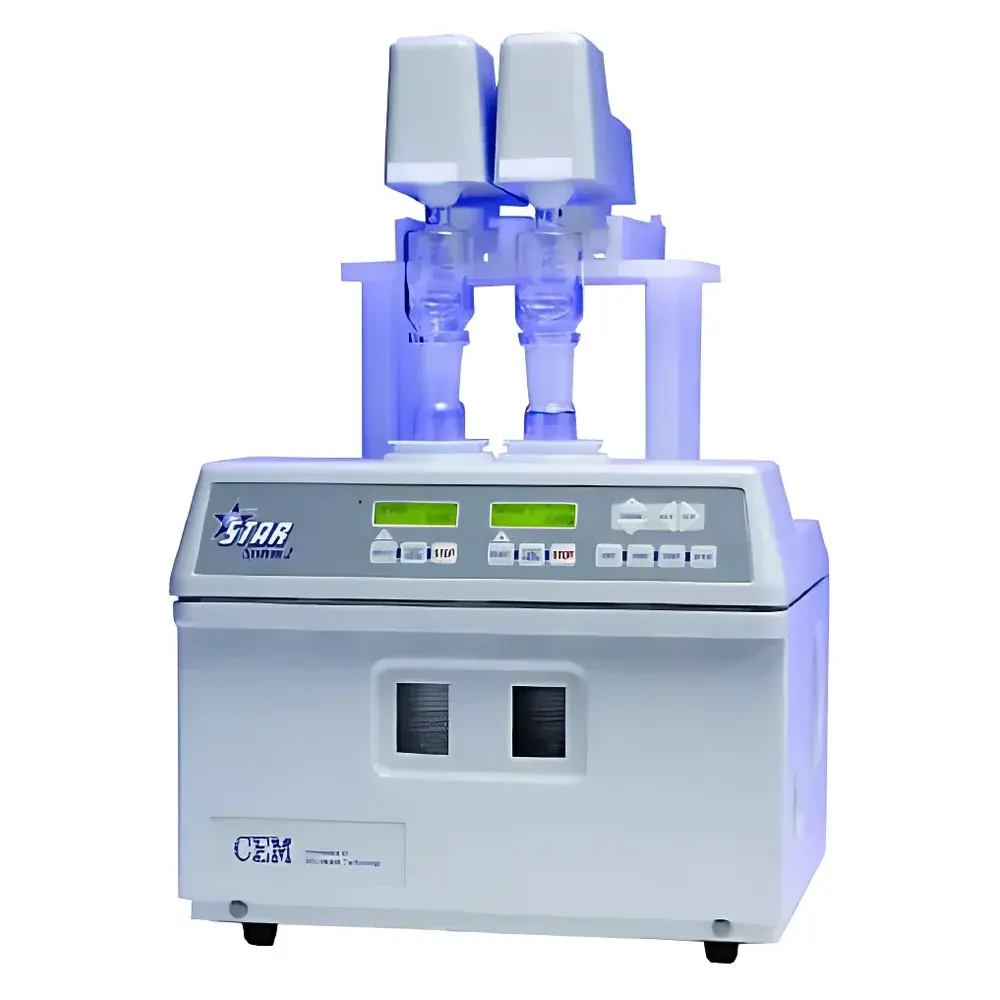
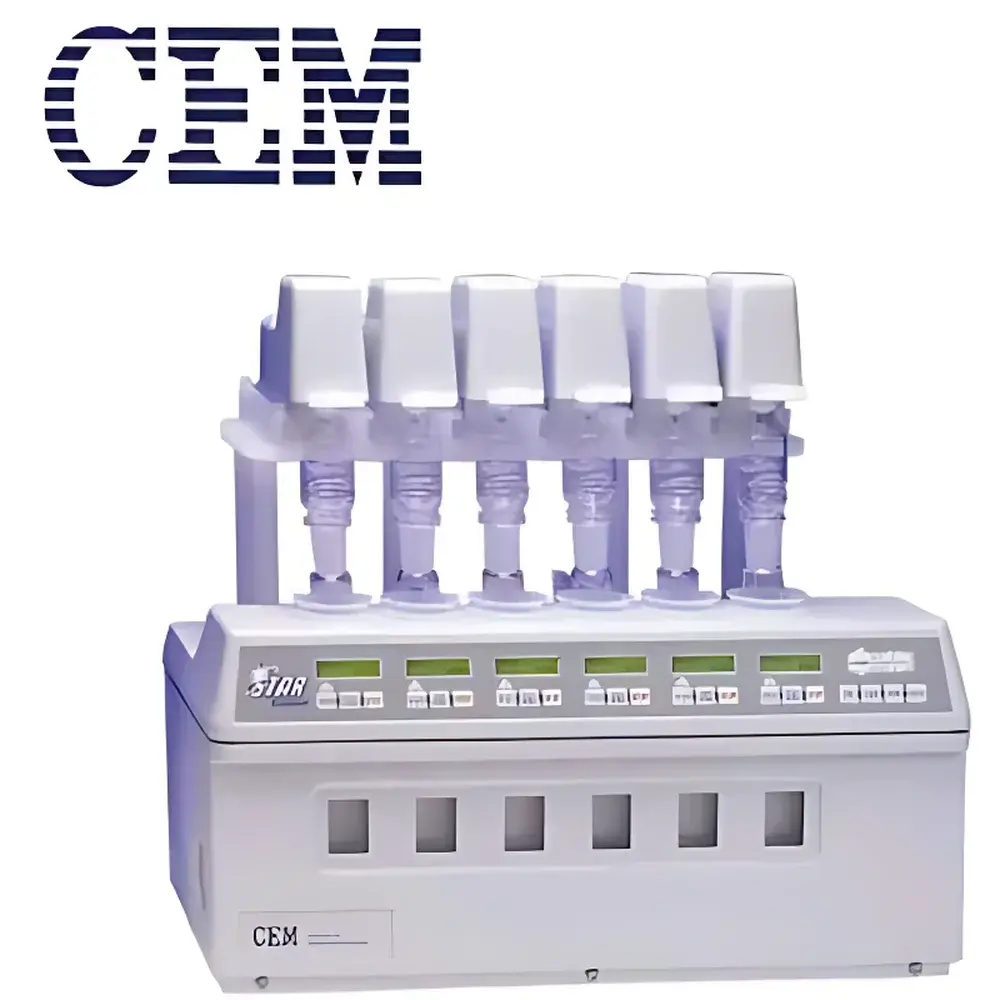
CEM STAR-Plus 6/2 Open-Focused Microwave Digestion System
| Brand | CEM |
|---|---|
| Origin | USA |
| Model | STAR-Plus 6/2 |
| Cavity Class | Industrial-Grade |
| Sample Capacity | 2 / 4 / 6 positions |
| Microwave Source | Single or Dual Magnetron |
| Max Operating Temperature | 500 °C (reaction zone), 300 °C (vessel wall) |
| Pressure Regime | Ambient (atmospheric-pressure operation) |
| Temperature Control Range | 0–430 °C |
| Temp. Accuracy | ±1 °C |
| Reaction Vessel Options | 50 / 100 / 250 mL |
| Vessel Materials | Borosilicate Glass, Quartz, PTFE |
| Organic Sample Mass Capacity | Up to 10 g |
| Reagent Addition Stations | 12–24 independent channels |
| Preloaded Methods | 20 methods × up to 40 steps each |
| Compliance | EPA Method 3050B, ISO 14001-aligned exhaust management |
Overview
The CEM STAR-Plus 6/2 is an open-focused microwave digestion system engineered for high-throughput, atmospheric-pressure sample preparation in environmental, geological, and regulatory laboratories. Unlike sealed-vessel microwave digestion systems that rely on pressurized containment to elevate reaction kinetics, the STAR-Plus 6/2 employs a precisely directed, non-resonant microwave field focused onto individual reaction vessels operating at ambient pressure. This architecture eliminates pressure-related safety hazards while enabling direct thermal monitoring, unimpeded reagent addition, and real-time visual observation of digestion progress. The system is specifically validated for U.S. EPA Method 3050B — “Acid Digestion of Sediments, Sludges, and Soils” — and supports trace metal analysis requiring low detection limits and minimal blank contribution. Its open-vessel design accommodates large organic loads (up to 10 g), mitigating carbon buildup and ensuring complete matrix decomposition without vessel rupture risk.
Key Features
- Independent microwave flux control per position: Two or six dedicated magnetron-driven focusing units deliver calibrated energy directly to each reaction vessel, enabling heterogeneous sample processing within a single run.
- Dual-magnetron option available for enhanced power delivery and improved thermal uniformity across multi-vessel configurations.
- Non-contact infrared temperature sensing with ±1 °C accuracy across 0–430 °C range; operational vessel surface temperatures reach 300 °C, while localized reaction zones exceed 500 °C under optimized conditions.
- Modular reagent dispensing: 12–24 independently programmable channels support sequential or simultaneous addition of acids (e.g., HNO₃, HCl, HF, H₂O₂) to distinct vessels — critical for method flexibility and cross-contamination avoidance.
- Integrated process automation: Fully programmable sequences include reflux condensation, solvent evaporation, concentration endpoint detection, and post-digestion air cooling — all executed without manual intervention.
- Vessel compatibility: Accepts standard borosilicate glass, high-purity quartz, and PTFE digestion tubes (50 / 100 / 250 mL), allowing method-specific material selection for aggressive chemistries or ultra-trace applications.
Sample Compatibility & Compliance
The STAR-Plus 6/2 processes heterogeneous solid matrices including soils, sediments, sludges, plant tissues, polymers, and biological tissues. Its atmospheric operation avoids volatile loss associated with rapid depressurization in closed systems, preserving volatile analytes (e.g., As, Se, Hg) and enabling accurate speciation workflows. Exhaust gases pass through integrated acid scrubbing and particulate filtration, meeting ISO 14001 environmental performance benchmarks. The system conforms to EPA 3050B requirements for total recoverable metals analysis and supports GLP-compliant documentation when paired with CEM’s validated software suite. Vessel materials are certified to ASTM D5686 and ISO 17025 traceability standards for elemental analysis.
Software & Data Management
Control is managed via CEM’s proprietary Windows-based STAR-Plus software, supporting method development, execution logging, and audit-ready data export. Each method stores up to 40 discrete steps — including ramp rates, hold times, reagent volumes, and temperature setpoints — with electronic signatures and time-stamped event tracking compliant with FDA 21 CFR Part 11 requirements. All temperature profiles, reagent dispense logs, and system status flags are archived in encrypted binary format with optional CSV/XML export. Remote monitoring and diagnostic reporting are enabled via Ethernet interface; system calibration records and maintenance history are embedded in the database for regulatory inspection readiness.
Applications
- Environmental testing labs performing TCLP, SW-846, and ISO 11466 extractions prior to ICP-MS/OES quantification.
- Geochemical laboratories analyzing whole-rock digests for rare earth elements (REEs) and platinum group metals (PGMs).
- Food safety and agricultural labs conducting heavy metal screening in crops, feed, and fertilizers per EU Commission Regulation (EC) No 1881/2006.
- Pharmaceutical QC labs validating elemental impurities in APIs per ICH Q3D guidelines using USP /.
- Research institutions developing novel digestion protocols for carbon-rich or refractory matrices where closed-vessel systems exhibit incomplete oxidation.
FAQ
Does the STAR-Plus 6/2 require pressure-rated vessels or safety interlocks?
No. It operates exclusively at ambient pressure; no pressure sensors, burst disks, or mechanical locking mechanisms are required.
Can it be used for hydrofluoric acid (HF) digestions?
Yes — when configured with quartz or PTFE vessels and appropriate fume handling; HF-compatible reagent lines and corrosion-resistant internal surfaces are standard.
Is method validation support available from CEM?
Yes. CEM provides application notes, SOP templates, and third-party validation packages aligned with ISO/IEC 17025 and CLIA requirements.
How is temperature measured without physical probe contact?
Via dual-wavelength infrared pyrometry calibrated against NIST-traceable blackbody sources; emissivity compensation is applied per vessel material type.
What maintenance intervals are recommended for magnetrons and optical sensors?
Magnetrons are rated for ≥5,000 hours; IR sensor calibration is recommended annually or after 500 digestion cycles, verified using reference standards supplied by CEM.



