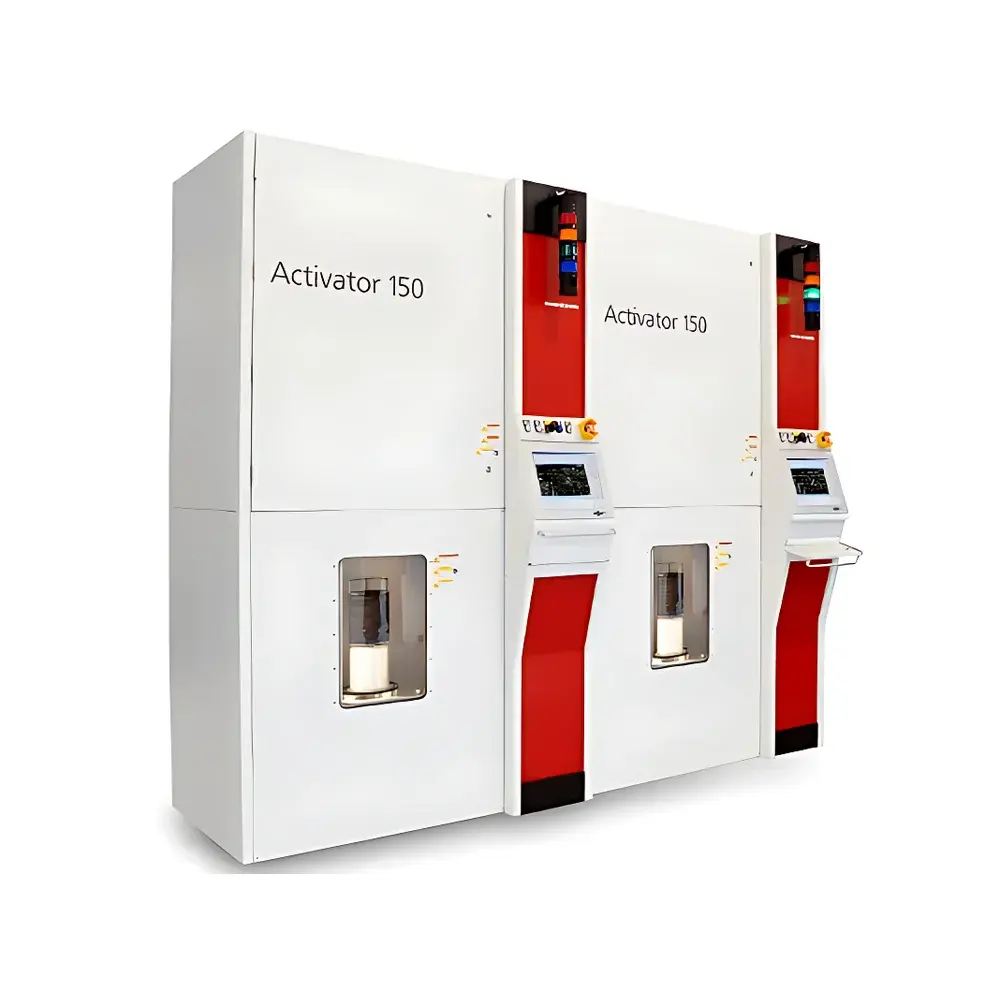
centrotherm Activator150 High-Vacuum Rapid Thermal Annealing System for SiC, GaN, and Graphene Processing
| Origin | Germany |
|---|---|
| Manufacturer Type | Authorized Distributor |
| Origin Category | Imported |
| Model | centrotherm Activator150 |
| Instrument Type | High-Vacuum Rapid Thermal Annealing Furnace |
| Sample Size | 150 mm (6-inch) wafers |
| Operating Atmosphere | Ambient pressure or controlled vacuum/pressure |
| Maximum Ramp Rate | 150 K/s |
| Maximum Cool-down Rate | 150 K/s |
| Temperature Accuracy | ±1 °C |
| Temperature Uniformity | ≥95% across wafer surface |
| Max Process Temperature | 1850 °C |
Overview
The centrotherm Activator150 is a high-precision, high-vacuum rapid thermal annealing (RTA) system engineered specifically for advanced compound semiconductor manufacturing and 2D material synthesis. Based on resistive heating with metal-free graphite or silicon carbide heating elements, the system delivers ultra-fast thermal transients—up to 150 K/s ramp and cool-down rates—enabling precise control over transient thermal profiles critical for dopant activation in silicon carbide (SiC) and gallium nitride (GaN) power devices, as well as nucleation-controlled graphene growth on catalytic or insulating substrates. Its compact chamber architecture supports both research-scale process development and low-volume production, with full compatibility for 150 mm (6-inch) wafers under cleanroom-integrated cassette-to-cassette automation. The furnace operates across a broad thermal envelope—from ambient up to 1850 °C—with exceptional repeatability and spatial uniformity (>95% across the wafer plane), validated per ASTM F1391 and ISO/IEC 17025 traceable calibration protocols.
Key Features
- Metal-free heating architecture eliminates metallic contamination risks—critical for high-purity SiC/GaN epitaxy and graphene CVD processes.
- High-vacuum capability (base pressure <1×10⁻⁶ mbar) combined with dynamic pressure control (10⁻⁶ to 10⁵ Pa) enables flexible ambient selection: inert gas (Ar/N₂), forming gas (N₂/H₂), reactive precursors (e.g., SiH₄ for Si overpressure), or ultra-high vacuum for oxide desorption studies.
- Real-time temperature monitoring via dual-wavelength pyrometry (700–1100 nm) with active emissivity compensation ensures ±1 °C accuracy independent of wafer emissivity drift during ramping.
- Modular chamber design accommodates interchangeable process liners (quartz, graphite, SiC) and optional in-situ optical viewport for real-time Raman or ellipsometry integration.
- Compact footprint (<1.6 m² floor space) and low power demand (≤45 kW) reduce facility infrastructure requirements while maintaining full GLP-compliant audit trails per FDA 21 CFR Part 11.
Sample Compatibility & Compliance
The Activator150 supports standard 150 mm semiconductor wafers—including SiC (4H/6H), GaN-on-sapphire/SiC, and transition metal dichalcogenide (TMD) substrates—as well as quartz, sapphire, and SiO₂/Si templates for graphene transfer or direct growth. Batch capacity reaches up to 50 wafers per run in vertical configuration (CLV200-compatible mode). All thermal cycles comply with JEDEC JESD22-A108 (high-temperature storage), SEMI F20 (wafer handling safety), and ISO 14644-1 Class 5 cleanroom specifications. Process recipes are fully exportable and version-controlled, supporting ICH Q5A/Q5D biocompatibility validation pathways where applicable.
Software & Data Management
Equipped with centrotherm’s proprietary ProcessControl™ v5.2 software suite, the system provides deterministic recipe execution with sub-second logging resolution (≥100 Hz), multi-zone thermal profiling, and automated fault detection based on statistical process control (SPC) limits. All user actions, parameter changes, and alarm events are time-stamped and cryptographically signed, satisfying ALCOA+ data integrity principles. Raw thermal datasets (CSV/HDF5) include metadata tags for instrument ID, operator, environmental conditions, and calibration certificate expiry—enabling seamless integration into LIMS or MES platforms via OPC UA or RESTful API.
Applications
- Dopant activation annealing for Al-ion-implanted SiC MOSFETs and GaN HEMTs, minimizing lattice damage while maximizing carrier mobility.
- Graphene chemical vapor deposition (CVD) on Cu/Ni foils or SiC substrates using CH₄/H₂ mixtures at 1000–1500 °C under controlled carbon supersaturation.
- Post-deposition annealing of high-k dielectrics (Al₂O₃, HfO₂) for interface trap density reduction in GaN MIS-HEMTs.
- Rapid oxidation, nitridation, and silicidation processes compliant with USP <1058> analytical instrument qualification (AIQ) guidelines.
- Thermal stability testing of gate stack stacks under accelerated aging protocols per JEDEC JEP122G.
FAQ
What vacuum level can the Activator150 achieve, and is turbomolecular pumping standard?
The system achieves a base pressure of ≤1×10⁻⁶ mbar using a standard turbomolecular pump backed by a dry scroll pump; optional cryo-trapping is available for ultra-low partial pressure control of reactive species.
Is the system qualified for GMP environments?
Yes—fully documented IQ/OQ/PQ protocols, electronic signature support, and 21 CFR Part 11-compliant audit trail generation are included as standard features.
Can the furnace be integrated into an existing cluster tool platform?
Yes—the Activator150 supports SECS/GEM communication and offers mechanical interface kits for integration with common load-lock architectures (e.g., Brooks, MKS).
Does the system support in-situ optical diagnostics?
Standard quartz viewports (Ø50 mm, AR-coated, 200–2500 nm transmission) allow integration of laser reflectometry, spectroscopic ellipsometry, or fast-gated Raman systems without breaking vacuum.
What maintenance intervals are recommended for the heating elements and insulation?
Graphite heating elements require inspection every 500 thermal cycles; SiC elements are rated for >2000 cycles at ≤1600 °C—full maintenance logs and predictive lifetime analytics are embedded in ProcessControl™.