
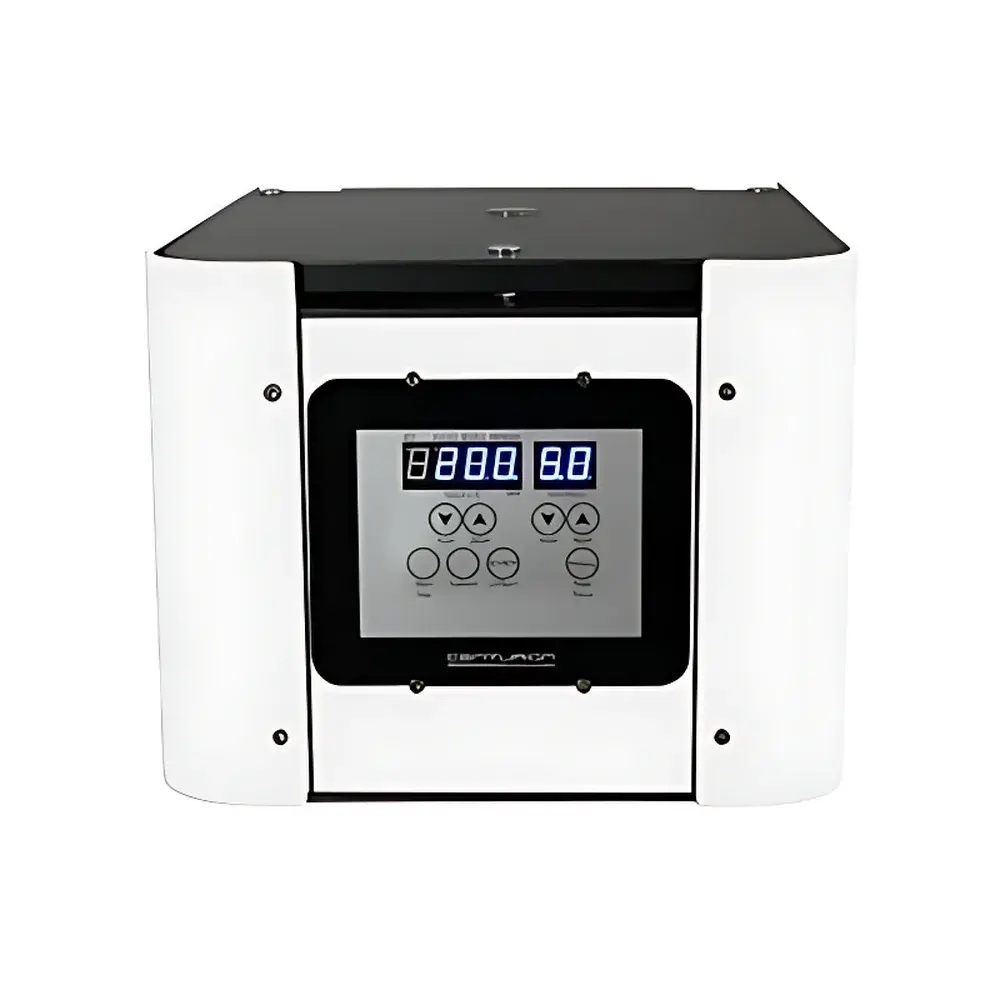
Centurion Scientific C2006 Benchtop Centrifuge
| Brand | Centurion Scientific |
|---|---|
| Origin | United Kingdom |
| Model | C2006 |
| Type | Benchtop Centrifuge |
| Maximum Speed | 6800 rpm |
| Maximum RCF | 3800 × g |
| Maximum Capacity | 6 × 50 mL |
| Dimensions | 27 × 32 × 47 cm |
| Weight (net) | 22 kg |
| Noise Level | <60 dB(A) |
| Timer Range | 0–99 min |
| Speed Accuracy | ±10 rpm |
| Speed Repeatability | ±1 rpm |
| Acceleration/Deceleration | 10-step programmable |
| Power Consumption | 160 W |
Overview
The Centurion Scientific C2006 is a compact, high-reliability benchtop centrifuge engineered for routine separation tasks in clinical diagnostics, microbiology, cell culture, and general laboratory workflows. It operates on the principle of sedimentation under controlled centrifugal force—generating radial acceleration to separate particles based on density, size, and shape within liquid suspensions. Designed for consistent low-to-medium speed applications (500–6800 rpm; up to 3800 × g), the C2006 is optimized for pelleting cells, bacteria, yeast, and subcellular organelles, as well as clarifying supernatants and preparing samples for downstream analysis such as ELISA, PCR, or electrophoresis. Its robust steel-alloy chassis, stainless-steel rotor chamber, and precision-engineered brushless DC motor ensure long-term mechanical stability and minimal thermal drift during extended operation.
Key Features
- Intuitive blue LED display with dual-mode speed selection: user-defined RPM or calculated RCF (× g), enabling method transfer across instruments and laboratories.
- Programmable 10-step acceleration and deceleration profiles—critical for preserving delicate biological structures (e.g., intact bacterial membranes or fragile extracellular vesicles) during spin-down.
- 10 pre-storable protocols with recall functionality, supporting standardized operating procedures (SOPs) and reducing operator-dependent variability.
- “Pulse” (short-run) mode: 1–90 second timed spins for gentle mixing or resuspension of pellets without full-speed rotation.
- Four-point lid locking mechanism with integrated lid presence sensor—prevents operation unless fully closed and latched, complying with IEC 61010-2-020 safety requirements for laboratory centrifuges.
- Real-time imbalance detection with automatic deceleration and audible/visual alert; self-resetting after correction—ensuring rotor integrity and operator safety.
- Integrated overspeed protection and motor overheat sensing, both independently monitored by embedded microcontroller firmware.
- Low acoustic signature (<60 dB[A] at maximum load), suitable for shared lab environments and laminar flow hoods.
Sample Compatibility & Compliance
The C2006 accommodates standard conical-bottom tubes (15 mL and 50 mL) via two interchangeable fixed-angle rotors: BRK5412 (12 × 15 mL, max 6000 rpm / 3800 × g) and BRK5406 (6 × 50 mL, max 6000 rpm / 3800 × g). All rotors are CE-marked and certified to ISO 13485-compliant manufacturing standards. The unit meets EN 61010-1 (electrical safety) and EN 61010-2-020 (particular safety requirements for centrifuges), and its design supports GLP/GMP-aligned documentation practices—including audit-trail-capable parameter logging when interfaced with external data acquisition systems.
Software & Data Management
While the C2006 operates as a standalone instrument with no built-in network interface, its programmable parameters (time, speed, acceleration/deceleration ramps) are retained in non-volatile memory and persist through power cycles. For laboratories requiring electronic record keeping, optional RS-232 or USB-to-serial adapters enable connection to LIMS or ELN platforms. When paired with validated third-party software, the device supports 21 CFR Part 11-compliant user authentication, electronic signatures, and immutable run logs—facilitating regulatory submissions in pharmaceutical QC and clinical testing environments.
Applications
- Routine pelleting of mammalian cells (e.g., HEK293, CHO) and microbial cultures (E. coli, S. cerevisiae) prior to lysis or media exchange.
- Clarification of serum, plasma, or tissue homogenates prior to protein quantification or immunoassay.
- Preparation of bacterial lysates for plasmid isolation or genomic DNA extraction.
- Separation of phase layers in phenol-chloroform extractions (e.g., TRIzol®-based RNA isolation).
- Processing of whole blood for serum or plasma separation in point-of-care or satellite lab settings.
- Quality control of reagent suspensions and colloidal formulations where particle settling kinetics must be reproducibly assessed.
FAQ
What safety certifications does the C2006 hold?
The unit complies with IEC/EN 61010-1 and IEC/EN 61010-2-020, including mechanical, electrical, and thermal hazard mitigation. It carries CE marking for the European Economic Area.
Can the C2006 be used for clinical diagnostic sample preparation under CLIA or CAP guidelines?
Yes—its precision speed control (±10 rpm), repeatability (±1 rpm), and programmable SOP storage support traceable, auditable workflows required by CLIA-waived and moderate-complexity testing environments.
Is rotor balancing required before each run?
While the four-point lock and imbalance detection system mitigate risk, manual symmetrical loading remains mandatory per ISO 21501-4 and manufacturer instructions to prevent premature bearing wear and ensure optimal RCF delivery.
Does the C2006 support temperature-controlled operation?
No—the C2006 is a non-refrigerated model. For temperature-sensitive applications (e.g., enzyme assays or cold-active protein purification), users should pre-chill samples and rotors and minimize run duration.
What maintenance intervals are recommended?
Annual inspection of rotor threads, lid latch integrity, and calibration verification (speed and timer) is advised. Brushless motor design eliminates carbon brush replacement; no scheduled lubrication is required.
Related Products



