
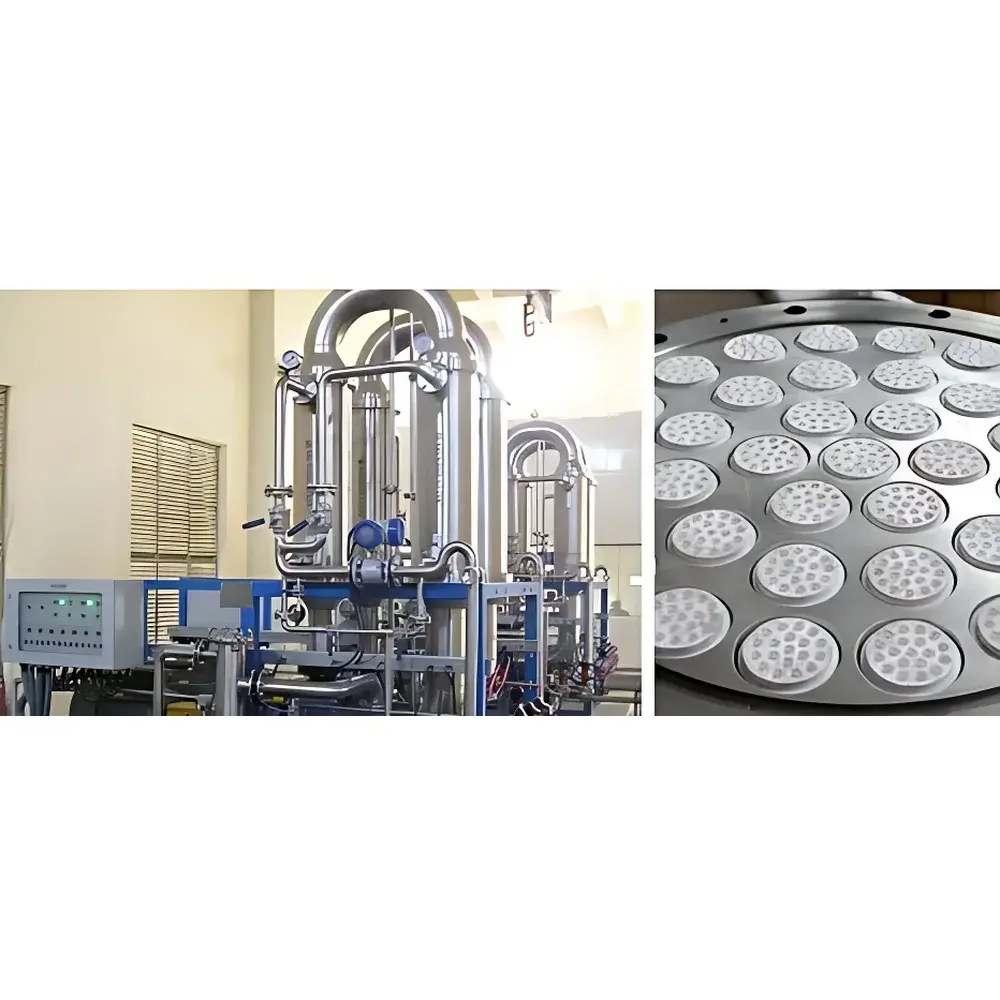
Ceramic Membrane Filtration System – Xinbaili (New Biolink) CM-Series
| Brand | Xinbaili (New Biolink) |
|---|---|
| Origin | Beijing, China |
| Manufacturer Type | Authorized Distributor |
| Product Category | Domestic |
| Model | CM-Series Ceramic Membrane System |
| Application | Wastewater Treatment |
| Filtration Modes | Cross-flow Microfiltration (MF) and Ultrafiltration (UF) |
| Pore Size Range | 50 nm – 1.4 µm (MF) |
| Molecular Weight Cut-off (MWCO) | 8–50 kDa (UF) |
| Operating Temperature | Up to 120 °C |
| pH Tolerance | 0–14 |
| Max. Operating Pressure | ≤10 bar |
| Chemical Resistance | Compatible with strong acids, alkalis, oxidants (e.g., NaOCl, H₂O₂), and organic solvents |
| Cleaning Regime | CIP-compatible with alkaline, acidic, and enzymatic solutions |
| Typical Flux Recovery Rate | >95% after standard CIP |
Overview
The Xinbaili (New Biolink) CM-Series Ceramic Membrane Filtration System is a robust, pressure-driven cross-flow separation platform engineered for high-reliability purification and clarification of complex aqueous streams in laboratory and pilot-scale environments. Built upon asymmetric ceramic composite membranes—sintered from α-alumina (Al₂O₃), titania (TiO₂), or zirconia (ZrO₂)—the system leverages rigid inorganic architecture to deliver stable performance under thermally demanding, chemically aggressive, and biologically challenging conditions. Unlike polymeric membranes, ceramic membranes operate via size-exclusion and surface charge-mediated transport mechanisms within well-defined pore structures, enabling precise separation across microfiltration (0.05–1.4 µm) and ultrafiltration (8–50 kDa MWCO) regimes. This dual-mode capability supports both particulate removal (e.g., cells, colloids, suspended solids) and macromolecular fractionation (e.g., proteins, polysaccharides, humic substances), making the CM-Series suitable for process development, feasibility studies, and regulatory-compliant method validation in water treatment, bioprocessing, and food & beverage R&D.
Key Features
- High-temperature operational envelope (up to 120 °C), enabling in-line thermal sterilization and hot filtration without membrane degradation
- Exceptional mechanical integrity: fracture toughness >120 MPa, abrasion resistance compliant with ISO 6507-1, and pressure stability up to 10 bar (145 psi)
- Chemical resilience across full pH spectrum (0–14) and compatibility with cleaning agents including 2 M NaOH, 1 M HNO₃, 500 ppm NaOCl, and 3% H₂O₂
- High-flux design with low fouling propensity; typical pure-water flux ≥800 L/m²·h·bar at 25 °C (depending on module configuration)
- Modular tubular and multi-channel monolith configurations available for scalable flow path optimization and laminar-to-turbulent transition control
- Integrated backpulse capability (optional) to mitigate concentration polarization and extend run cycles between chemical clean-in-place (CIP) procedures
Sample Compatibility & Compliance
The CM-Series accommodates feed streams with total suspended solids (TSS) up to 15,000 mg/L and oil-in-water concentrations ≤500 ppm—ideal for pretreated landfill leachate, oily wastewater, fermentation broths, and plant-based extracts. All wetted components comply with FDA CFR Title 21 Part 177 (food-contact polymers) and EU Regulation (EC) No. 1935/2004. System design adheres to ISO 9001:2015 manufacturing protocols, while membrane modules meet ASTM D4185 (standard test method for determining pore size distribution of microporous membranes). For GLP/GMP-aligned workflows, optional audit-trail-enabled controllers support 21 CFR Part 11-compliant electronic records when paired with validated SCADA software.
Software & Data Management
The CM-Series integrates with New Biolink’s proprietary LabMembrane Control Suite—a Windows-based interface supporting real-time monitoring of transmembrane pressure (TMP), permeate flux, temperature, and differential pressure across feed-retentate-permeate loops. Data logging occurs at user-defined intervals (1–60 sec resolution) and exports natively to CSV, Excel, and SQL-compatible formats. Advanced analytics include automatic fouling index calculation (Silt Density Index, SDI), flux decay modeling, and CIP efficacy scoring based on pre- and post-cleaning permeability recovery. Optional OPC UA integration enables seamless interoperability with LIMS and MES platforms for traceable batch documentation.
Applications
- Wastewater reclamation: MBR integration for municipal leachate and industrial effluent polishing (meeting discharge limits per EPA 40 CFR Part 403)
- Biopharmaceutical downstream processing: Cell harvest and clarified lysate concentration prior to chromatography
- Food & beverage stabilization: Cold sterile filtration of fruit juices, vinegars, soy sauce, and wine without thermal degradation
- Oilfield water management: Removal of emulsified hydrocarbons and suspended solids from produced water for reinjection
- Enzyme and polysaccharide recovery: Fractionation of fermentation supernatants under non-denaturing pH/temperature conditions
FAQ
What is the expected service life of the ceramic membrane elements under routine lab use?
With proper CIP scheduling and avoidance of mechanical shock or thermal cycling beyond specifications, ceramic membrane modules typically exceed 5 years of continuous operation—validated by accelerated lifetime testing per ISO 15713.
Can this system be validated for GMP-compliant processes?
Yes. The CM-Series supports IQ/OQ/PQ documentation packages, including as-built schematics, calibration certificates for all pressure/flow/temperature sensors, and FAT/SAT reports. Optional 21 CFR Part 11 add-ons provide electronic signature, audit trail, and role-based access control.
Is membrane replacement required after each experiment?
No. Ceramic membranes are reusable and designed for >1,000 CIP cycles. Replacement frequency depends on feed matrix complexity—not experimental turnover—and is determined by sustained flux decline (>20% from baseline) uncorrected by standard cleaning protocols.
Does the system support automated cleaning sequences?
Standard configurations include programmable CIP routines with timed acid/alkali/enzyme dosing, recirculation flow control, and endpoint conductivity/pH verification—configurable via LabMembrane Control Suite.
Are custom pore sizes or module geometries available?
Yes. Xinbaili offers OEM membrane fabrication services for non-standard MWCOs (down to 1 kDa) and specialized channel counts (e.g., 7-, 19-, or 37-channel monoliths) subject to minimum order quantities and lead time confirmation.



