
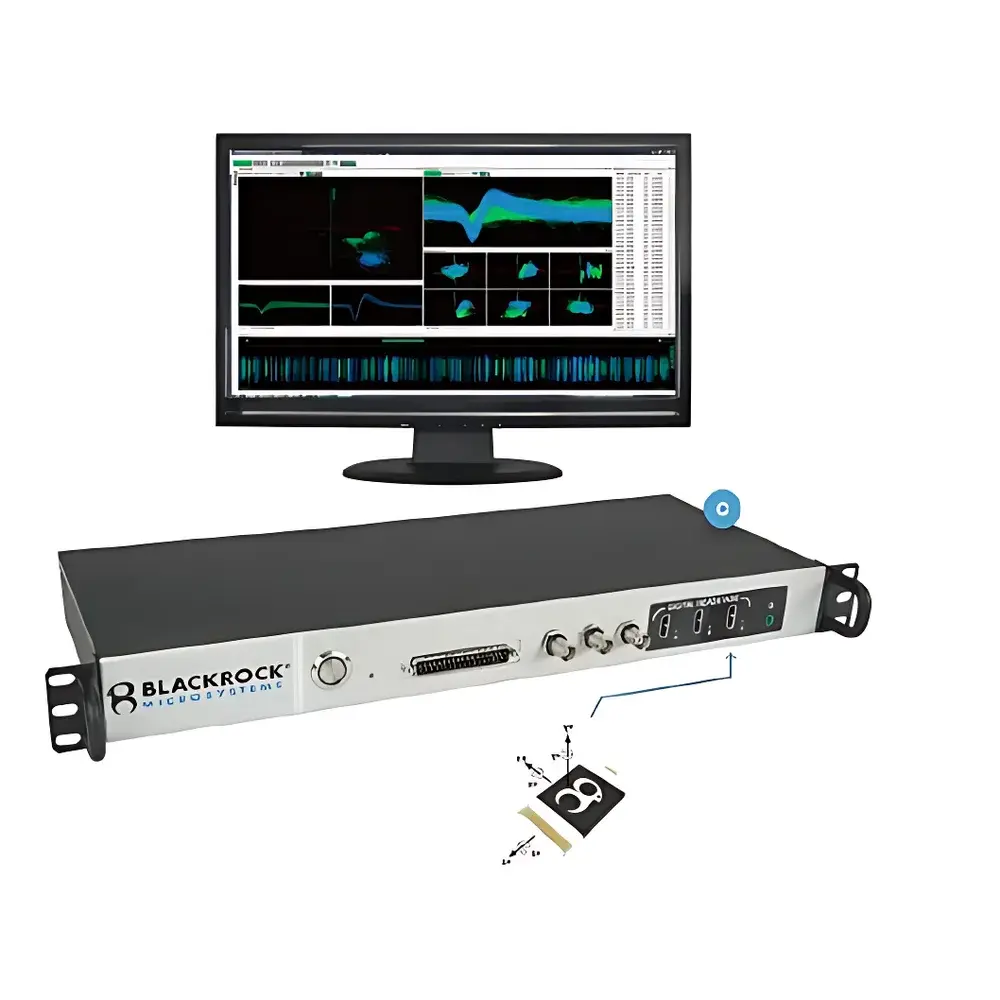
Cereplex Direct In Vivo Multichannel Neural Signal Recording System
| Origin | USA |
|---|---|
| Manufacturer Type | Authorized Distributor |
| Origin Category | Imported |
| Model | Cereplex Direct |
| Price Range | USD 14,000 – 70,000 |
Overview
The Cereplex Direct In Vivo Multichannel Neural Signal Recording System is a high-fidelity, real-time neural data acquisition platform engineered for rigorous preclinical neuroscience research. Developed by Blackrock Microsystems—a leader in intracortical neurotechnology—the system implements low-noise, front-end digitization architecture to preserve signal integrity from the electrode-tissue interface through to downstream analysis. It operates on the principle of extracellular electrophysiological recording: capturing voltage transients generated by neuronal action potentials (spikes) and local field potentials (LFPs) via chronically implanted microelectrode arrays. Designed for both head-fixed and freely behaving rodent or non-human primate preparations, the system supports closed-loop experimental paradigms by enabling synchronous acquisition of neural activity with behavioral metrics, optogenetic stimulation, and external device triggers. Its modular design centers on ultra-lightweight (1 g), 32-channel digital micro-amplifiers—each performing analog amplification, programmable analog filtering, and 16-bit analog-to-digital conversion at the probe site—minimizing electromagnetic interference and cable-induced artifacts common in traditional analog-only systems.
Key Features
- Scalable channel capacity: Base configuration supports up to 96 channels; expandable to 256 channels via multi-unit synchronization.
- Front-end digitization: Analog-to-digital conversion performed within millimeters of the electrode tip, eliminating analog transmission noise over extended cabling.
- Integrated inertial sensing: Onboard 3-axis accelerometer and gyroscope capture fine-scale animal motion dynamics, time-synchronized with neural data for behavior–neurophysiology correlation.
- Real-time impedance monitoring: Continuous, non-invasive electrode impedance assessment ensures stable recording quality and aids in post-hoc artifact rejection.
- Flexible interfacing: Native compatibility with CerePort™, MultiPort™, ICS-96, and Rodent-specific connectors; supports Utah Slanted Electrode Arrays (USEAs), silicon probes, microwire bundles, and custom microelectrode configurations.
- Dual sampling modes: Configurable sampling rates of 30 kHz or 60 kHz per channel, with simultaneous acquisition of raw broadband signals, spike waveforms, and LFPs.
- Optogenetics-ready integration: Optional opto-electrical commutator enables synchronized delivery of 1-channel laser light with 32-channel electrophysiological recording—critical for causal circuit interrogation.
Sample Compatibility & Compliance
The Cereplex Direct system accommodates a broad spectrum of in vivo preparation models, including acute and chronic implants in mice, rats, non-human primates, and human clinical trial settings (under IRB/ethics approval). It interfaces seamlessly with standard stereotaxic implantation tools (e.g., electrode inserters, microdrives) and supports biocompatible electrode materials including iridium oxide, platinum-iridium, and tungsten. From a regulatory standpoint, the hardware and associated software modules comply with GLP-aligned data integrity practices. BOSS offline spike sorting software and NeuroExplorer analytics platform support audit trails, user access control, and metadata embedding—facilitating alignment with FDA 21 CFR Part 11 requirements for electronic records in translational and clinical-stage neuroengineering studies. The system adheres to ISO 14155:2020 principles for good clinical practice in medical device trials involving neural interfaces.
Software & Data Management
The Cereplex Direct ecosystem includes a unified software suite for acquisition, visualization, preprocessing, and analysis. Real-time acquisition software provides configurable digital filtering (FIR/IIR), differential referencing, and live oscilloscope display. Spike detection and classification are supported in both online and offline modes using multiple validated algorithms—including Hoops (manual thresholding), Manual PCA, K-means PCA, and DBSCAN PCA—enabling rigorous cluster validation across recording sessions. All acquired data are stored in standardized, open-format binary files (e.g., .ns6, .nev) compatible with MATLAB, Python (Neo, MNE-Python), and commercial platforms such as Plexon Offline Sorter and Spike2. The included neural signal simulator allows controlled validation of detection thresholds and classifier performance under defined noise conditions. Data export supports CSV, HDF5, and NWB 2.0 formats to ensure interoperability with FAIR-compliant neuroscience repositories.
Applications
- Basic cortical circuit mapping: Characterizing functional connectivity, receptive field properties, and interneuron subtype contributions in visual, motor, and hippocampal cortices.
- Brain–machine interface (BMI) development: Real-time decoding of movement intention for prosthetic control, validated in NHP and human pilot studies.
- Epilepsy network analysis: High-temporal-resolution tracking of seizure onset zones and propagation pathways using chronic LFP and multiunit spiking.
- Neuromodulation mechanism studies: Closed-loop responsive neurostimulation informed by real-time neural state detection.
- Sensory coding and perception: Quantifying how PV+ and SOM+ interneuron populations shape stimulus discriminability, as demonstrated in landmark Nature Communications studies on visual cortex reliability.
- Peripheral nerve interfacing: Bidirectional communication with residual limb nerves using USEA implants—enabling restoration of proprioception and motor volition in amputees.
FAQ
What is the maximum number of simultaneously recordable channels?
The base Cereplex Direct host supports up to 96 channels; expansion to 256 channels is achievable via synchronized multi-host operation.
Does the system support wireless recording?
No—the Cereplex Direct is a wired, low-latency, high-bandwidth system optimized for signal fidelity. Wireless variants (e.g., Cereplex W) are available separately.
Can I use third-party electrodes with this system?
Yes—provided they conform to Blackrock’s mechanical and electrical interface standards (e.g., CerePort™ pinout, impedance range, and connector geometry). Custom adapter solutions are available upon request.
Is the software compatible with Linux or only Windows?
Acquisition and real-time visualization software runs exclusively on Windows 10/11 (64-bit). Offline analysis tools (BOSS, NeuroExplorer) and exported data are fully compatible with Linux and macOS environments via script-based workflows.
How is data security and traceability ensured during long-term experiments?
All sessions generate immutable metadata logs, including timestamps, hardware configuration, user credentials, and calibration parameters. Software supports role-based access control and encrypted project archives compliant with institutional data governance policies.




