
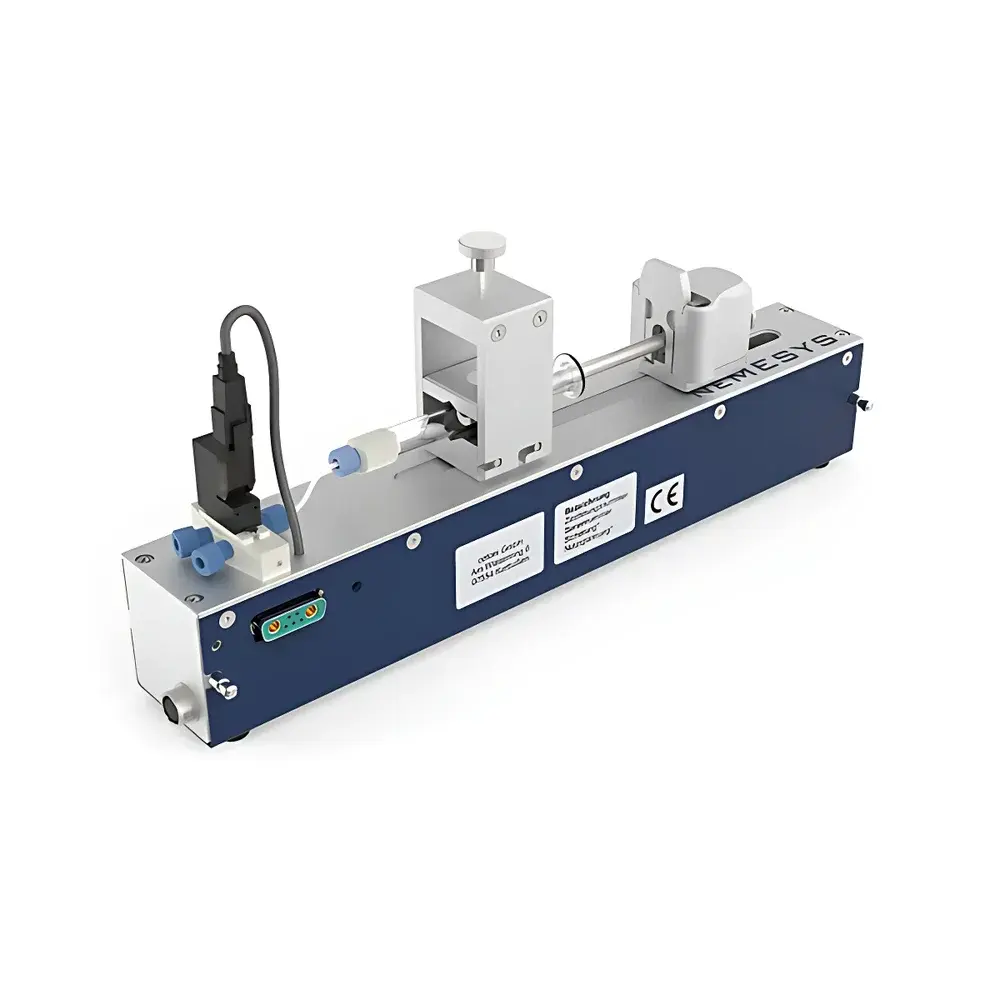
Cetoni neMESYS 290N Low-Pressure Precision Syringe Pump
| Brand | CETONI |
|---|---|
| Origin | Germany |
| Model | neMESYS 290N |
| Instrument Type | Microfluidic Syringe Pump |
| Flow Control Range | 0.006–152.6 mL/min (dependent on syringe size and gear ratio) |
| Minimum Flow Rate | 0.006 mL/min (6 µL/min) down to sub-µL/min equivalent in nanoliter-per-second resolution |
| Pressure Stages | 3 bar / 6 bar / 10 bar |
| Syringe Compatibility | Outer diameter 6–30 mm |
| Drive Mechanism | Servo motor with integrated PID control |
| Repeatability | Pulse-free, high-stability fluid delivery |
| Modular Architecture | Stackable with other neMESYS pumps and Qmix microfluidic modules |
| Software Suite | QmixElements GUI + SDK + LabVIEW drivers |
| Valve Integration | Integrated replaceable 3/2-way valve |
| Gear Ratios | 14:1 and 29:1 options |
Overview
The Cetoni neMESYS 290N is a low-pressure, servo-driven precision syringe pump engineered for pulse-free, high-reproducibility microfluidic dosing in research and analytical laboratories. Based on closed-loop PID-controlled servo motor actuation and direct linear displacement of the syringe plunger, the neMESYS 290N delivers stable volumetric flow across a wide dynamic range—from nanoliter-per-second regimes up to 152.6 mL/min—without flow pulsation or mechanical backlash. Its core architecture eliminates traditional stepper-motor limitations by integrating real-time position feedback, enabling consistent flow profiles essential for applications requiring temporal fidelity, such as cell perfusion, microreactor feeding, or sequential reagent injection in assay development. Designed and manufactured in Germany, the system complies with CE marking requirements and adheres to IEC 61000-6-2/6-4 electromagnetic compatibility standards.
Key Features
- Pulse-free fluid delivery enabled by high-resolution servo positioning and adaptive PID regulation
- Three selectable pressure stages: 3 bar, 6 bar, and 10 bar—optimized for low-viscosity aqueous solutions, polymer precursors, and light organic solvents
- Modular stacking capability: multiple neMESYS 290N units can be mechanically and electrically synchronized via EtherCAT bus for multi-channel parallel operation
- Universal syringe holder accommodating glass or stainless-steel syringes with outer diameters from 6 mm to 30 mm
- Integrated 3/2-way directional valve allows automatic switching between aspiration and dispensing without manual syringe or tubing reconfiguration
- Dual gear ratio options (14:1 and 29:1) provide flexibility between higher torque (for viscous media) and finer positional resolution (for ultra-low-flow applications)
- Full software stack included: QmixElements GUI for intuitive graphical programming, real-time pressure and flow visualization, script-based automation, and audit-trail-ready operation logs
Sample Compatibility & Compliance
The neMESYS 290N supports a broad range of chemically compatible fluids—including aqueous buffers, cell culture media, low-concentration polymer solutions, and mild organic solvents—when used with appropriate syringe materials (e.g., borosilicate glass or 316 stainless steel). It is not intended for use with highly corrosive, abrasive, or high-vapor-pressure solvents without prior validation. The system meets ISO 13485-aligned manufacturing practices and supports GLP/GMP workflows through QmixElements’ configurable user access levels, electronic signature support, and 21 CFR Part 11-compliant data integrity features—including immutable timestamps, operator identification, and change history tracking. All firmware and software updates are traceable and version-controlled per IEC 62304 requirements.
Software & Data Management
QmixElements serves as the unified control environment for the neMESYS platform. It provides drag-and-drop graphical programming for complex fluid sequences (e.g., timed multi-step injections, conditional valve actuation, pressure-triggered events), real-time monitoring of actual plunger position, flow rate estimation, and system pressure. The included SDK enables integration into custom MATLAB, Python (via PyQmix), or C# applications, while native LabVIEW VIs allow seamless incorporation into existing NI-based test benches. All operational parameters, executed commands, and sensor readings are logged in timestamped, searchable CSV or SQLite formats—with optional encryption and network backup to centralized lab servers.
Applications
- Microfluidic chip priming and continuous reagent delivery in organ-on-a-chip and microphysiological systems
- Controlled cell seeding and perfusion in 3D bioreactors and scaffold-based tissue engineering platforms
- Sequential injection in micro-ELISA, digital droplet PCR, and multiplexed immunoassays
- Precise metering of catalysts or initiators in microscale polymerization and photochemical synthesis
- Low-shear sample introduction for rheological characterization of shear-thinning biological fluids
- Dynamic fluid replacement in live-cell imaging chambers and electrophysiology setups
- Calibration and validation of flow sensors and micro-PIV systems
FAQ
What syringe sizes are supported by the neMESYS 290N?
Syringes with outer diameters from 6 mm to 30 mm are mechanically compatible—including standard Luer-lock glass and stainless-steel variants ranging from 10 µL to 50 mL capacity.
Can multiple neMESYS 290N units be synchronized?
Yes—up to 64 axes can be coordinated over EtherCAT with sub-millisecond timing accuracy, enabling true parallel multi-channel flow control.
Is the system suitable for GMP-regulated environments?
When deployed with QmixElements’ audit trail, electronic signatures, and configuration lockdown features, it fulfills core data integrity expectations under FDA 21 CFR Part 11 and EU Annex 11.
Does the neMESYS 290N require recalibration after syringe changes?
No—automatic syringe detection and plunger position homing eliminate manual zero-point adjustments; calibration is retained per syringe ID when using encoded syringes.
How is pressure regulated during operation?
Pressure is maintained via closed-loop force feedback from the servo motor’s current draw, with three preset mechanical limit stages (3/6/10 bar) enforced by internal overload protection circuits.



