
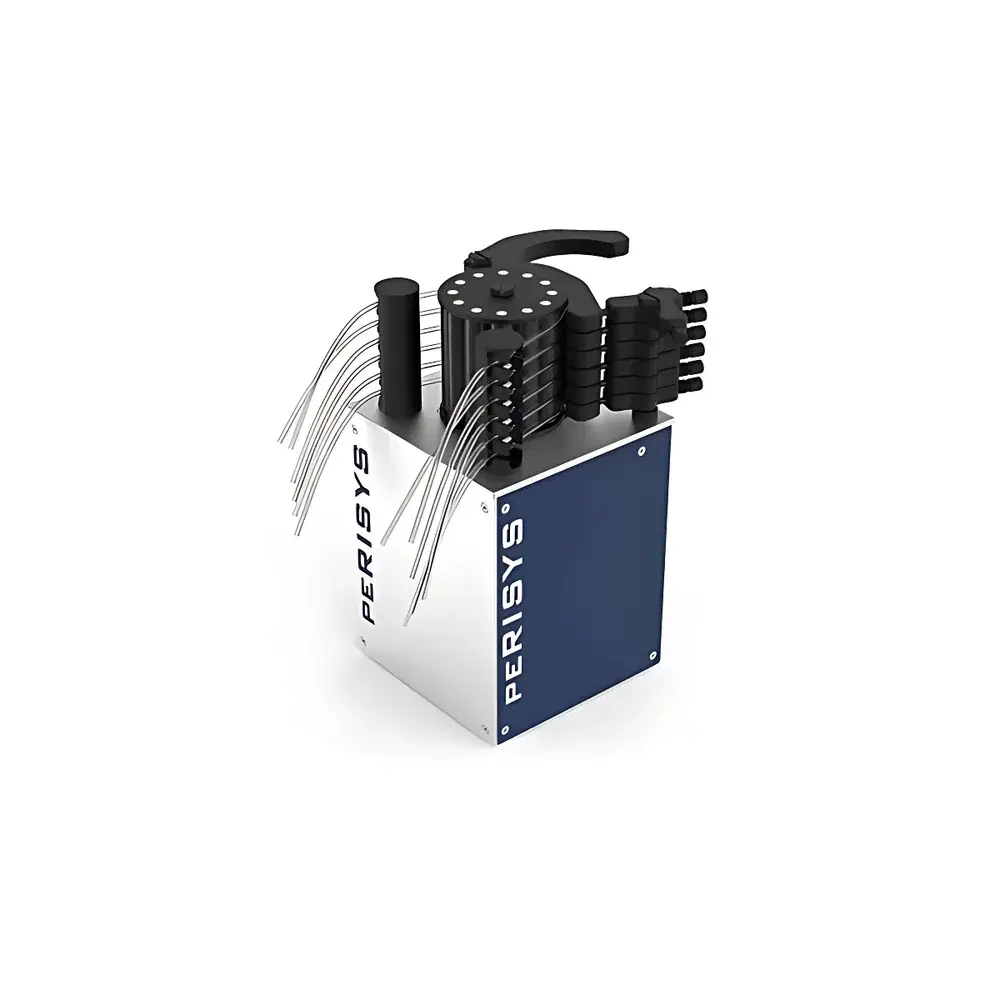
Cetoni peRISYS-S Microfluidic Peristaltic Pump
| Brand | Cetoni |
|---|---|
| Origin | Germany |
| Model | peRISYS-S |
| Pump Type | Peristaltic Pump |
| Channel Configuration | Up to 6 independent channels (field-configurable) |
| Drive Mechanism | 12-roller peristaltic head |
| Flow Rate Range | 0.0004–19.2 mL/min (dependent on capillary inner diameter: 0.13–2.79 mm) |
| Software Integration | QmixElements (multi-pump control up to 32 units), Qmix SDK, LabVIEW drivers |
| System Compatibility | neMESYS and Qmix fluidic platforms |
| Compliance | Designed for GLP/GMP-aligned lab environments |
Overview
The Cetoni peRISYS-S is a precision-engineered microfluidic peristaltic pump designed for low-pulsation, high-reproducibility fluid handling in demanding laboratory and automated fluidic systems. Based on the proven principle of positive displacement via sequential roller compression of elastomeric tubing, the peRISYS-S employs a 12-roller peristaltic head architecture to minimize flow pulsation and maximize volumetric accuracy—critical for applications such as cell culture perfusion, microreactor feeding, organ-on-chip media delivery, and analytical sample introduction. Its modular mechanical design enables rapid reconfiguration from single- to six-channel operation without tools, making it uniquely adaptable to evolving experimental workflows while maintaining traceable, repeatable performance across all channels.
Key Features
- Tool-free channel expansion: Adjustable pressure bracket allows mechanical conversion from 1 to 6 independent pumping channels by simply tightening or loosening set screws—no disassembly or recalibration required.
- Multi-diameter capillary compatibility: Supports fused silica, PTFE, and fluorinated ethylene propylene (FEP) capillaries with inner diameters ranging from 0.13 mm to 2.79 mm, enabling flow rate tuning from 0.0004 mL/min up to 30.6 mL/min per channel (depending on tubing ID and rotational speed).
- Low-pulsation fluid delivery: The 12-roller geometry ensures overlapping occlusion zones, reducing flow ripple to <±1.5% (measured at constant RPM under steady-state conditions with 0.51 mm ID FEP tubing), essential for shear-sensitive biological samples.
- Scalable system integration: Each peRISYS-S unit features standardized digital I/O and RS485 communication interfaces, supporting daisy-chaining and synchronized control of up to 32 pumps via a single host controller.
- Rugged industrial-grade construction: CNC-machined aluminum housing, IP54-rated enclosure, and brushless DC motor ensure long-term stability in continuous-duty laboratory environments.
Sample Compatibility & Compliance
The peRISYS-S is compatible with a wide range of chemically resistant microbore tubing materials—including FEP, PFA, silicone, and Viton—enabling safe handling of aqueous buffers, organic solvents, and mildly corrosive reagents. Its non-invasive pumping mechanism eliminates risk of sample contamination or degradation associated with piston seals or diaphragm fatigue. When deployed within validated workflows using QmixElements software configured with electronic signature and audit trail modules, the system supports compliance with ISO/IEC 17025, ASTM D3418 (for viscosity-related fluid handling validation), and FDA 21 CFR Part 11 requirements for electronic records and signatures. Routine calibration verification can be performed using gravimetric or timed-volume methods aligned with ISO 8655-4 for peristaltic pump accuracy assessment.
Software & Data Management
Cetoni provides comprehensive software support through QmixElements—a Windows-based graphical interface that enables real-time monitoring, multi-pump scheduling, and script-driven protocol execution. Users can define complex fluidic sequences (e.g., gradient mixing, timed bolus injection, bidirectional perfusion) and export timestamped CSV logs containing flow rate, elapsed time, error status, and motor current data. For custom automation, the Qmix SDK delivers native C++, Python, and LabVIEW APIs with full access to low-level device registers, including microstep position feedback and thermal sensor readings. All software components are version-controlled, digitally signed, and documented per IEC 62304 Class B medical device software standards—facilitating integration into regulated QC/QA and GMP manufacturing support systems.
Applications
- Microphysiological systems: Stable, pulse-free perfusion of endothelialized microchannels and 3D tissue constructs in organ-on-chip platforms.
- Automated assay preparation: Precise metering of reagents and standards in ELISA, PCR setup, and high-throughput screening workflows.
- Chromatography auxiliary delivery: Low-flow mobile phase blending and column washing in nanoLC and capillary electrophoresis systems.
- Cell therapy process development: Controlled feeding and waste removal in bioreactor-scale-up studies and closed-system expansion protocols.
- Environmental sensor calibration: Traceable dispensing of certified reference materials for dissolved oxygen, pH, and conductivity probe validation.
FAQ
Can the peRISYS-S operate in sterile or cleanroom environments?
Yes—the pump head and tubing path are fully accessible for autoclaving (up to 121°C, 2 bar) or gamma irradiation (25 kGy); however, the main electronics housing must remain outside the sterilization zone. Sterile tubing manifolds may be pre-assembled and connected via Luer-lock or Swagelok fittings.
Is flow rate calibration traceable to national standards?
While the peRISYS-S itself is not NIST-traceable out-of-the-box, its linear flow-RPM relationship allows end-user calibration against gravimetric or volumetric standards compliant with ISO 8655-4. Cetoni provides calibration templates and uncertainty calculation worksheets upon request.
What safety mechanisms prevent tube rupture or dry-running damage?
The integrated motor controller monitors current draw and rotational consistency; abnormal load profiles trigger immediate stop-and-hold action, logged with event timestamp and error code. Optional external pressure sensors can be interfaced via analog input for overpressure cutoff.
How does multi-pump synchronization achieve sub-millisecond timing accuracy?
All peRISYS-S units on a shared RS485 bus derive timing from a common master clock signal generated by the host PC or Qmix Controller. Internal hardware timers resolve command execution to ±100 µs, verified under load using oscilloscope-triggered photodiode detection on LED status indicators.
Does QmixElements support remote access or cloud-based monitoring?
Local network access (LAN/Wi-Fi) is supported via standard HTTP API endpoints; however, direct cloud connectivity is not implemented for security reasons. Customers may deploy their own secure reverse proxy or integrate with enterprise SCADA/MES platforms using RESTful webhooks and TLS 1.2 encryption.
Related Products



