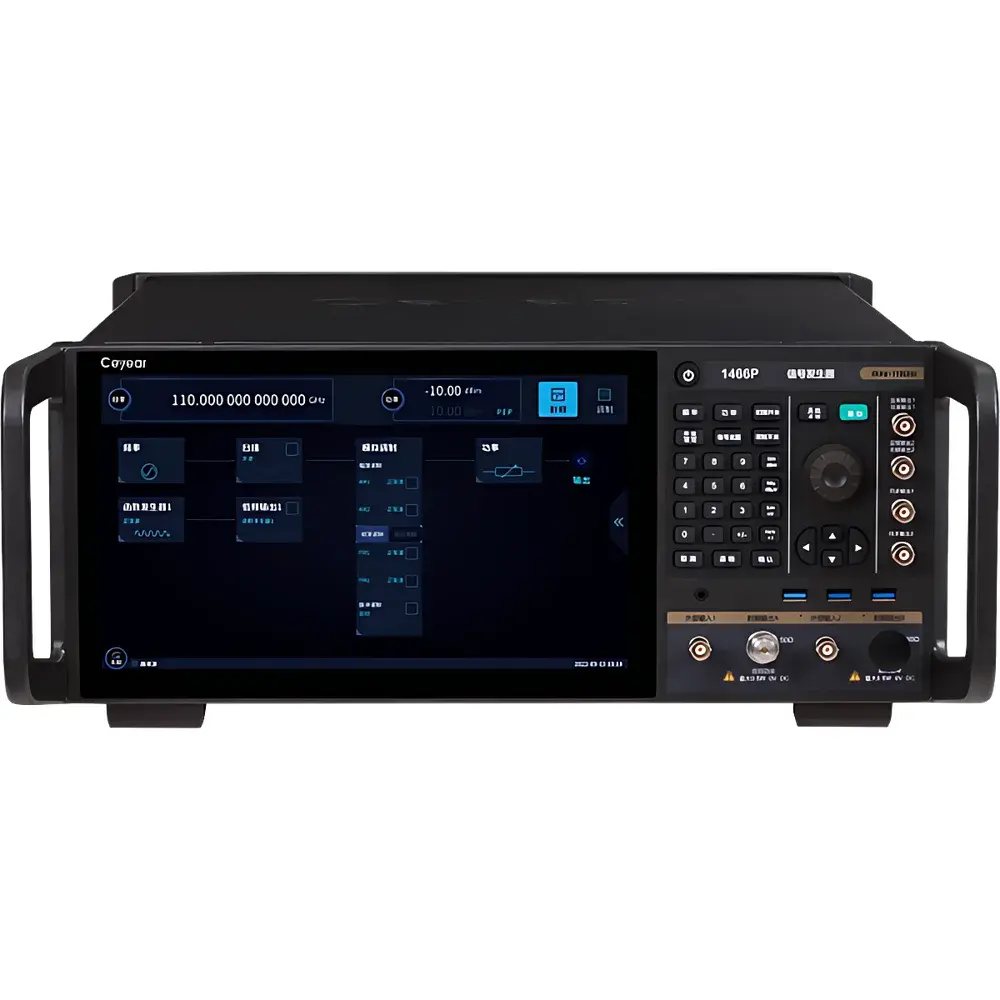
Ceyear 1466 Series Microwave Signal Generator
| Brand | Ceyear |
|---|---|
| Model | 1466 Series |
| Type | Analog Microwave Signal Generator |
| Frequency Range | 6 kHz to 110 GHz (coaxial, standard) |
| Phase Noise | –132 dBc/Hz @ 10 GHz carrier, 10 kHz offset (typ.) |
| Spurious | < –80 dBc @ 10 GHz carrier |
| Harmonics | < –55 dBc |
| Output Power Range | –150 dBm to +25 dBm (configurable, >170 dB dynamic range) |
| Modulation | AM, FM, ΦM, Pulse (min. pulse width 20 ns), complex pulse modes (dual-pulse, burst, PRI stagger/jitter/ramp) |
| Scan Modes | Stepped, List, Analog (ramp), Power Sweep |
| Touchscreen Interface | 11.6″ HD capacitive display |
| Remote Control | SCPI-compliant, web browser & cross-platform client support, SCPI script recording & auto-generation for C++, C#, Qt, MATLAB, LabVIEW |
Overview
The Ceyear 1466 Series Microwave Signal Generator is a high-performance, analog-based microwave test instrument engineered for demanding applications in radar systems validation, 5G mmWave RF conformance testing, aerospace avionics characterization, and defense electronic warfare (EW) subsystem evaluation. Operating on direct coaxial synthesis architecture—without mandatory external upconversion—this series delivers continuous, calibrated signal generation from 6 kHz to 110 GHz in a single instrument platform. Its design adheres to fundamental microwave metrology principles: phase-locked loop (PLL)-based frequency synthesis combined with ultra-low-noise voltage-controlled oscillators (VCOs), high-linearity power amplification stages, and precision digital attenuator arrays. The absence of external harmonic mixers or multiplier chains eliminates insertion loss uncertainty, amplitude ripple, and calibration drift inherent in legacy external frequency extension approaches—ensuring traceable amplitude accuracy (< ±0.5 dB typical below 20 GHz) and long-term spectral stability required for GLP-compliant component-level verification and system-level over-the-air (OTA) measurements.
Key Features
- Coaxial frequency coverage up to 110 GHz—eliminates need for external frequency converters in most mmWave test setups
- Exceptional spectral purity: SSB phase noise of –132 dBc/Hz (10 GHz carrier, 10 kHz offset), –161 dBc/Hz broadband noise floor (20 GHz carrier, 30 MHz offset)
- Ultra-wide output power dynamic range exceeding 170 dB (–150 dBm to +25 dBm, user-configurable)
- Dual independent RF channels—each fully programmable for frequency, power, modulation, and sweep parameters
- Comprehensive analog modulation suite: AM, FM, ΦM, and advanced pulse modulation including dual-pulse, burst, PRI stagger/jitter/ramp
- Multi-mode scanning: stepped, list, analog (ramp), and power sweep—supporting automated receiver sensitivity mapping and filter response characterization
- 11.6-inch high-resolution capacitive touchscreen with signal-flow diagram interface and customizable soft-key menus
- Native SCPI command recording with one-click export and automatic generation of driver examples for MATLAB, LabVIEW, C++, C#, and Qt environments
Sample Compatibility & Compliance
The 1466 Series is designed for compatibility with industry-standard test fixtures, waveguide-to-coaxial adapters (WR-10, WR-08, etc.), and calibrated power sensors from Keysight, Rohde & Schwarz, and Anritsu. Its amplitude accuracy and phase noise performance meet the technical requirements for compliance testing per IEEE Std 802.11ay, 3GPP TS 38.141-1 (NR FR2), and MIL-STD-461G radiated emissions pre-scan validation. While not certified as a safety-critical device, its firmware architecture supports audit-ready operation under ISO/IEC 17025-accredited laboratories: full SCPI command logging, timestamped parameter change history, and user-accessible configuration snapshots enable reproducible test method documentation aligned with GLP and internal QA procedures. Optional hardware security modules (HSM) and role-based access control (RBAC) configurations are available for GxP-regulated environments requiring FDA 21 CFR Part 11 electronic record integrity.
Software & Data Management
The embedded Linux-based operating system provides native support for LXI Class C (LAN eXtensions for Instrumentation) and IVI-COM drivers. All remote operations—including real-time waveform streaming, multi-instrument synchronization via PXIe timing backplane (when integrated into modular test systems), and concurrent multi-client sessions—are governed by deterministic TCP/IP protocols with sub-millisecond latency. The built-in web server enables secure HTTPS access from any modern browser (Chrome, Edge, Safari), supporting TLS 1.2 encryption and configurable session timeouts. SCPI command sequences are stored in UTF-8 encoded .csv logs with millisecond-precision timestamps, compatible with third-party data analysis tools such as Python’s Pandas, JMP, or DIAdem. For enterprise deployment, the instrument supports integration with TestStand sequence editors and custom REST API wrappers via optional software development kit (SDK).
Applications
- Radar front-end testing: chirp linearity verification, ADC/DAC dynamic range assessment, and T/R module gain compression analysis
- 5G NR FR2 OTA chamber calibration: reference signal generation for channel sounder synchronization and beamforming pattern validation
- Satellite payload transponder characterization: LO injection testing, intermodulation distortion (IMD3/IMD5) measurement, and adjacent channel leakage ratio (ACLR) evaluation
- Millimeter-wave material property analysis: free-space transmission/reflection measurements using vector network analyzer (VNA) stimulus-response pairing
- Electronic warfare receiver testing: dynamic range mapping, spurious response identification, and pulse descriptor word (PDW) fidelity verification
FAQ
Does the 1466 Series support external frequency conversion beyond 110 GHz?
Yes—optional integration with Ceyear 8240X series harmonic mixer-based frequency extenders enables operation up to 750 GHz in waveguide bands (e.g., WR-1.5, WR-1.0). Calibration files for each extender are factory-loaded and automatically applied during frequency switching.
Is the instrument compliant with IEEE 1588 Precision Time Protocol (PTP)?
No—PTP support is not implemented. However, it provides 10 MHz and 100 MHz reference input/output ports for phase-coherent synchronization with other instruments in a rack-mounted ATE system.
Can the touch interface be disabled for secure lab environments?
Yes—GUI lock mode can be enabled via password-protected system settings, restricting all local interaction to front-panel rotary encoder and dedicated function keys.
What is the maximum update rate for power level changes during a sweep?
The instrument achieves ≤ 500 µs settling time for power steps within ±5 dB of current setting; full-range transitions (e.g., –100 dBm → +20 dBm) require ≤ 2 ms under default calibration mode.
Are firmware updates field-installable without returning the unit to service center?
Yes—signed firmware packages (.bin files) can be loaded via USB drive or SCP transfer; update process includes automatic backup of current calibration coefficients and rollback capability.