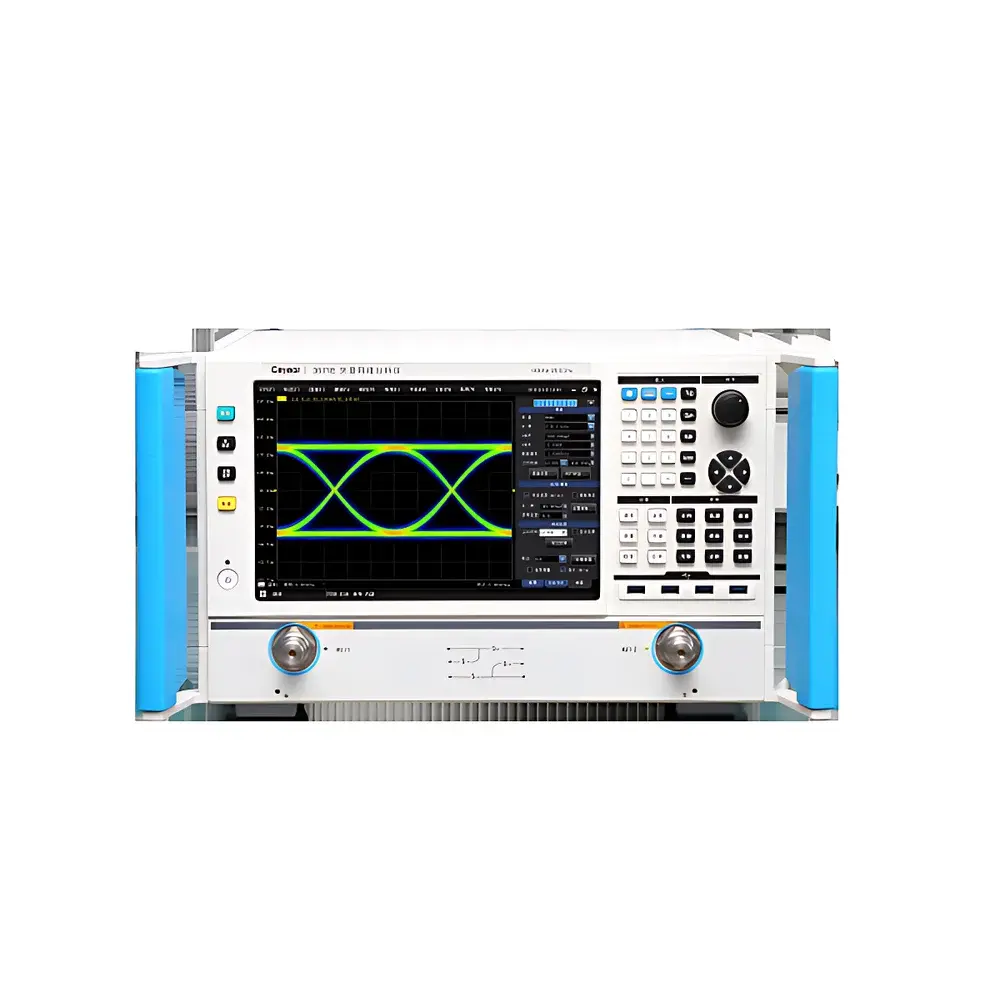
Ceyear 3671 Series Vector Network Analyzer
| Brand | Ceyear |
|---|---|
| Origin | Shandong, China |
| Manufacturer Type | Original Equipment Manufacturer (OEM) |
| Country of Origin | China |
| Model | 3671 Series (3671C: 100 kHz–14 GHz |
| 3671D | 100 kHz–20 GHz |
| 3671E | 100 kHz–26.5 GHz |
| 3671G | 10 MHz–43.5 GHz) |
| Calibration Options | Response, One-Port, Response-Isolation, Enhanced Response, Full Two-Port SOLT, TRL, Electronic Calibration (ECal) |
| Display Formats | Log Magnitude, Linear Magnitude, SWR, Phase, Group Delay, Smith Chart, Polar Plot |
| Interfaces | USB 2.0/3.0, LAN (10/100/1000BASE-T), GPIB (IEEE-488.2), VGA, HDMI |
| Dynamic Range | >120 dB (typ. at 1 GHz, 10 Hz IFBW) |
| Sweep Speed | 43 ms for 201 points across full frequency range (600 kHz IF bandwidth, typical) |
| Software Compliance | Supports ASTM E29, ISO/IEC 17025 traceability workflows, GLP/GMP audit trail logging (via optional secure firmware mode) |
| Optional Modules | Time-Domain Reflectometry (TDR), Advanced Time-Domain Analysis (including virtual eye diagram generation, jitter/noise injection, pre-emphasis/CTLE equalization simulation), Automatic Fixture Removal (AFR) |
Overview
The Ceyear 3671 Series Vector Network Analyzer (VNA) is a high-performance, modular microwave measurement platform engineered for precision characterization of linear RF and microwave components across frequencies from 100 kHz up to 43.5 GHz. Based on heterodyne superheterodyne architecture with fundamental mixing reception, the instrument delivers high dynamic range, low phase noise, and excellent measurement repeatability—critical for R&D validation, production line testing, and compliance verification in defense electronics, aerospace subsystems, 5G/6G infrastructure, and high-speed digital interconnect development. Its hardware architecture integrates dual-source synthesis, real-time digital IF processing, and temperature-stabilized RF front-ends to ensure consistent S-parameter accuracy under varying environmental conditions. Unlike legacy VNAs, the 3671 series maintains metrological integrity while optimizing physical ergonomics: reduced chassis depth (≤450 mm), acoustic noise <42 dBA at 1 m, and thermal management designed for continuous operation in controlled lab or semi-rugged bench environments.
Key Features
- Multi-band frequency coverage across four models: 3671C (100 kHz–14 GHz), 3671D (100 kHz–20 GHz), 3671E (100 kHz–26.5 GHz), and 3671G (10 MHz–43.5 GHz)—enabling scalable deployment from baseband RF to millimeter-wave applications.
- Comprehensive calibration flexibility: supports mechanical SOLT, TRL, response-only, enhanced-response, and electronic calibration (ECal) using industry-standard coaxial (3.5 mm, SMA, 2.92 mm) and waveguide-compatible ECal modules compliant with IEEE Std 1686-2018.
- High-density visualization: up to 64 measurement channels, 32 concurrent display windows, and 16 traces per window—facilitating comparative analysis of multi-port DUTs, cascaded networks, and parametric sweeps.
- Integrated sequence scripting engine with GUI-triggered dialog prompts: enables fully automated test sequences including conditional branching, user confirmation steps, and timestamped execution logs—fully compatible with LabVIEW, Python (PyVISA), and MATLAB automation frameworks.
- Hardware-accelerated sweep performance: 43 ms full-span sweep (201 points, 600 kHz IF bandwidth, typical), with deterministic trigger latency (<100 ns) and sub-microsecond marker positioning resolution—essential for time-sensitive production test throughput.
Sample Compatibility & Compliance
The 3671 Series accommodates standard coaxial interfaces (SMA, 3.5 mm, 2.92 mm) and supports adapter-based extension to non-standard fixtures via its Automatic Fixture Removal (AFR) option. AFR implements rigorous de-embedding based on measured fixture standards (Thru, Open, Short), enabling accurate characterization of on-wafer devices, packaged MMICs, and embedded PCB structures without requiring custom calibration kits. The platform complies with ISO/IEC 17025 requirements for measurement uncertainty estimation, supports traceable calibration certificate generation, and—when configured with secure firmware—meets FDA 21 CFR Part 11 data integrity criteria (electronic signatures, audit trails, role-based access control). All factory calibrations are performed against NIST-traceable reference standards maintained at Ceyear’s CNAS-accredited calibration laboratory (Certificate No. CNAS L5867).
Software & Data Management
The embedded Windows 10 IoT Enterprise OS hosts Ceyear’s VNA Control Suite—a Qt-based GUI optimized for touch and keyboard/mouse interaction. Measurement data is stored in industry-standard Touchstone (.s2p, .s4p) and CSV formats, with metadata embedding (frequency range, IFBW, power level, calibration date, operator ID). The software includes built-in statistical analysis tools (min/max/mean/std dev over multiple sweeps), pass/fail limit testing with configurable tolerance bands, and export-ready report generation (PDF, HTML). For enterprise integration, RESTful API endpoints support remote configuration, data retrieval, and status polling—enabling seamless inclusion in MES, SCADA, or cloud-based test data lakes. Firmware updates are delivered via signed OTA packages with SHA-256 hash verification and rollback capability.
Applications
- Radar subsystem validation: amplitude/phase stability testing of T/R modules, circulators, and ferrite isolators across temperature and bias sweeps.
- 5G FR2 antenna array characterization: active S-parameter measurement of beamforming networks with synchronized multi-channel triggering.
- High-speed serial link qualification: S-parameter acquisition for PCIe Gen6, USB4, and CEI-112G channel modeling—feeding into IBIS-AMI and channel simulation tools.
- Material property extraction: dielectric constant and loss tangent determination of laminates and substrates using split-post dielectric resonator (SPDR) or waveguide cavity methods.
- RF filter design verification: group delay ripple analysis, stopband rejection mapping, and harmonic suppression assessment under modulated stimulus conditions.
FAQ
Does the 3671 Series support TDR measurements natively?
No—Time-Domain Reflectometry requires the optional TDR license and associated time-domain firmware module. Once activated, it transforms raw S-parameters into impulse responses with user-selectable windowing, gating, and impedance normalization.
Can I perform differential S-parameter measurements without external baluns?
Yes—the 3671G model supports true 4-port differential mode analysis when equipped with the Advanced Differential Option, enabling direct mixed-mode S-parameter (e.g., SDD11, SCC22) acquisition and conversion.
Is remote programming supported via SCPI commands?
Yes—all models implement full IEEE 488.2-compliant SCPI command sets, including vendor-extended syntax for AFR, TDR, and eye diagram functions. Full command reference documentation is included with the instrument delivery package.
What is the uncertainty budget for S21 magnitude at 26.5 GHz?
At 26.5 GHz, 10 Hz IFBW, and –10 dBm output power, the expanded uncertainty (k=2) for S21 magnitude is ±0.15 dB, derived from systematic error correction, residual directivity, and thermal drift compensation algorithms validated per IEC 61557-15.
How does Automatic Fixture Removal handle asymmetric夹具 geometries?
AFR accepts user-defined fixture topology (single-ended or differential), port count (2–4), and standard definitions—including non-ideal Thru length and offset short models—allowing accurate de-embedding even for non-reciprocal or dispersive fixtures.