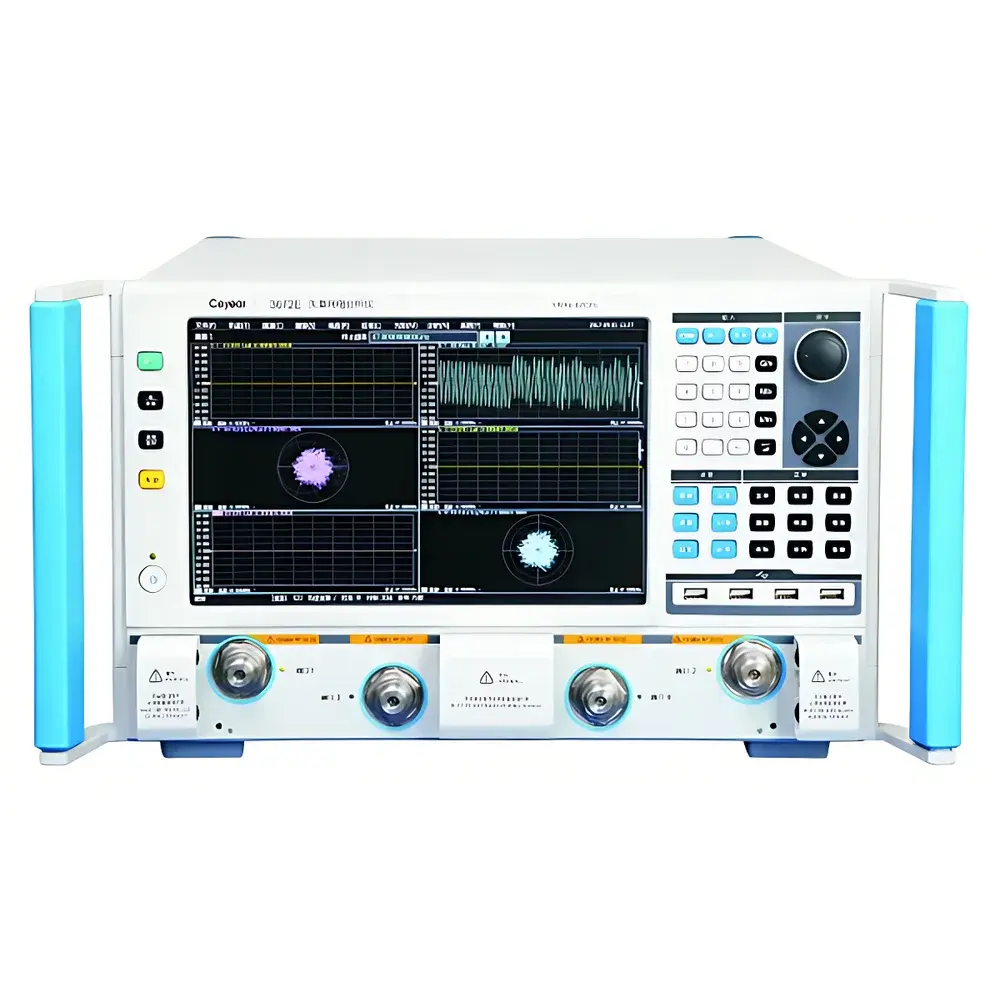
Ceyear 3672 Series Vector Network Analyzer
| Brand | Ceyear |
|---|---|
| Origin | Shandong, China |
| Manufacturer Type | Original Equipment Manufacturer (OEM) |
| Product Line | 3672A (10 MHz–13.5 GHz), 3672B (10 MHz–26.5 GHz), 3672C (10 MHz–43.5 GHz), 3672D (10 MHz–50 GHz), 3672E (10 MHz–67 GHz) |
| Calibration Methods | Frequency Response, One-Port, Response-Isolation, Enhanced Response, Full Two-Port SOLT, TRL, Electronic Calibration (ECal) |
| Display Formats | Log Magnitude, Linear Magnitude, VSWR, Phase, Group Delay, Smith Chart, Polar Plot |
| Interfaces | USB 2.0/3.0, LAN (10/100/1000BASE-T), GPIB (IEEE-488.2), VGA |
| Operating System | Embedded Windows Platform |
| Dynamic Range | >130 dB (typ. at 10 GHz, depending on model and IF bandwidth) |
| Trace Noise | <0.005 dBrms (1 kHz IFBW, 3672B typical) |
| Channel Capacity | Up to 64 measurement channels |
| Window Capacity | Up to 32 simultaneous display windows, 16 traces per window |
| Optional Features | Pulse S-parameter Measurement, Mixer/Converter Characterization, Gain Compression (Pout vs. Pin & Freq), Time-Domain Reflectometry (TDR), Advanced Time-Domain Analysis (ATDA), Fixture De-embedding (Single-ended & Differential), Virtual Eye Diagram Generation (with PRBS emulation), Jitter/Noise Injection, Pre-emphasis & Equalization Simulation |
Overview
The Ceyear 3672 Series Vector Network Analyzer (VNA) is a high-performance, modular microwave and millimeter-wave measurement platform engineered for precision characterization of linear RF and microwave components across frequency bands from 10 MHz to 67 GHz. Based on coherent heterodyne receiver architecture with dual-source synthesis and vector error correction, the 3672 Series implements full two-port S-parameter measurement using the scattering parameter formalism (S11, S21, S12, S22) under controlled impedance conditions (typically 50 Ω). Its design adheres to fundamental principles of microwave network theory and electromagnetic wave propagation, enabling accurate extraction of magnitude, phase, group delay, and impedance behavior in both frequency and time domains. The system supports rigorous traceable calibration methodologies aligned with international standards including IEEE Std 1785.1 (for TDR/TDT), IEC 61000-4-21 (EMC test fixtures), and ISO/IEC 17025–compliant uncertainty evaluation frameworks. It serves as a foundational instrument in R&D labs, production test floors, and metrology centers engaged in radar subsystem validation, 5G/6G front-end module qualification, aerospace T/R module verification, and high-speed digital interconnect characterization.
Key Features
- Multi-band modular architecture: Five models (3672A–3672E) covering continuous frequency ranges from 10 MHz to 67 GHz — each optimized for harmonic suppression, spurious-free dynamic range, and phase stability.
- Comprehensive calibration flexibility: Supports SOLT, TRL, LRM, response-only, enhanced response, isolation-corrected, and electronic calibration (ECal) via precision coaxial or waveguide ECal modules — fully compliant with MIL-STD-461G and IEEE 145-2013 definitions of calibration traceability.
- High-fidelity signal integrity: Typical dynamic range exceeds 130 dB at mid-band frequencies; trace noise floor <0.005 dBrms (1 kHz IF bandwidth), enabling reliable insertion loss measurements down to –110 dB.
- Advanced time-domain analysis (ATDA): With optional TDR and ATDA firmware, performs impedance profiling, discontinuity localization, near-end/far-end crosstalk decomposition, and virtual eye diagram generation using convolution-based PRBS emulation (NRZ, PAM4).
- Automated fixture de-embedding: Supports single-ended and differential fixture modeling using user-defined standards (Thru, Open, Short); implements full 4-port de-embedding for on-wafer DUTs and packaged MMICs per IEEE P370 guidelines.
- Intuitive embedded Windows platform: Dual-core x86 processor with SSD storage, multi-touch GUI, scriptable automation (SCPI over LAN/GPIB), and real-time macro recording with conditional user prompts for unattended test sequences.
Sample Compatibility & Compliance
The 3672 Series accommodates a broad spectrum of DUT topologies including coaxial connectors (3.5 mm, 2.92 mm, 2.4 mm, 1.85 mm), waveguide flanges (WR-28 to WR-12), probe stations (GSG, GS), and non-standard interfaces via custom fixture integration. All models comply with CE marking requirements (EMC Directive 2014/30/EU, Low Voltage Directive 2014/35/EU), RoHS 2011/65/EU, and meet environmental operating specifications per MIL-PRF-28800F Class 3. Calibration traceability follows NIST-traceable reference standards, and software audit trails satisfy FDA 21 CFR Part 11 requirements when operated in validated environments. Instrument firmware and calibration data files support GLP/GMP-compliant documentation workflows, including electronic signatures and change history logging.
Software & Data Management
The analyzer runs on a real-time Windows Embedded Standard OS with native support for MATLAB® scripting, Python 3.8+ (via PyVISA), and LabVIEW™ drivers (NI-VISA compatible). Measurement data export formats include Touchstone (.s1p, .s2p, .s4p), CSV, BMP/PNG screenshots, and XML metadata containers compliant with ASTM E2920-21 for materials characterization datasets. Built-in data management enables version-controlled calibration kit libraries, hierarchical project folders, automated report generation (PDF/HTML), and secure remote access via TLS 1.2–encrypted LAN sessions. Optional IQ Analyzer license extends functionality to complex baseband signal analysis for modulated S-parameter validation.
Applications
- Radar and EW subsystem testing: T/R module gain flatness, phase coherence, and pulse-profiled S-parameters under modulated excitation.
- High-speed digital interconnect validation: PCB trace impedance uniformity, via stub resonance, channel loss budgeting, and compliance testing against PCIe 6.0, USB4 v2, and IEEE 802.3ck specifications.
- Material property extraction: Complex permittivity (ε′, ε″) and permeability (μ′, μ″) determination via free-space or waveguide resonant cavity methods.
- Optoelectronic device characterization: Electro-optic modulator S-parameters, photodiode frequency response, and RF-over-fiber link modeling.
- Millimeter-wave IC development: On-wafer probing of GaN HEMTs, SiGe BiCMOS transceivers, and antenna-in-package (AiP) modules up to 67 GHz.
FAQ
What calibration standards are supported for on-wafer measurements?
The 3672 Series supports TRL, LRM, and custom-defined calibration kits for probe station use; full 4-port de-embedding requires measured Thru, Open, and Short standards on the same substrate.
Does the instrument support pulse-modulated S-parameter measurement?
Yes — with the Pulse Measurement Option, it acquires gated S-parameters synchronized to external trigger inputs, supporting pulse widths from 10 ns to continuous wave.
Can virtual eye diagrams be generated directly from S-parameters without hardware bit-error-rate testing?
Yes — the ATDA option performs time-domain transformation, convolution with user-defined PRBS patterns, and adds configurable jitter/noise profiles to generate pass/fail eye masks per IEEE 802.3, USB-IF, or PCI-SIG specifications.
Is fixture de-embedding validated per industry consensus guidelines?
Yes — implementation follows IEEE P370 draft standards for fixture removal accuracy, including uncertainty quantification for impedance discontinuities and crosstalk coupling terms.
What level of measurement repeatability can be expected over temperature drift?
With internal temperature stabilization and periodic reference plane verification, amplitude repeatability is ±0.01 dB and phase repeatability is ±0.1° over 8-hour periods within ±5°C ambient variation.