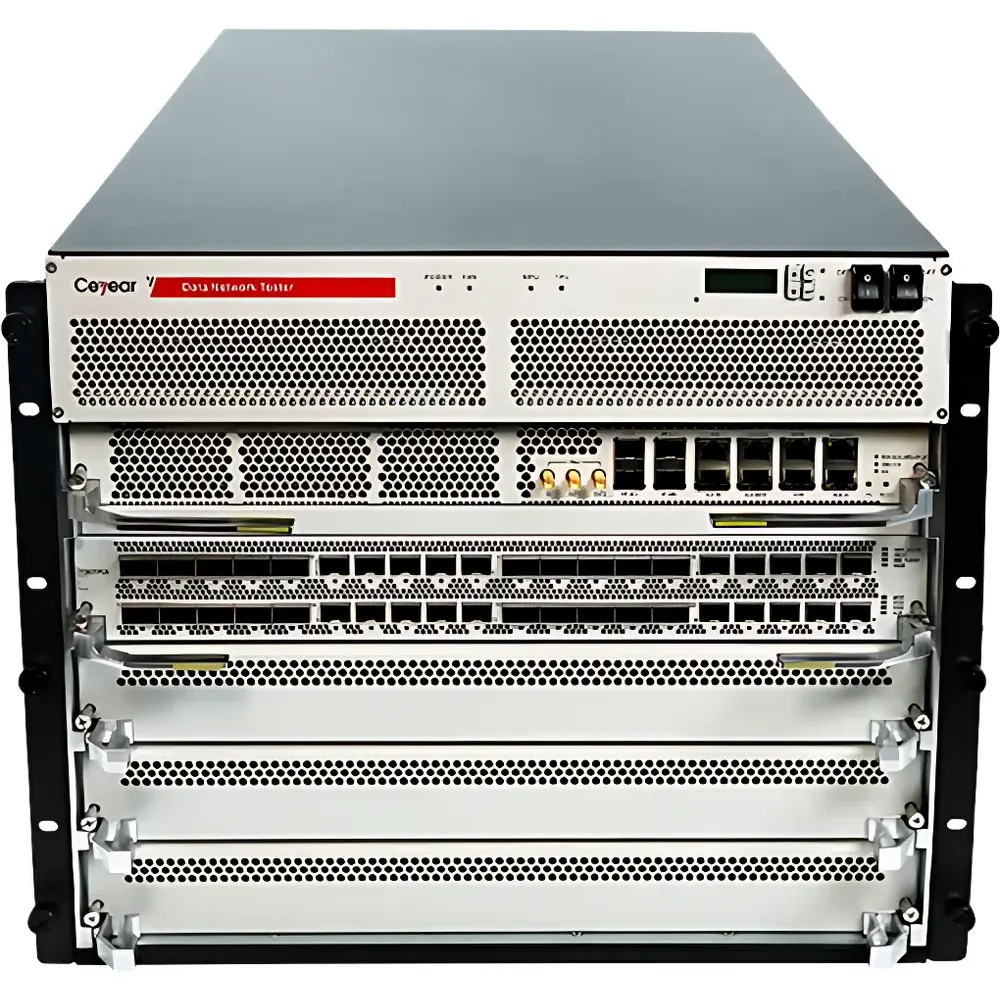
Ceyear 5201 High-Performance Multi-Rate Data Network Tester
| Brand | Ceyear |
|---|---|
| Origin | China |
| Manufacturer Type | Original Equipment Manufacturer (OEM) |
| Model | 5201 |
| Supported Data Rates | 1 Gbps, 10 Gbps, 25 Gbps, 40 Gbps, 50 Gbps, 100 Gbps |
| Max Port Density | 80 × 100G ports (across 4 slots) |
| Layer Coverage | L2–L3 |
| Compliance | RFC 2544, RFC 2889, RFC 3918 |
| Synchronization | Precision PTP/IEEE 1588 v2 and SyncE support |
| Scalability | Multi-chassis clustering with deterministic latency synchronization |
| Software Architecture | Modular test application framework with CLI, GUI, and RESTful API interfaces |
| Pricing | Available upon technical evaluation and configuration quote |
Overview
The Ceyear 5201 High-Performance Multi-Rate Data Network Tester is a carrier-grade, modular hardware platform engineered for comprehensive Layer 2–Layer 3 protocol validation, performance benchmarking, and conformance verification across modern high-speed data networks. Built upon a deterministic, low-latency FPGA-accelerated architecture, the instrument implements line-rate packet generation and analysis at speeds up to 100 Gbps per port—enabling bit-accurate emulation of real-world traffic loads under controlled, repeatable conditions. Its core measurement methodology integrates stateful traffic modeling, precise timestamping (sub-100 ns resolution), and hardware-based packet classification to support objective quantification of forwarding performance, jitter, frame loss, throughput, and latency percentiles. Designed for environments where regulatory traceability and process integrity are critical—including telecom equipment certification labs, cloud infrastructure R&D centers, and network equipment manufacturing QA facilities—the 5201 delivers metrology-grade repeatability aligned with ITU-T Y.1564, RFC 2544, and IETF RFC 3918 methodologies.
Key Features
- Modular 4-slot chassis supporting hot-swappable test modules for 1G/10G/25G/40G/50G/100G Ethernet interfaces—scalable to 80 full-duplex 100G ports in multi-chassis configurations
- Dedicated hardware acceleration for wire-speed packet generation, filtering, and timestamped capture without CPU bottlenecks or software-induced jitter
- Integrated RFC 2544, RFC 2889, and RFC 3918 test suites with automated pass/fail criteria, configurable burst patterns, and statistical confidence interval reporting
- Multi-protocol simulation engine supporting IPv4/IPv6 routing (OSPFv2/v3, BGP-4, IS-IS), MPLS forwarding, multicast (PIM-SM/DM, IGMPv2/v3), and data center fabrics (VXLAN, EVPN, TRILL)
- IEEE 1588-2008 (PTP) and SyncE clock synchronization with sub-microsecond phase alignment across distributed test nodes—essential for time-sensitive networking (TSN) and 5G transport validation
- Role-based access control (RBAC), audit logging, and encrypted configuration export compliant with ISO/IEC 17025 documentation requirements
Sample Compatibility & Compliance
The Ceyear 5201 supports physical layer compatibility with SFP+, QSFP28, QSFP56, and QSFP-DD form factor transceivers across IEEE 802.3 standards (e.g., 802.3bj, 802.3bs, 802.3cd). It validates device behavior against industry-standard conformance test suites including IETF RFCs (2544, 2889, 3918, 6349), ITU-T Y.1564 and Y.156sam, and MEF CE 2.0 specifications. All test reports include embedded metadata—test date, operator ID, firmware version, calibration epoch, and environmental monitoring logs—to satisfy GLP, GMP, and ISO/IEC 17025 traceability mandates. The platform undergoes annual metrological verification per CNAS-CL01:2018 requirements for accredited testing laboratories.
Software & Data Management
The instrument runs Ceyear’s NTS-OS—a real-time, deterministic operating system optimized for deterministic packet timing and memory-mapped I/O. Test automation is enabled via Python SDK, RESTful HTTP APIs (OpenAPI 3.0 compliant), and native CLI integration with Jenkins, GitLab CI, and Spirent TestCenter-compatible orchestration frameworks. All captured traffic traces are stored in standardized PCAP-NG format with nanosecond-precision timestamps and optional AES-256 encryption. Audit trails record every configuration change, user login/logout event, and report generation action—supporting FDA 21 CFR Part 11 electronic signature compliance when deployed in regulated environments.
Applications
- Pre-certification validation of switching/routing ASICs and white-box switches against MEF, IEEE, and IETF interoperability profiles
- Latency and jitter characterization of TSN-enabled industrial Ethernet controllers and automotive ADAS gateways
- Throughput and buffer occupancy analysis for 5G fronthaul/midhaul transport networks using eCPRI and RoE protocols
- Automated regression testing in continuous integration pipelines for SDN controller firmware releases
- Service-level agreement (SLA) verification for cloud service providers performing RFC 6349 TCP throughput benchmarking
- Conformance testing of O-RAN Alliance-defined fronthaul interfaces (O-RU/O-DU) under Open Fronthaul WG specifications
FAQ
Does the Ceyear 5201 support 400G Ethernet testing?
No—the current 5201 platform supports up to 100G per port. A 400G-capable variant (5201-HD) is under development and scheduled for Q4 2025 release.
Can test configurations be exported for third-party analysis tools?
Yes—configuration files, results databases (SQLite3), and packet captures (PCAP-NG) are fully portable and include embedded calibration metadata.
Is remote operation supported over WAN connections?
Yes—secure remote access is implemented via TLS 1.3-encrypted web GUI, SSHv2 CLI, and authenticated REST API endpoints with configurable session timeouts and IP whitelisting.
What calibration interval is recommended for metrological traceability?
Annual calibration against NIST-traceable reference instruments is recommended; internal self-test routines execute on power-up and prior to each RFC-compliant test run.
How does the 5201 handle multi-vendor interoperation testing?
It includes vendor-neutral protocol stacks with customizable TLVs, vendor-specific MIB extensions, and interoperability mode presets aligned with ONF, O-RAN, and MEF interoperability test plans.