
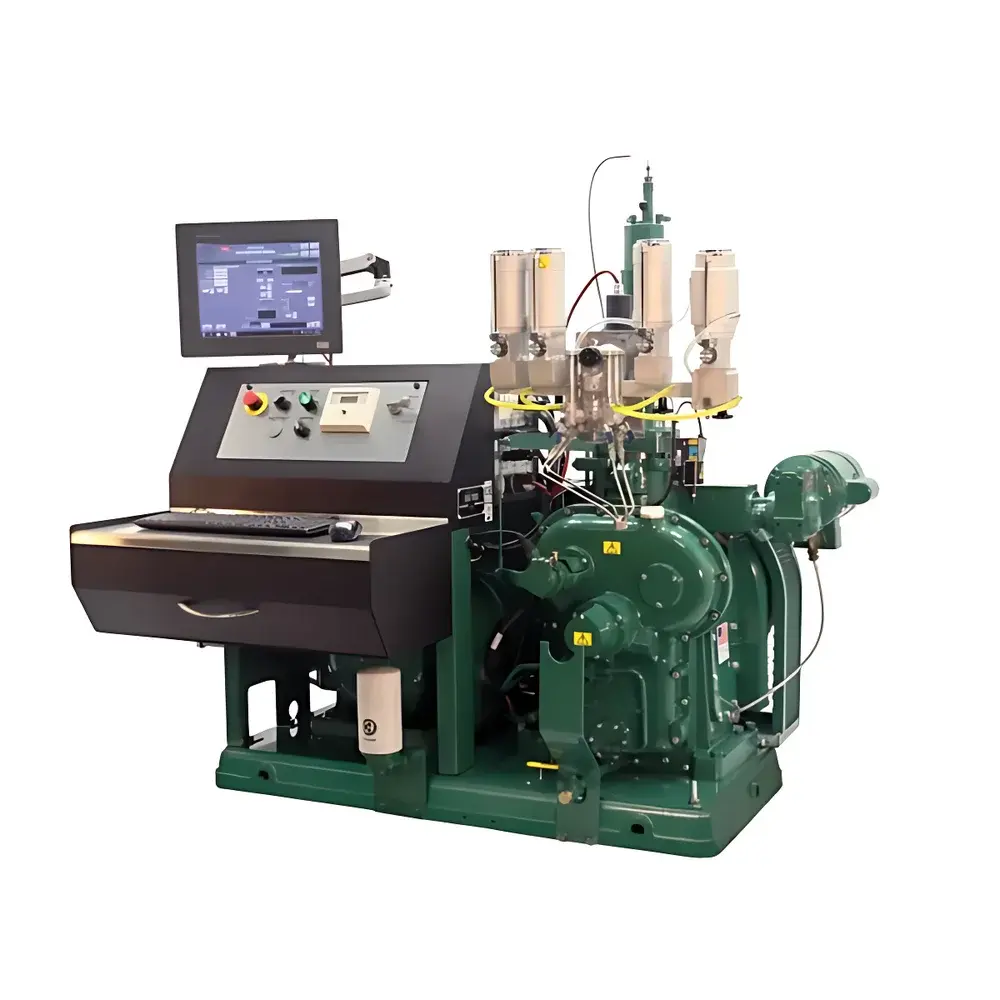
CFR F1/F2 Research and Motor Octane Number Engine
| Key | Brand: CFR |
|---|---|
| Origin | USA |
| Model | F1/F2 |
| Application | Gasoline Octane Number (RON/MON) Determination |
| Configuration | Benchtop |
| Standards Compliance | ASTM D2699, ASTM D2700, ISO 5164, ISO 5163, GB/T 5487, GB/T 503 |
| Compression Ratio Range | 4:1 to 18:1 (continuously adjustable) |
| Ignition Timing | 13° BTDC (capacitor discharge system) |
| Knock Detection | Factory-calibrated analog knock meter (0–100 scale), magnetic reluctance sensor mounted in combustion chamber |
| Lubrication | Pressure-fed, external oil pump with filtration, cooling, and flow monitoring |
| Cooling System | Thermosiphon jacketed cylinder with boiling/condensation recirculation |
| Air Intake Humidity Control | 25–50 g H₂O per lb dry air (ASTM-compliant) |
| Safety Interlocks | Low oil pressure, low coolant pressure, low voltage, motor overload |
| Drive Motor | Three-phase synchronous/reluctance motor (constant-speed operation) |
| Carburetor | Single-venturi, level-viewable fuel bowl |
| Cylinder Head | Monolithic, integrated design for thermal stability and measurement repeatability |
| Crankcase | CFR 48D cast iron box-type, service-accessible side and gear covers |
Overview
The CFR F1/F2 Research and Motor Octane Number Engine is a precision-engineered, benchtop internal combustion test engine designed exclusively for the standardized determination of gasoline octane ratings—specifically Research Octane Number (RON) per ASTM D2699 / ISO 5164 and Motor Octane Number (MON) per ASTM D2700 / ISO 5163. As the globally recognized arbitration instrument for fuel rating, the CFR F1/F2 embodies over eight decades of empirical refinement in cooperative fuel evaluation methodology. Its operational principle relies on controlled, repeatable combustion under defined thermodynamic boundary conditions—including precisely regulated compression ratio, intake air humidity, ignition timing, engine speed, and cooling jacket temperature—to quantify a fuel’s resistance to knock relative to primary reference fuels (PRFs). This comparative, full-scale engine-based approach remains the definitive physical benchmark against which all surrogate methods (e.g., NIR, GC-MS, or empirical correlations) are validated. The F1/F2 configuration enables seamless transition between RON and MON test modes via mechanical reconfiguration of engine parameters—eliminating cross-method calibration drift and ensuring metrological traceability to national standards.
Key Features
- Continuously Adjustable Compression Ratio (4:1 to 18:1): Achieved via a dedicated mechanical actuator with tactile lever control (F2U option), maintaining constant valve lash across the full range through a patented cam-follower geometry—enabling accurate rating of conventional, oxygenated, and high-octane reformulated gasolines.
- Integrated Monolithic Cylinder Head: Precision-machined from a single casting to minimize thermal gradients and mechanical hysteresis, directly contributing to inter-laboratory reproducibility (RSD < 0.3 octane units per ASTM repeatability criteria).
- Factory-Calibrated Analog Knock Measurement System: A 115 V AC, 50/60 Hz analog knock meter (0–100 scale) coupled to a magnetic reluctance sensor embedded in the combustion chamber wall—providing direct, linear transduction of combustion-induced vibration without digital interpolation or signal averaging.
- ASTM-Compliant Air Humidity Conditioning: Integrated humidification module delivers 25–50 g H₂O per pound of dry air at the intake manifold, meeting strict requirements of both D2699 and D2700 for consistent charge density and knock threshold definition.
- Pressure-Lubricated Cranktrain: External oil pump supplies filtered, temperature-regulated lubricant to all main and connecting rod bearings—ensuring long-term dimensional stability and minimizing wear-related drift during extended certification testing.
- Thermosiphon Jacket Cooling: Passive, self-regulating boiling-condensation loop maintains cylinder block temperature within ±1.5°C of setpoint—critical for stable heat transfer coefficients and consistent pre-ignition behavior.
Sample Compatibility & Compliance
The CFR F1/F2 is validated exclusively for liquid hydrocarbon fuel samples meeting ASTM D4814 specifications, including conventional gasoline, ethanol-blended (E10, E15), MTBE-containing, and alkylate-rich formulations. It is not suitable for diesel, aviation turbine fuels, or oxygenates with vapor pressures exceeding 75 kPa at 37.8°C. Regulatory compliance includes full alignment with U.S. EPA Tier 3 gasoline certification protocols, EU EN 228 Annex B, and China’s GB/T 503–1995 (MON) and GB/T 5487–1985 (RON) as the legally designated arbitration method. All operational procedures conform to GLP principles, supporting audit-ready documentation for ISO/IEC 17025-accredited laboratories. The instrument’s mechanical architecture—free of software-controlled actuators or closed-loop feedback—ensures deterministic behavior required for regulatory submission data.
Software & Data Management
The CFR F1/F2 operates as a fully manual, analog-dominant platform with no embedded microprocessor or proprietary firmware. All operational parameters (compression ratio, ignition timing, coolant temperature, air/fuel ratio) are set mechanically or via calibrated analog dials. Knock intensity is recorded manually from the front-panel meter; supporting data (engine speed, intake air temperature/humidity, fuel temperature, barometric pressure) are logged using external NIST-traceable instruments. This architecture eliminates validation burdens associated with computerized systems—making it inherently compliant with FDA 21 CFR Part 11 when used in conjunction with paper-based or electronic lab notebooks (ELN) that implement appropriate audit trails and user access controls. CFR provides comprehensive SOP templates aligned with ASTM practice E1488 for data recording, uncertainty estimation, and result reporting.
Applications
- Primary octane certification for refinery batch release and pipeline custody transfer
- Development and validation of alternative fuel formulations (e.g., bioethanol blends, synthetic hydrocarbons)
- Reference method verification for rapid analytical techniques (FTIR, Raman, GC-SCD)
- International round-robin testing programs coordinated by CONCAWE, JPI, or CEC
- Regulatory compliance testing for national fuel quality mandates (e.g., China’s GB 17930, India’s IS 2796)
- Academic research on combustion kinetics, autoignition chemistry, and surrogate fuel modeling
FAQ
Is the CFR F1/F2 compliant with current ASTM and ISO standards?
Yes—the F1/F2 meets all mechanical, procedural, and calibration requirements of ASTM D2699–23, D2700–23, ISO 5164:2022, and ISO 5163:2022.
Can the same engine be used for both RON and MON testing?
Yes—by adjusting compression ratio, ignition timing, engine speed, intake air temperature, and humidity per standard specifications, the identical hardware serves both methods without modification.
Does the system require computer interfacing or specialized software?
No—operation is entirely manual and analog. Data acquisition relies on external calibrated instruments and documented manual observation.
What maintenance intervals are recommended for long-term accuracy?
CFR recommends quarterly verification of knock meter linearity, annual recalibration of compression ratio indicator, and biannual inspection of carburetor float level and valve lash—detailed in the CFR Maintenance Manual Rev. 7.2.
Is technical support and spare parts availability guaranteed outside the U.S.?
CFR maintains authorized service partners in 28 countries, with critical spares (knock sensors, cylinder liners, carburetor assemblies) stocked regionally and shipped within 72 hours under warranty terms.






