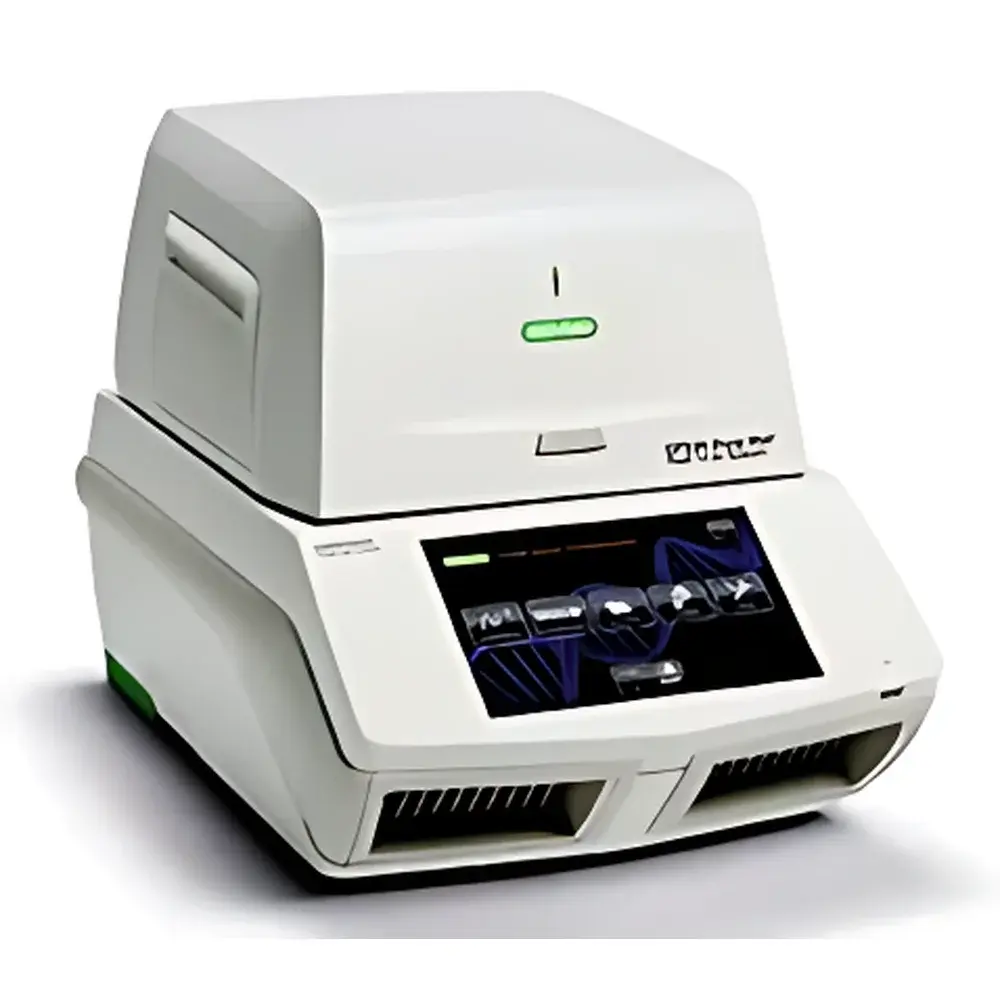
CFX96 Deep Well Dx Real-Time PCR Detection System
| Brand | Bio-Rad |
|---|---|
| Origin | USA |
| Model | CFX96 Deep Well Dx |
| Instrument Type | Real-Time Fluorescence Quantitative PCR System |
| Sample Throughput | 96-well format |
| Heating Rate | 2.5 °C/sec |
| Temperature Accuracy | ±0.2 °C |
| Well-to-Well Temperature Uniformity | ±0.4 °C |
| Excitation Channels | 5 + 1 (including reference channel) |
| Detection Method | Scanning-based fluorescence acquisition |
| Max Reaction Volume | 125 µL |
| LED Light Source Lifetime | >50,000 hours |
| Compliance | MIQE-guided software, FDA 21 CFR Part 11–ready audit trail, ISO 13485-aligned IVD design |
Overview
The CFX96 Deep Well Dx Real-Time PCR Detection System is a CE-IVD and FDA-listed real-time fluorescence quantitative polymerase chain reaction instrument engineered for high-fidelity nucleic acid amplification and detection in clinical diagnostic laboratories. Built upon a robust Peltier-based thermal cycling architecture with a precision-machined aluminum block, the system delivers exceptional thermal accuracy (±0.2 °C) and uniformity (±0.4 °C across all 96 wells), enabling reproducible quantification even in large-volume reactions up to 125 µL—critical for low-abundance pathogen detection in respiratory, bloodborne, and gastrointestinal infectious disease panels. Unlike CCD-based systems, its scanning optical engine eliminates edge effects and well-to-well optical path variation, ensuring consistent signal capture without requiring passive reference dyes or post-run normalization. The integrated 5+1 excitation channel array—comprising five target-specific LEDs plus one reference channel—enables simultaneous multiplex detection of up to five targets per well while maintaining spectral separation via proprietary optical filtering and beam-steering optics (“Optical Shuttle” design), minimizing crosstalk and supporting broad dye compatibility (FAM, HEX, ROX, Cy5, Cy5.5, and more).
Key Features
- Scanning-based fluorescence detection architecture eliminates CCD-related spatial bias and photobleaching gradients
- Thermal module with dynamic gradient capability (0.1–24 °C range) for rapid assay optimization and primer annealing profiling
- Onboard touchscreen interface with dual-language OS (English & Simplified Chinese), supporting standalone operation without external PC
- Modular thermal block design allows field-swappable modules for future protocol expansion (e.g., fast-cycling or high-capacity configurations)
- Long-life, factory-calibrated LED excitation sources (>50,000 hours MTBF); no routine optical recalibration required
- Open reagent architecture compliant with global MIQE guidelines—no proprietary consumables or mandatory calibration kits
- Embedded API interface (RESTful) for bidirectional integration with LIS/LIMS platforms, supporting HL7 and ASTM E1384 message protocols
- Automated self-diagnostic sequence at power-on, including thermal sensor validation, optical path integrity check, and LED intensity verification
Sample Compatibility & Compliance
The CFX96 Deep Well Dx accommodates standard 0.2 mL skirted 96-well plates and tube strips, with mechanical alignment features ensuring repeatable positioning for high-precision thermal transfer. Its IVD-grade hardware and firmware are designed and validated per ISO 13485:2016 requirements, with full traceability of calibration records, change control logs, and software version history. Data integrity is maintained through FDA 21 CFR Part 11–compliant audit trails—including user action timestamps, parameter modification logs, and electronic signature support. All pre-installed analysis methods (e.g., ΔΔCq, standard curve, high-resolution melt (HRM) analysis for SNP genotyping and methylation profiling) adhere to MIQE reporting standards, facilitating regulatory submission documentation.
Software & Data Management
CFX Maestro Dx Software v5.x provides an intuitive, workflow-driven interface for assay setup, run monitoring, and post-acquisition analysis. It supports automated baseline adjustment, multi-color compensation matrix generation, and HRM curve normalization using internal reference peaks. Raw fluorescence data (.rdml) and analysis reports (.pdf/.xlsx) are exportable with embedded metadata (instrument ID, operator, date/time, thermal profile, and optical settings). Role-based access control (RBAC) enforces SOP compliance, while encrypted local storage and optional network backup ensure data sovereignty. Audit logs record every user-initiated event—including file deletion, parameter override, or report regeneration—with immutable timestamps and operator identifiers.
Applications
This system is routinely deployed in clinical microbiology labs for quantitative detection of SARS-CoV-2, influenza A/B, RSV, HIV viral load, HBV DNA, and multidrug-resistant bacterial markers (e.g., mecA, vanA). Its high-volume well design and thermal stability support complex multiplex assays for syndromic panels (e.g., GI Pathogen Panels, CNS Infection Panels). Beyond diagnostics, it serves research applications requiring high-resolution melt analysis—such as allele discrimination in pharmacogenomic testing (CYP2C19, VKORC1), methylation-sensitive PCR, and CRISPR-based detection workflows. Integration-ready architecture enables linkage to automated nucleic acid extraction platforms (e.g., QIAGEN QIAcube Connect, Roche MagNA Pure) and liquid handlers for end-to-end molecular workflow automation.
FAQ
Is the CFX96 Deep Well Dx compliant with FDA 21 CFR Part 11 for electronic records and signatures?
Yes—audit trail functionality, electronic signature enforcement, and secure user authentication are enabled by default and configurable per institutional policy.
Can the system perform high-resolution melt (HRM) analysis without additional hardware?
Yes—the scanning optics and high-precision thermal ramping (0.01 °C/sec resolution) are fully integrated; no add-on modules or external accessories are required.
Does the instrument require periodic optical recalibration?
No—LED light sources are factory-characterized and thermally stabilized; no user-performed optical recalibration is necessary during routine operation.
What data formats does the software support for export and interoperability?
RDML v1.2 for qPCR data exchange, PDF and XLSX for reports, and RESTful API endpoints for LIS/LIMS integration with JSON payloads.
Is the thermal block compatible with non-standard plate formats (e.g., 384-well or low-profile tubes)?
No—the CFX96 Deep Well Dx is optimized exclusively for 96-well deep-well plates (up to 125 µL/well); 384-well support requires the CFX384 Touch Dx platform.