
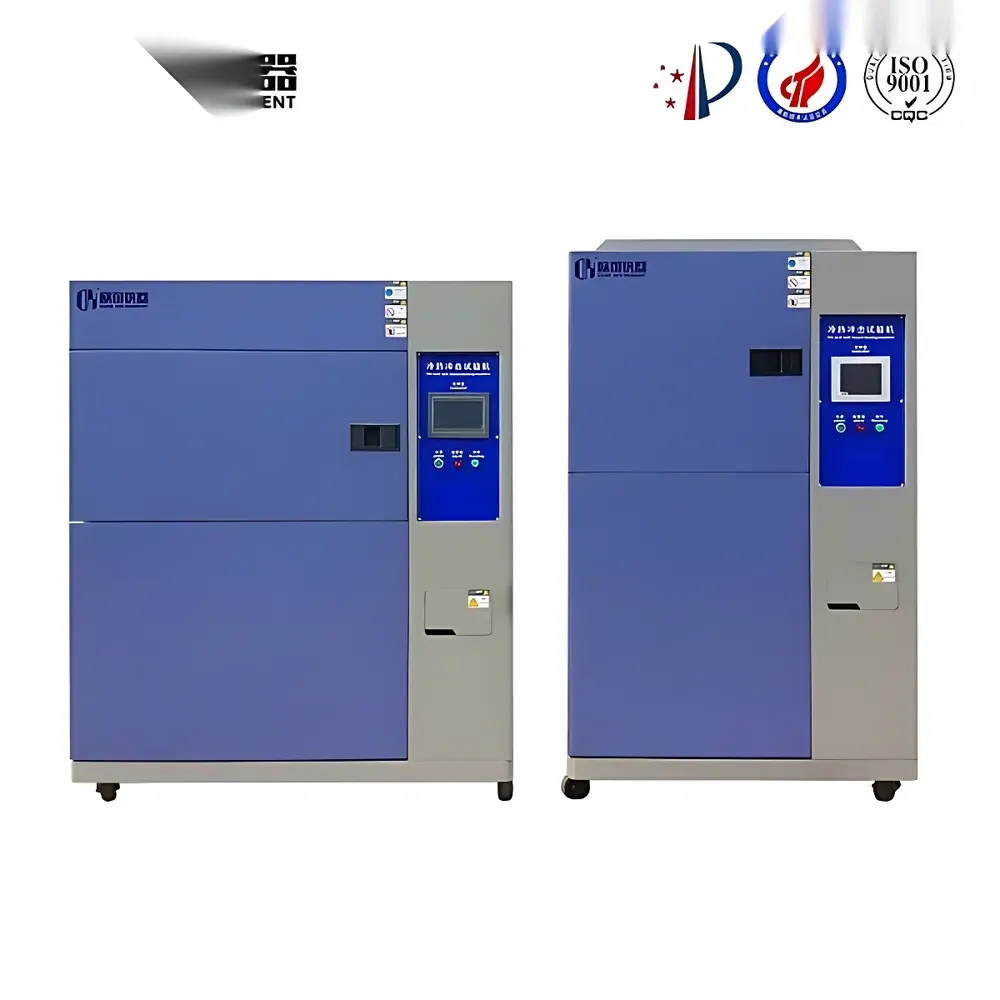
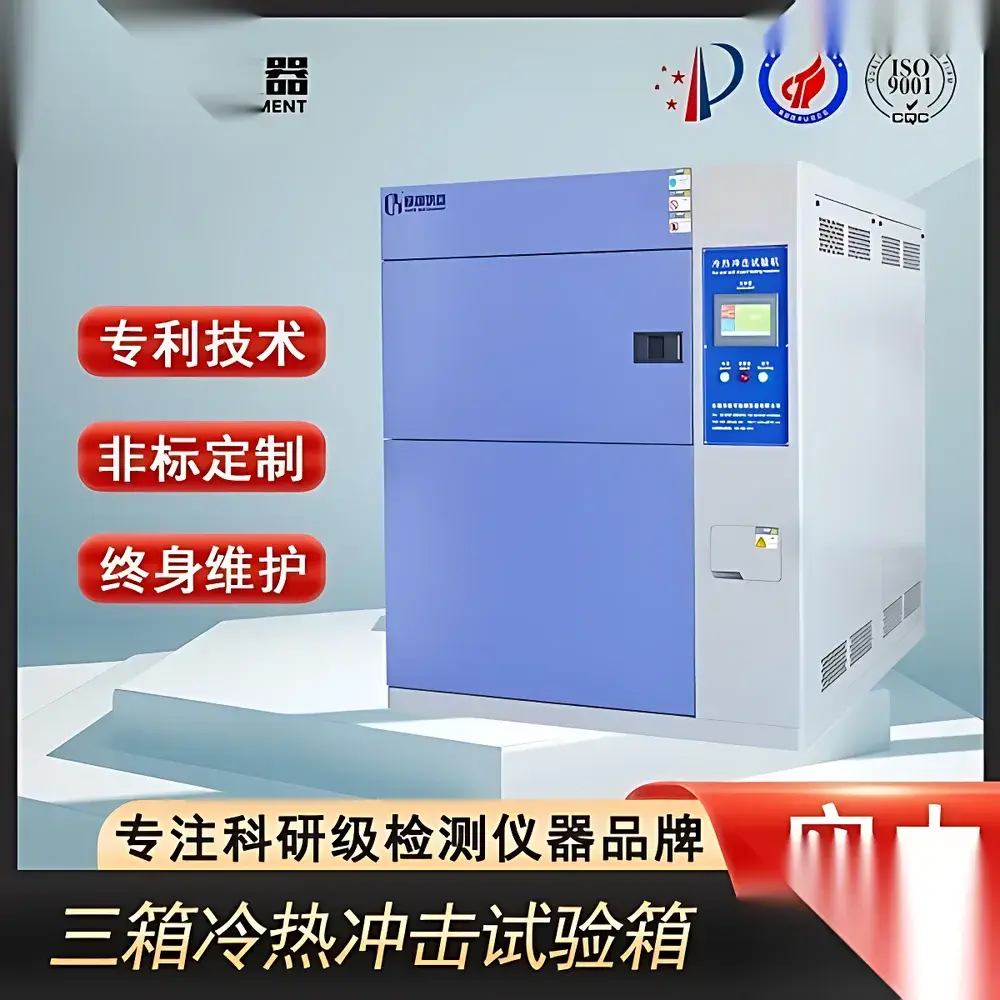
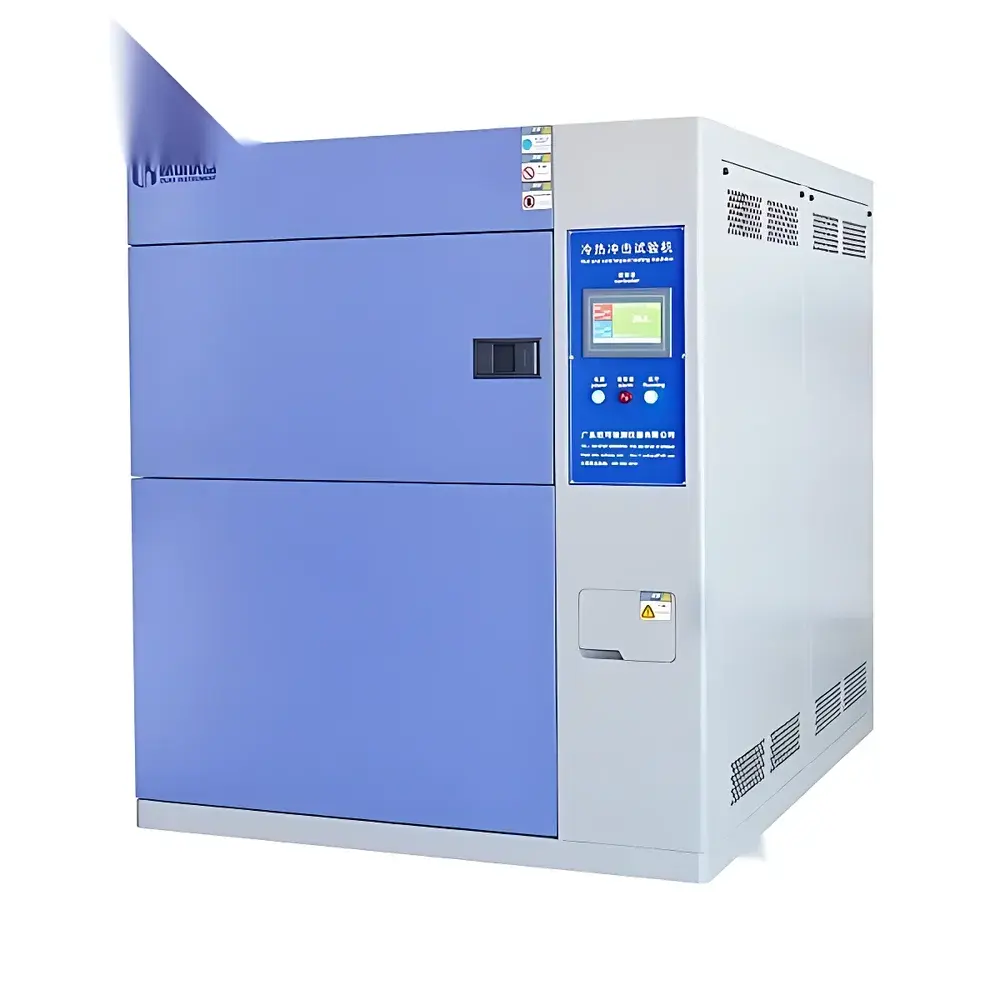
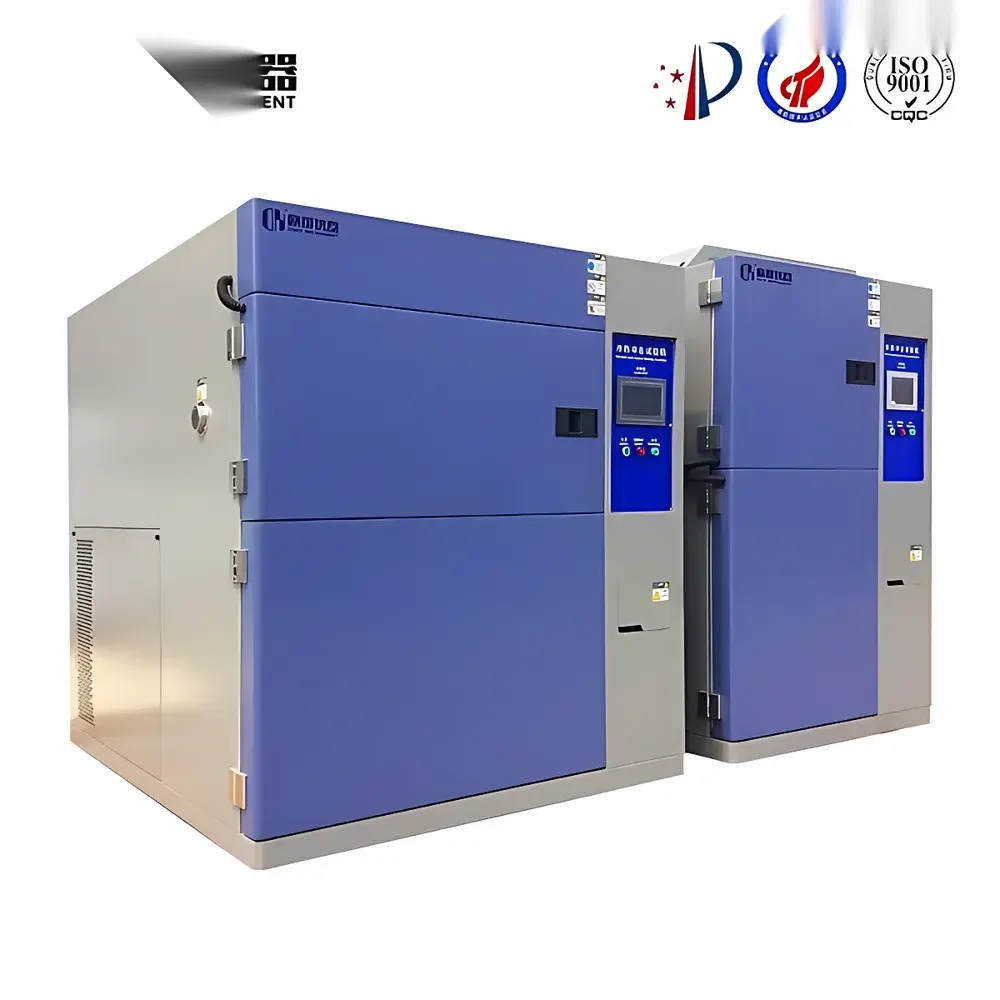
Three-Chamber Thermal Shock Test Chamber
| Key Features | Three-chamber design (hot, cold, test chambers) |
|---|---|
| Controller options | TEMI880 color touchscreen programmable temperature/humidity controller (English/Chinese switchable) or TEMI300 membrane-key programmable controller (English only) |
| Protection functions | Compressor overheat/overcurrent/overpressure protection, heater dry-run prevention, chamber over-temperature alarm, low-water-level detection |
| Standard configuration | Double-glazed tempered observation window |
| Temperature/humidity control | Balanced Temperature and Humidity Control System (BTSC) |
| Operating ambient | +5°C to +35°C |
| Heating | Nickel-chromium alloy wire heaters |
| Humidification | Surface evaporation type |
| Air circulation | Wide-band forced-air system (top discharge, bottom intake) |
| Cooling method | Air-cooled |
| Refrigeration | Original French “Tecumseh” hermetic compressors |
| Refrigeration circuit | Single- or dual-stage low-temperature loop design |
| Construction | Outer shell — SUS304B stainless steel |
| Airflow | Multi-wing centrifugal blower |
| Compliance | Designed to support ISO 16750-4, JEDEC JESD22-A104, MIL-STD-810H Method 503.5, IEC 60068-2-14, and ASTM D4332 test protocols |
Overview
The Three-Chamber Thermal Shock Test Chamber is an engineered environmental simulation system designed for rapid, repeatable, and highly controlled thermal cycling between extreme high- and low-temperature conditions. Unlike two-chamber configurations, this three-chamber architecture physically isolates the hot zone, cold zone, and test zone—enabling true zero-transfer-time thermal shock by transferring the test specimen via a lift-and-shift mechanism directly from one stabilized environment to another. This design eliminates thermal inertia associated with door opening and minimizes exposure of specimens to transitional temperatures, thereby ensuring strict adherence to test profiles defined in international standards such as IEC 60068-2-14 (Change of temperature) and MIL-STD-810H Method 503.5 (Temperature Shock). The chamber supports both air-to-air thermal shock testing and optional humidity-enabled variants for combined thermal-hygric stress evaluation, making it suitable for qualification testing of electronic assemblies, automotive ECUs, aerospace components, and advanced packaging materials.
Key Features
- Triple-compartment architecture with independent temperature stabilization in hot, cold, and test chambers—eliminating thermal lag during specimen transfer
- Programmable controllers: TEMI880 color touchscreen unit with bilingual (English/Chinese) interface and data logging capability, or TEMI300 membrane-key controller for simplified operation in English-only environments
- Comprehensive safety system including compressor overheat/overcurrent/overpressure cutoffs, heater dry-run prevention, chamber over-temperature lockout, and automatic low-water-level shutdown for humidification circuits
- High-integrity chamber construction: Fully welded 304 stainless steel inner chamber with helium-leak-tested seams; outer shell fabricated from SUS304B; dual-silicone rubber door gasket ensuring >99.5% sealing efficiency under thermal cycling
- Optimized airflow management: Multi-wing centrifugal blower coupled with internal axial fans ensures uniform temperature distribution (±0.5°C at 100 L volume per IEC 60068-3-5) and rapid recovery (<3 min) after door opening
- Energy-efficient refrigeration: Original Tecumseh hermetic compressors integrated into single- or dual-stage vapor-compression loops, enabling stable operation down to –70°C with minimal maintenance intervals and extended service life
- Standardized test interfaces: Ø50 mm left-side cable port with EPDM grommet, RS485/RS232 serial communication, and bundled PC software supporting script-based test sequencing, real-time monitoring, and CSV/Excel export
Sample Compatibility & Compliance
This chamber accommodates standard test specimens up to 300 mm × 300 mm × 300 mm (custom sizes available), mounted on two independently height-adjustable 304 stainless steel sample racks. The interior lighting (fluorescent, non-UV-emitting) enables visual inspection without thermal interference. All structural and operational parameters comply with GLP-aligned documentation practices. The system supports audit-ready test execution per ISO/IEC 17025 requirements when paired with validated software and calibrated sensors traceable to NIST or PTB standards. It is routinely deployed in laboratories performing qualification per JEDEC JESD22-A104 (Temperature Cycling), ISO 16750-4 (Road vehicles – Environmental conditions), and AEC-Q200 stress screening protocols. Optional calibration certificates and IQ/OQ documentation packages are available upon request.
Software & Data Management
The included PC-based control software provides full remote supervision, test profile definition (including ramp/soak/transfer timing, dwell duration, cycle count), and real-time graphical display of chamber and sensor data. All operational events—including alarms, mode transitions, and manual interventions—are timestamped and stored with user ID tagging, satisfying FDA 21 CFR Part 11 requirements for electronic records and signatures when configured with password-protected operator roles and audit trail activation. Data export conforms to ASTM E2500-13 Annex A1 guidelines for raw data integrity, supporting traceability from test initiation through final report generation. Firmware updates are delivered via secure HTTPS channel with SHA-256 signature verification.
Applications
- Qualification testing of printed circuit board assemblies (PCBAs) subjected to solder joint fatigue under repeated thermal expansion mismatch
- Reliability screening of MEMS sensors, power modules, and LED packages prior to automotive or industrial deployment
- Evaluation of adhesive bond integrity in multi-material assemblies (e.g., metal-ceramic, polymer-metal interfaces)
- Validation of conformal coating performance under aggressive thermal cycling conditions
- Material science research on phase transition behavior, microcrack propagation, and intermetallic growth kinetics
- Pre-compliance stress testing for medical device electronics intended for use in variable-climate field environments
FAQ
What is the typical temperature range for hot and cold chambers?
The hot chamber typically operates from +60°C to +200°C; the cold chamber from –70°C to –10°C. Exact limits depend on model configuration and optional upgrades.
Is humidity control available across all three chambers?
Humidity is implemented only in the test chamber. The hot and cold chambers remain dry to preserve thermal stability and prevent condensation-related damage.
Can the system be integrated into a centralized laboratory monitoring network?
Yes—via Modbus RTU over RS485 or optional Ethernet/IP module, enabling interoperability with SCADA systems and enterprise LIMS platforms.
What calibration interval is recommended for routine operation?
Annual calibration of temperature sensors and controller outputs is advised, with intermediate verification checks performed before each critical qualification test series.
Does the chamber support automated test reporting compliant with ISO/IEC 17025?
When used with validated software, calibrated transducers, and documented procedures, the system meets data integrity and reporting requirements outlined in ISO/IEC 17025:2017 Clause 7.7.
Related Products



