
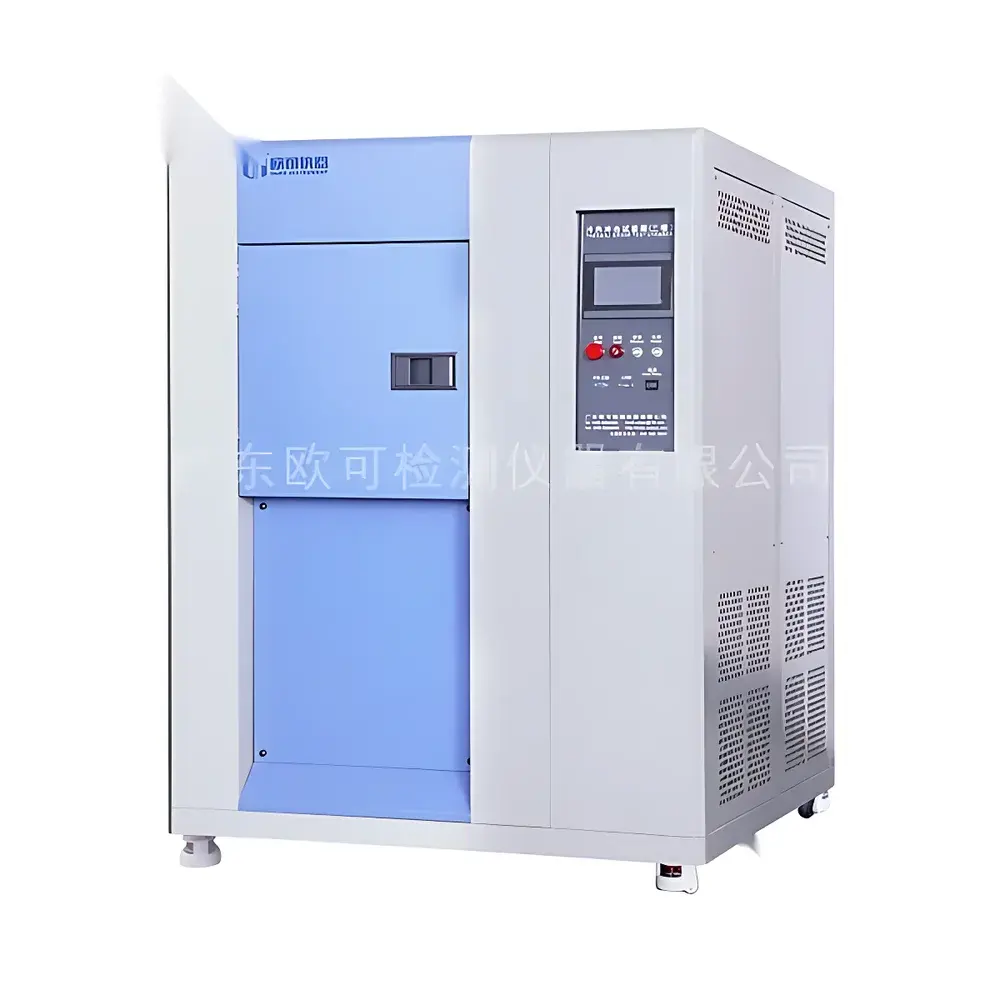
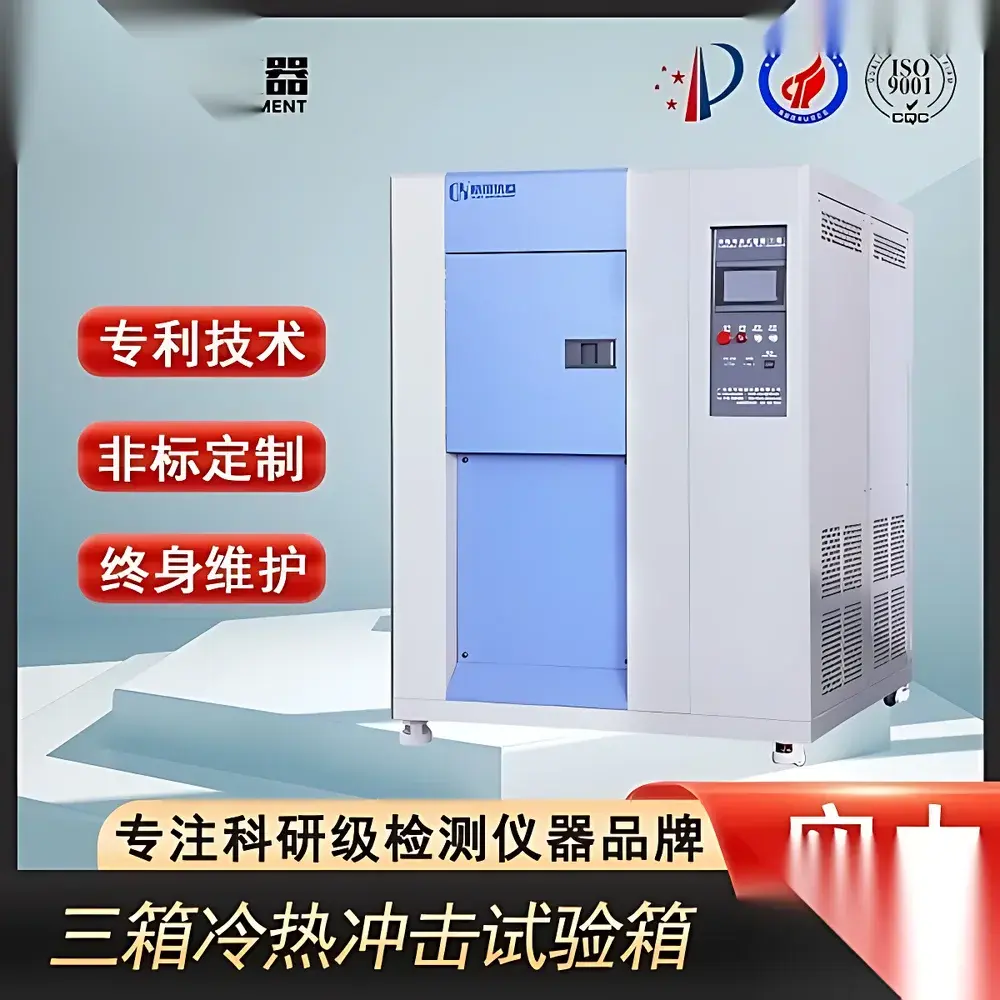
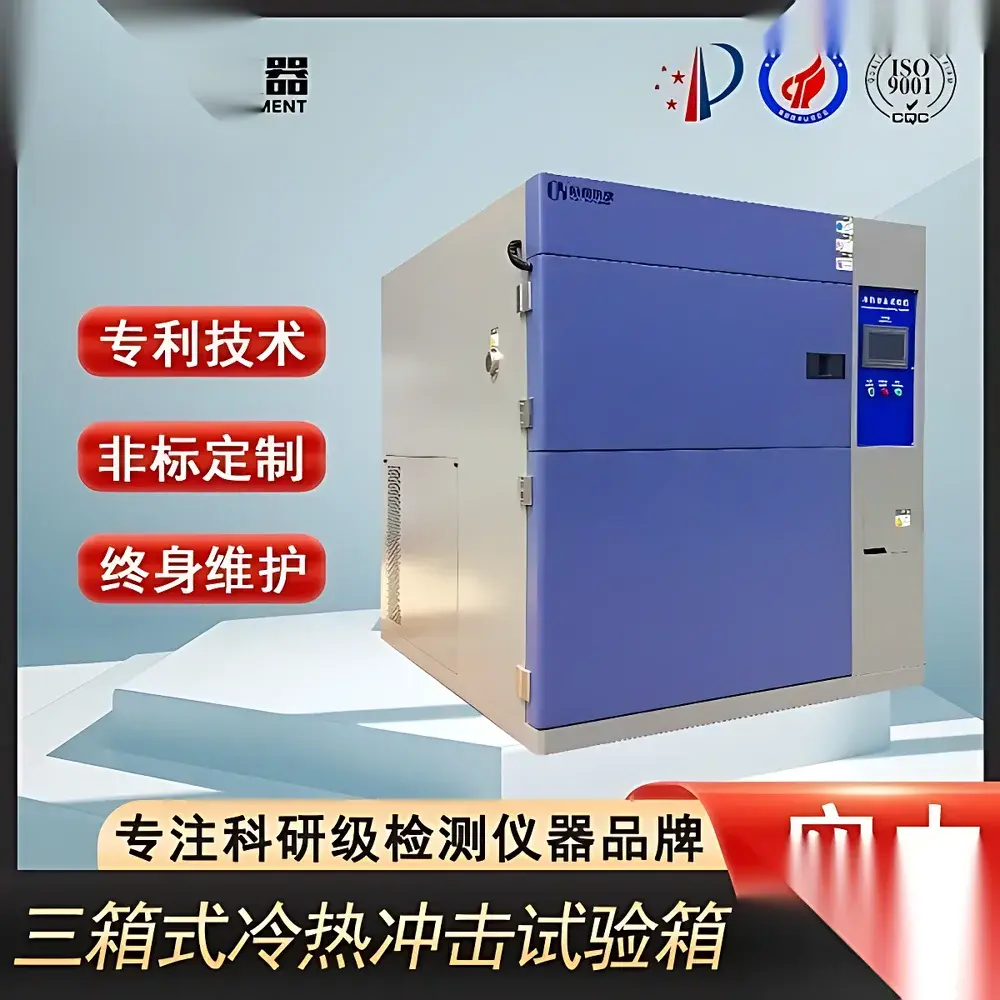
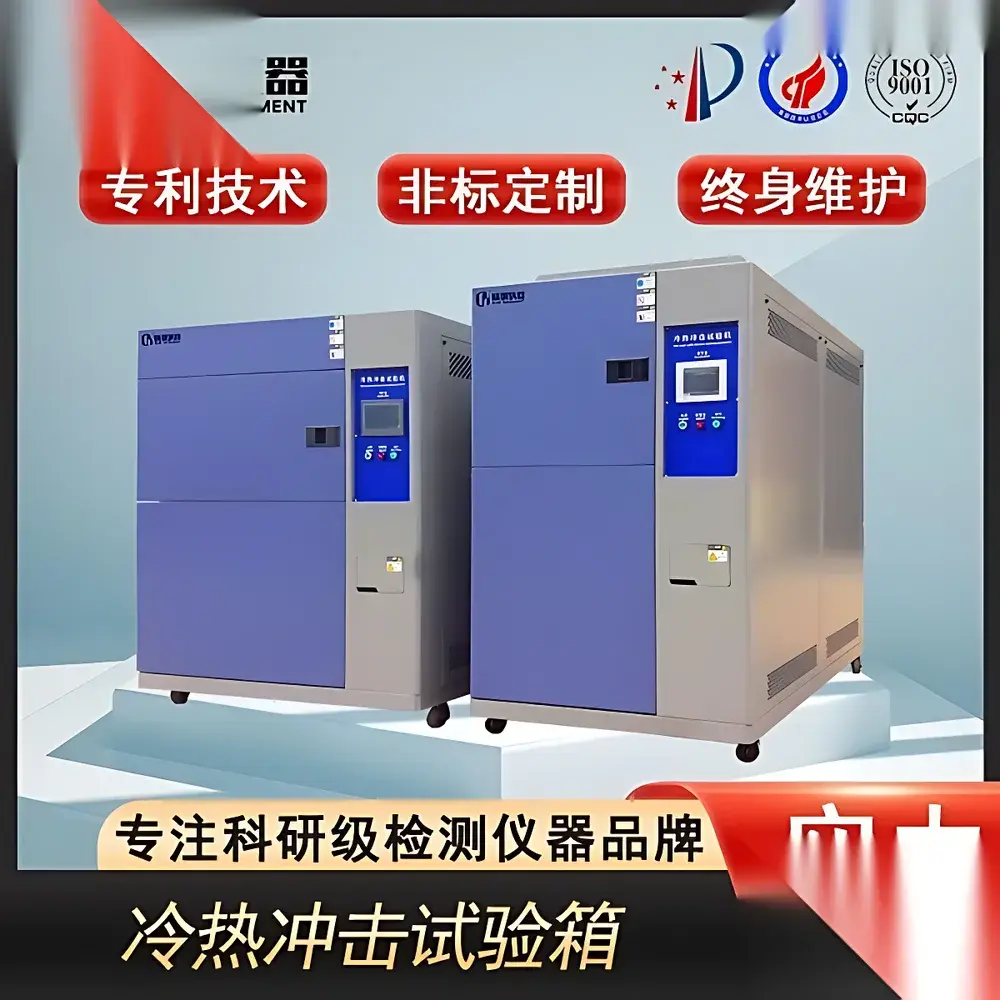
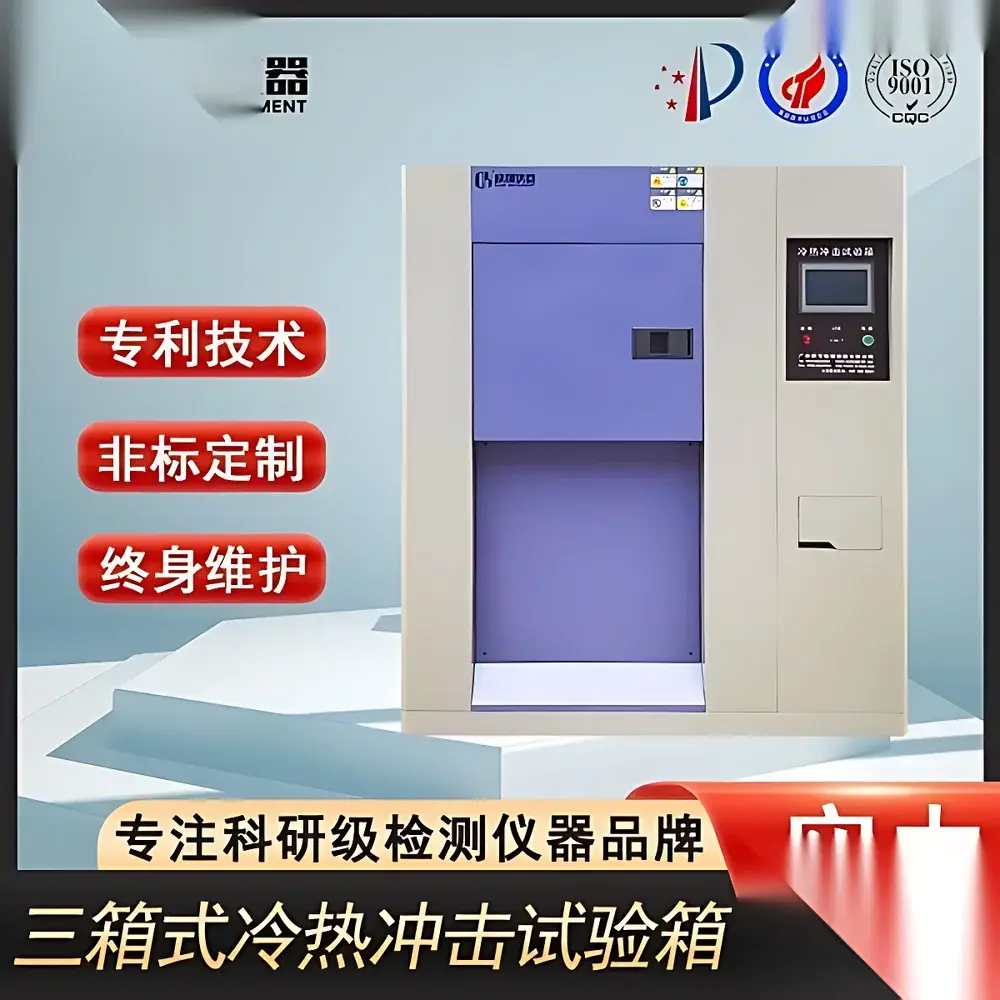
Three-Chamber Thermal Shock Test Chamber OK-TS Series
| Brand | Other Brands |
|---|---|
| Origin | Imported |
| Manufacturer Type | Authorized Distributor |
| Temperature Range | −70 °C to +150 °C |
| Thermal Shock Conditions | −40 °C ↔ +70 °C and −55 °C ↔ +85 °C |
| Temperature Uniformity | ≤ ±2 °C |
| Temperature Stability | ≤ ±0.5 °C |
| Transfer Time (Cold ↔ Hot) | ≤ 5 s |
| Temperature Recovery Time | ≤ 5 min |
| Control Resolution | 0.1 °C / 1 s |
| Programmable Capacity | 10 programs × 99 segments |
| Compliance | GB/T 2423.22–1989, GJB 150.5A–2009, MIL-STD-810G Method 503.5 |
Overview
The OK-TS Series Three-Chamber Thermal Shock Test Chamber is an engineered environmental test system designed for rapid, high-fidelity thermal cycling of electronic components, aerospace hardware, automotive modules, and advanced materials. Unlike single- or two-chamber configurations, this tri-compartment architecture physically isolates the low-temperature chamber (−70 °C), high-temperature chamber (+150 °C), and test chamber—enabling true vertical transfer of specimens via a lift-and-transfer basket mechanism. This design eliminates residual thermal mass interference and ensures strict adherence to defined shock profiles per IEC 60068-2-14, MIL-STD-810G Method 503.5, and GJB 150.5A–2009. The chamber operates on a dual-stage cascade refrigeration principle: a primary R404A-based high-temperature loop couples with a secondary R23-based low-temperature loop via an evaporative condenser, delivering stable sub-zero performance without liquid nitrogen dependency. All thermal transitions are governed by PID-controlled pneumatic actuators and monitored in real time via calibrated PT100 sensors traceable to NIST standards.
Key Features
- Triple-compartment architecture with independent temperature control for cold, hot, and test zones—enabling true “zero-dwell” thermal shock per ASTM D5229/D5229M and IPC-9701A requirements
- Cascade refrigeration system using imported French Tecumseh (or equivalent) hermetic compressors; achieves −70 °C without cryogenic consumables
- Lift-and-transfer basket with ≤5 s transition time between chambers and ≤5 min temperature recovery—validated per MIL-STD-810G Clause 503.5.3
- High-precision touchscreen controller with 0.1 °C setpoint resolution, auto-tuning PID, and built-in data logging (time-stamped temperature history)
- Redundant safety architecture: independent over-temperature cut-off, door interlock switches, refrigerant pressure monitoring, and leakage detection
- Compliance-ready configuration: supports audit trails, user access levels, and optional 21 CFR Part 11–compliant software add-ons for GLP/GMP environments
Sample Compatibility & Compliance
The OK-TS series accommodates samples up to 800 × 750 × 750 mm (OK-TS-450 model), with standardized mounting fixtures compatible with JEDEC trays, PCB carriers, and MIL-STD-810-compliant test fixtures. Internal airflow is optimized via multi-blade centrifugal fans and insulated ducting to maintain uniformity ≤±2 °C across the working volume (per ISO 16750-4 Annex A). The system meets electromagnetic compatibility (EMC) per EN 61326-1 and electrical safety per IEC 61010-1. Calibration documentation includes as-found/as-left reports, sensor uncertainty budgets, and traceability to national metrology institutes. It is routinely deployed in qualification labs certified to ISO/IEC 17025:2017 for reliability testing of avionics, medical electronics, and EV battery modules.
Software & Data Management
Built-in controller firmware supports RS-485 Modbus RTU communication and integrates natively with industry-standard test management platforms including WinTest, TestXpert II, and custom LabVIEW applications. Optional PC-based software provides full lifecycle data capture—including real-time graphing, alarm event tagging, deviation reporting, and PDF/CSV export compliant with internal QA protocols. Audit trail functionality records operator ID, parameter changes, start/stop timestamps, and fault codes—all stored in non-volatile memory with write-protection. For regulated industries, optional validation packages include IQ/OQ documentation, electronic signature support, and 21 CFR Part 11–aligned user role definitions (Administrator, Operator, Reviewer).
Applications
- Qualification testing of solder joint integrity in lead-free PCB assemblies under accelerated thermal fatigue (IPC-9701)
- Screening of MEMS sensors and optoelectronic packages for latent defects induced by coefficient-of-thermal-expansion (CTE) mismatch
- Reliability assessment of power semiconductor modules (IGBTs, SiC MOSFETs) prior to AEC-Q101 certification
- Material-level evaluation of polymer encapsulants, conformal coatings, and adhesive bonds used in space-grade electronics
- Pre-conditioning of lithium-ion battery cells per UN 38.3 Section 38.3.4 thermal shock requirements
FAQ
What distinguishes the three-chamber design from two-chamber thermal shock systems?
Vertical three-chamber architecture eliminates thermal cross-contamination during transfer, enabling faster, more repeatable transitions and stricter compliance with zero-dwell shock profiles required by MIL-STD-810G and GJB 150.5A.
Is the system suitable for use in ISO/IEC 17025-accredited laboratories?
Yes—when equipped with factory-calibrated sensors and accompanied by a full metrological package (including calibration certificates, uncertainty statements, and traceability documentation), it satisfies clause 6.4.10 of ISO/IEC 17025:2017.
Can the controller log data continuously for extended qualification runs?
The embedded controller stores ≥30 days of high-resolution (1-second interval) temperature data internally; external logging via RS-485 extends retention indefinitely with proper host configuration.
Does the system support custom thermal shock profiles beyond standard −40 °C/+70 °C and −55 °C/+85 °C?
Yes—the programmable controller accepts user-defined multi-segment profiles with variable dwell times, ramp rates, and cycle counts—fully configurable within the −70 °C to +150 °C operational envelope.
What maintenance intervals are recommended for sustained accuracy?
Refrigerant circuit integrity verification every 12 months; PT100 sensor recalibration every 6 months; mechanical actuator lubrication and door gasket inspection every 3 months—detailed in the OEM maintenance manual.



