
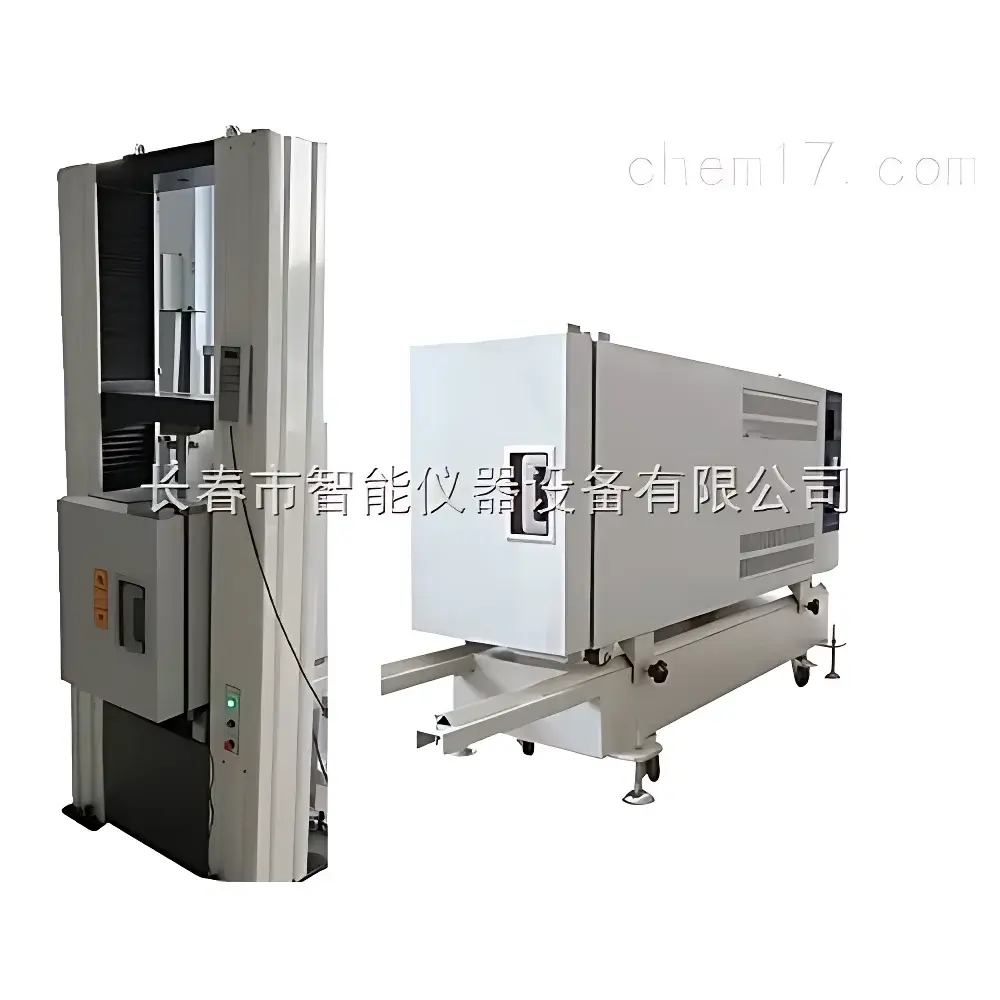
Changchun Intelligent RSW-30K Electronic Creep and Stress Rupture Testing Machine
| Brand | Changchun Intelligent |
|---|---|
| Origin | Jilin, China |
| Model | RSW-30K |
| Max Test Load | 30 kN |
| Crosshead Travel | 100 mm |
| Dimensions (L×W×H) | 600 × 450 × 1900 mm |
| Weight | 300 kg |
| Load Frame Type | Electromechanical |
| Compliance | GB/T 16491, GB/T 2611, GB/T 11546.1, GB/T 15048, GB/T 20672, GB/T 1040.1, GB/T 1041, GB/T 9341 |
Overview
The Changchun Intelligent RSW-30K Electronic Creep and Stress Rupture Testing Machine is a precision-engineered electromechanical system designed for long-term mechanical deformation analysis of polymeric and cellular materials under sustained load and controlled thermal environments. It operates on the principle of constant-load or constant-stress creep testing, where specimen strain is monitored over time—ranging from hours to thousands of hours—to quantify viscoelastic response, time-dependent modulus decay, and rupture life under static loading conditions. The machine integrates a high-rigidity load frame, servo-controlled crosshead actuation, and real-time feedback loops for force, displacement, and (optionally) extensometer-based strain measurement. Its architecture supports both ambient and conditioned testing via integrated high/low-temperature environmental chambers compliant with ASTM D2990 and ISO 899-1 methodologies for thermoplastic and thermoset characterization.
Key Features
- Electromechanical drive system featuring imported Japanese AC servo motor and matched driver, enabling precise closed-loop control of force, displacement, and strain rate.
- High-accuracy load cell (CELTRON LCD series, USA) with 30 kN capacity, 0.4–100% full-scale effective range, and ±0.5% FS accuracy per GB/T 16491 verification protocol.
- Position resolution of 0.001 mm and displacement error ≤ ±0.5%, achieved via high-precision KGS-series ball screw assembly (Jining Huazhu, China) and HTD synchronous belt transmission.
- Multi-mode control capability: constant-force, constant-strain-rate, constant-displacement-rate, and ramp-hold profiles—all programmable with ≤0.5% control deviation in dynamic operation.
- Modular environmental chamber (−40 °C to +150 °C, ±0.5 °C stability, ±2 °C uniformity) with SUS304 interior, dual-stage refrigeration (French Tecumseh compressor), and Pt100 RTD sensing—enabling creep testing across service-relevant thermal boundaries.
- Quick-detach chamber design allows seamless transition between ambient and conditioned testing without recalibration; chamber slides out on dedicated rails for unobstructed access to standard fixtures.
Sample Compatibility & Compliance
The RSW-30K accommodates tensile, compressive, and flexural specimens per ISO 527, ISO 604, and ISO 178 geometries—including dumbbell-shaped polymer bars, foam blocks, and sandwich-core laminates. Standard fixtures include wedge-action tensile grips (0–8 mm plate / φ6–φ16 mm rod), compression platens (φ70 mm), and three-point bending assemblies (support span adjustable up to 120 mm). All test procedures align with national and international standards: GB/T 11546.1 (tensile creep of plastics), GB/T 15048 (compressive creep of rigid foams), GB/T 20672 (time-dependent compression at elevated temperature), and GB/T 1040.1 (tensile properties baseline). System validation follows GB/T 2611 general requirements and GB/T 16491 electronic universal testing machine specifications. Data acquisition and reporting are structured to support GLP-compliant documentation and traceable audit trails.
Software & Data Management
The embedded measurement control system runs proprietary Windows-compatible software developed by Changchun Intelligent, supporting multi-channel synchronized acquisition (load, displacement, temperature, extensometer output) at user-defined sampling intervals (10 ms to 60 s). Real-time curve plotting includes stress–strain–time overlays, derivative creep rate (dε/dt) visualization, and logarithmic time scaling for Arrhenius-based lifetime extrapolation. Raw data exports to CSV or Excel formats with timestamped metadata (operator ID, test ID, calibration certificate number, environmental setpoint). Software architecture permits configuration of pass/fail criteria per test method (e.g., maximum allowable creep strain at 1000 h), automatic alert generation upon threshold breach, and batch report compilation. While native software does not implement FDA 21 CFR Part 11 electronic signature controls, it provides full audit log export (user actions, parameter changes, calibration events) suitable for internal QA review and third-party GMP readiness assessment.
Applications
This system is deployed in polymer R&D laboratories, quality control departments of extrusion and molding facilities, and certification bodies evaluating long-term structural integrity of plastic components. Typical use cases include: accelerated creep life prediction for automotive under-hood polymers; dimensional stability assessment of PVC piping under hydrostatic pressure; compressive relaxation behavior of PU insulation foams in building envelope systems; and time–temperature superposition (TTS) modeling of amorphous thermoplastics using isothermal creep master curves. When coupled with optional extensometers and environmental chambers, it enables compliance testing per UL 746B (polymeric materials for electrical equipment) and ISO 9001 clause 8.2.4 (monitoring and measurement resource control).
FAQ
What standards does the RSW-30K comply with for creep testing?
It meets GB/T 11546.1 (tensile creep), GB/T 15048 (compressive creep of rigid foams), GB/T 20672 (temperature-dependent compression creep), and foundational mechanical test standards including GB/T 1040.1, GB/T 1041, and GB/T 9341.
Can the system perform tests beyond creep—e.g., tensile or compression strength?
Yes. As an electromechanical universal testing platform, it supports static tensile, compressive, and flexural tests per GB/T 1040.1, GB/T 1041, and GB/T 9341, with full digital control of rate, hold, and cycling profiles.
Is the environmental chamber removable for ambient testing?
Yes—the chamber mounts on linear rails and can be fully withdrawn to expose the standard test zone, eliminating thermal interference during room-temperature experiments.
What is the resolution and accuracy of displacement measurement?
Crosshead displacement is resolved to 0.001 mm with a relative error of ±0.5% FS, verified per GB/T 16491 calibration protocols.
Does the system support automated data export for LIMS integration?
Raw test data exports to CSV or Excel with embedded metadata (test ID, timestamps, operator, calibration status); structured formatting facilitates ingestion into common laboratory information management systems.



