
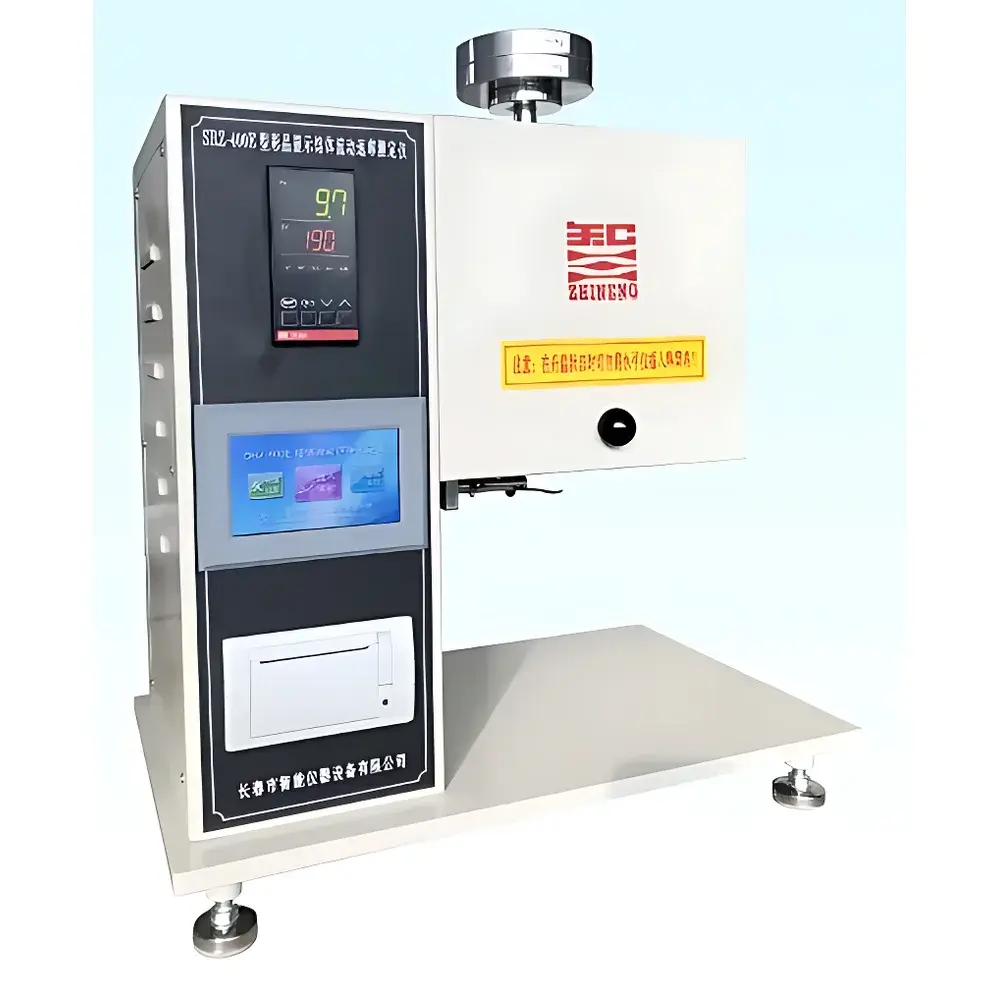
Changchun Intelligent SRZ-400E LCD Display Melt Flow Indexer
| Brand | Changchun Intelligent |
|---|---|
| Origin | Jilin, China |
| Model | SRZ-400E |
| Temperature Range | 80–400 °C |
| Temperature Accuracy | ±0.2 °C |
| Temperature Resolution | 0.1 °C |
| Die Diameter | 2.095 ± 0.005 mm |
| Barrel Bore | 9.550 ± 0.025 mm |
| Piston Head Diameter | 9.475 ± 0.015 mm |
| Piston Head Length | 6.35 ± 0.1 mm |
| Stroke Detection Accuracy | ±0.1 mm |
| Standard Spacing Between Cut Positions | 30 mm |
| Max Power Consumption | <500 W |
| Temperature Recovery Time | 4 min |
| Weight | 50 kg |
| Accuracy Class | Class 1 |
| Compliance | GB/T 3682–2000 Method A, ISO 1133:1997 |
Overview
The Changchun Intelligent SRZ-400E LCD Display Melt Flow Indexer is a precision gravimetric instrument engineered for the standardized determination of melt mass-flow rate (MFR) and melt volume-flow rate (MVR) of thermoplastic polymers under defined load and temperature conditions. It operates on the fundamental principle of extrusion rheometry—measuring the mass or volume of polymer melt extruded through a standardized capillary die (2.095 mm nominal diameter) over a fixed time interval (typically 10 minutes), as governed by ASTM D1238, ISO 1133, and GB/T 3682. Designed for routine quality control and material specification verification in R&D laboratories and production environments, the SRZ-400E delivers high reproducibility across a broad thermal range (80–400 °C), supporting characterization of polyolefins (e.g., PE, PP), engineering thermoplastics (e.g., PC, PA, POM), fluoropolymers, and specialty resins such as ABS and acrylics.
Key Features
- Microprocessor-based digital control system with integrated PID temperature regulation, ensuring stable thermal equilibrium and rapid recovery (<4 min) after load changes or sample insertion.
- High-contrast monochrome LCD with Chinese character interface and voice-guided operation—optimized for operator efficiency and reduced training burden in multilingual industrial settings.
- Automated cutting mechanism synchronized to preset displacement intervals (30 mm spacing), eliminating manual timing errors and improving inter-laboratory repeatability.
- Precision-machined barrel (bore: 9.550 ± 0.025 mm) and piston assembly (head diameter: 9.475 ± 0.015 mm; length: 6.35 ± 0.1 mm) conforming to ISO 1133 Annex A tolerances for geometric fidelity and minimal wall-slip artifacts.
- Calibrated stainless-steel die (2.095 ± 0.005 mm) supplied with traceable dimensional certification; compatible with standard test loads (0.325 kg to 1.640 kg, including pressure rod).
- Integrated weighing support with optional external analytical balance interface; full compliance with Class 1 accuracy per GB/T 3682–2000 requirements.
- Robust mechanical architecture (50 kg mass) minimizes vibration-induced measurement drift; includes built-in spirit level and alignment mirror for precise vertical orientation during calibration and testing.
Sample Compatibility & Compliance
The SRZ-400E is validated for use with all common thermoplastic materials specified in ISO 1133 and GB/T 3682, including but not limited to polyethylene (PE), polypropylene (PP), polystyrene (PS), acrylonitrile-butadiene-styrene (ABS), polyamide (PA), polyoxymethylene (POM), polytetrafluoroethylene (PTFE), and polycarbonate (PC). Its thermal stability and geometric conformity ensure reliable data generation for raw material acceptance, batch release, and process validation. The instrument meets the dimensional, thermal, and operational requirements of ISO 1133:1997, GB/T 3682–2000 Method A, and ASTM D1238–22 (with appropriate load/die configuration). While not inherently 21 CFR Part 11 compliant, its deterministic output (time-stamped mass readings, user ID logging via optional firmware upgrade) supports integration into GLP/GMP workflows when paired with validated laboratory information management systems (LIMS).
Software & Data Management
The SRZ-400E operates via embedded firmware without dependency on external PCs. All test parameters—including temperature setpoint, dwell time, cut interval, and applied load—are configured directly via front-panel navigation. Real-time temperature and piston displacement are displayed continuously. Upon completion, the unit calculates MFR (g/10 min) and MVR (cm³/10 min) using preloaded density tables or user-entered values. Results are stored internally (up to 100 test records), printable via integrated thermal printer (optional), and exportable via RS-232 serial interface for CSV-formatted data transfer. For audit-trail requirements, external timestamped logging (e.g., via connected PC running custom Python or LabVIEW scripts) is recommended to satisfy ISO/IEC 17025 documentation standards.
Applications
- Quality assurance of incoming polymer pellets and regrind feedstock in compounding and injection molding facilities.
- Correlation of MFR with molecular weight distribution (MWD) trends during polymer synthesis and stabilization studies.
- Process troubleshooting—detecting thermal degradation, crosslinking, or contamination via anomalous flow behavior across consecutive cuts.
- Material substitution validation: confirming equivalence between alternate resin grades prior to production ramp-up.
- Educational instruction in polymer physics labs—demonstrating shear-thinning behavior, temperature sensitivity, and the effect of molecular branching on melt viscosity.
FAQ
What standards does the SRZ-400E comply with?
It conforms to GB/T 3682–2000 Method A, ISO 1133:1997, and is dimensionally and thermally aligned with ASTM D1238 requirements for MFR/MVR testing.
Can the SRZ-400E measure both MFR and MVR?
Yes—MFR is determined gravimetrically; MVR is derived using user-input or reference melt density values.
Is calibration traceability available for the die and barrel?
Standard accessories include dimensional certificates for the die; metrological calibration of the barrel and piston requires third-party accredited service per ISO/IEC 17025.
Does the instrument support automatic calculation of flow rate ratios (FRR)?
No—FRR (e.g., MFR21.6/MFR5) requires separate tests at different loads; ratio computation must be performed externally.
What maintenance is required for long-term accuracy?
Routine cleaning of the barrel, die, and piston with brass brushes and solvent (e.g., xylene); annual verification of temperature uniformity and dimensional wear using certified gauges.






