
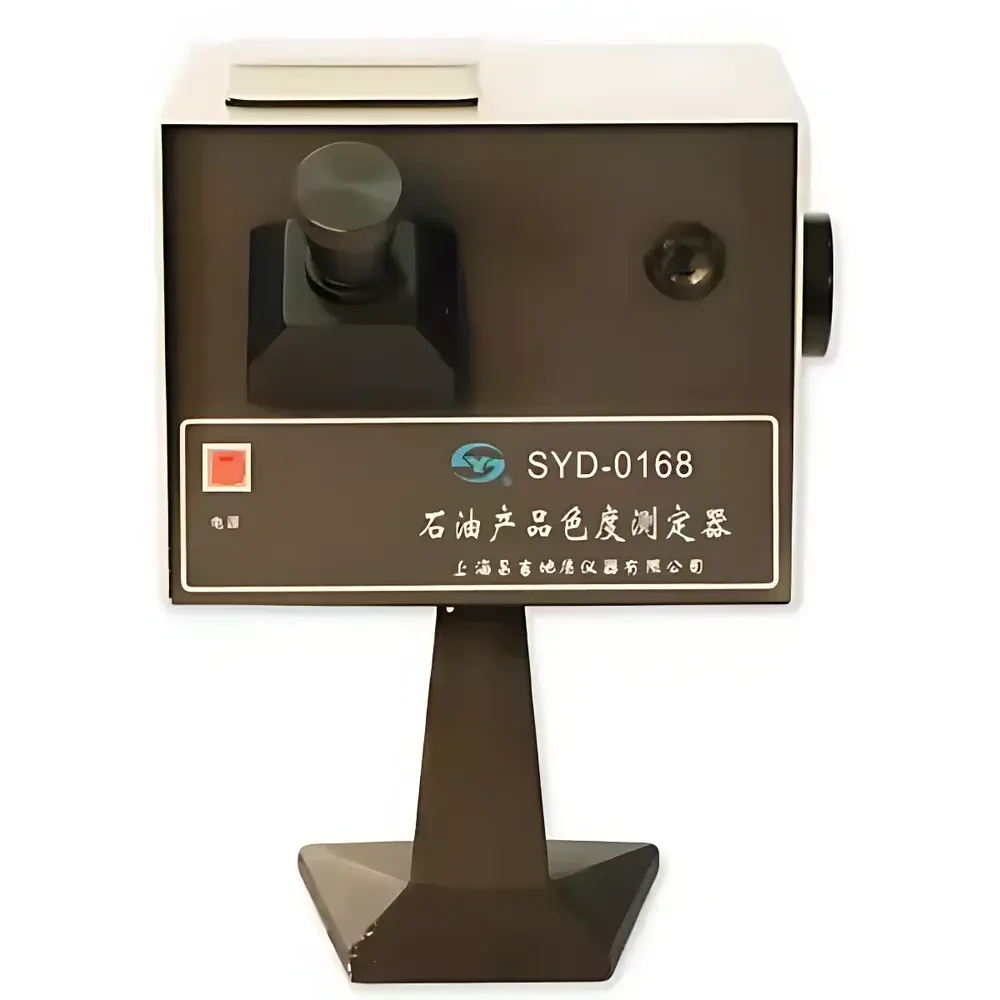
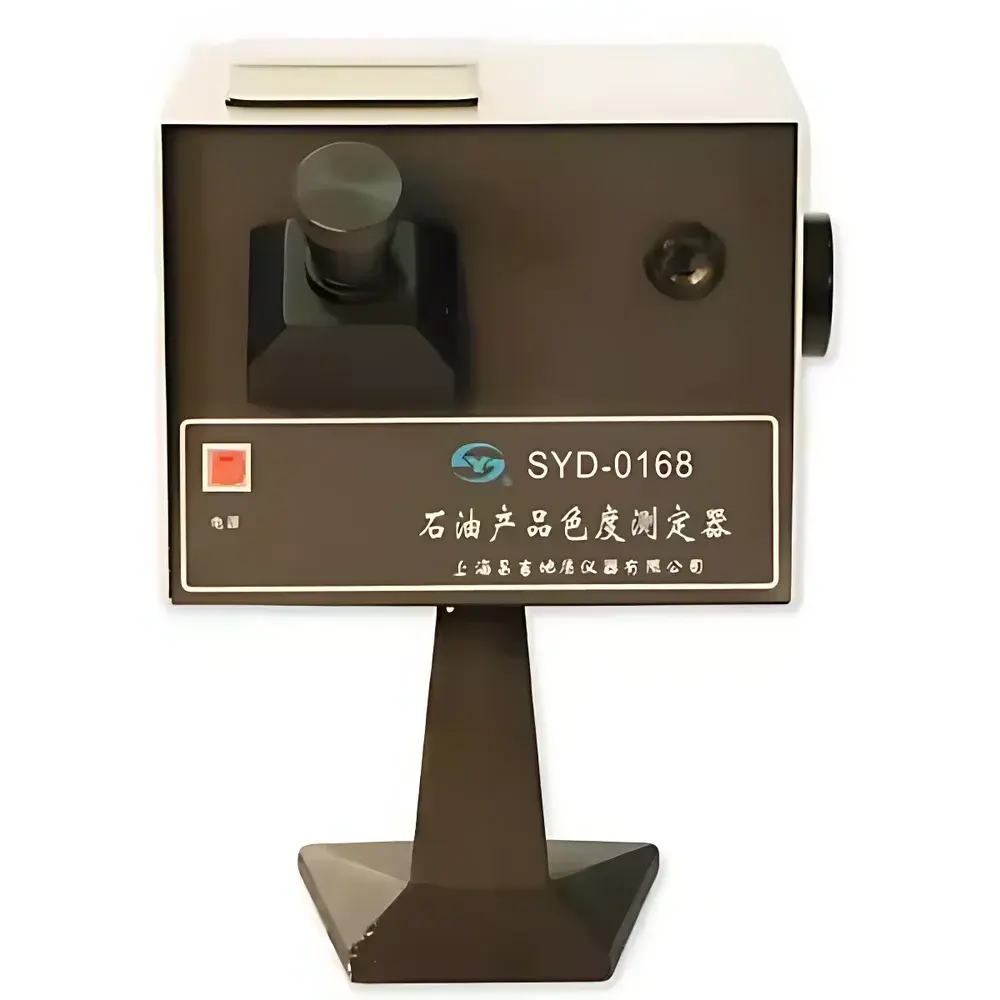
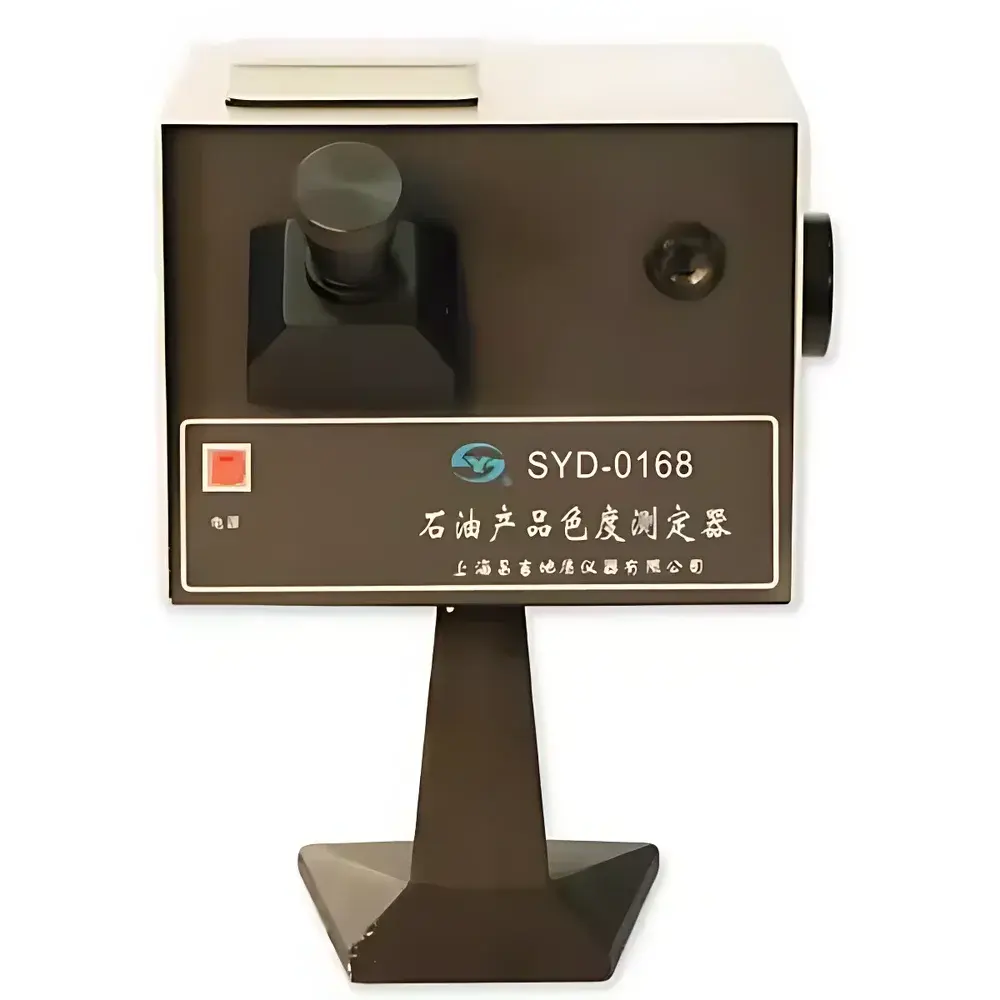
Changji Instruments SYD-0168 Petroleum Product Colorimeter
| Brand | Changji Instruments |
|---|---|
| Origin | Shanghai, China |
| Model | SYD-0168 |
| Standard Light Source | 220 V, 100 W, frosted milky incandescent lamp with color temperature 2750 ± 50 K |
| Color Scale Range | ASTM D1500-equivalent 1–25 color numbers (glass reference standards) |
| Power Supply | AC (220 ± 10%) V, 50 Hz |
| Power Consumption | 110 W |
| Dimensions (L×W×H) | 350 × 250 × 400 mm |
| Net Weight | 15 kg |
Overview
The Changji Instruments SYD-0168 Petroleum Product Colorimeter is a dedicated visual color comparison instrument engineered for precise, repeatable assessment of petroleum product hue in accordance with SH/T 0168—2019 “Test Method for Color of Petroleum Products (Visual Method)” and aligned with the color-number scale defined in GB/T 6540 and ASTM D1500. It operates on the principle of standardized visual color matching: a representative sample is introduced into a calibrated glass comparator tube and viewed under controlled illumination against a set of stable, traceable glass color standards spanning 1 to 25 color numbers. The instrument employs a rigorously specified incandescent light source—220 V, 100 W, frosted milky bulb with a nominal correlated color temperature of 2750 ± 50 K—to replicate the spectral output required by national and international test methods. This ensures metrological consistency across laboratories and enables direct comparability of results between facilities operating under SH/T 0168, GB/T 6540, or ASTM D1500 protocols. Designed for routine QC/QA environments in refineries, lubricant blending plants, and third-party testing labs, the SYD-0168 delivers high reproducibility without reliance on electronic photometric sensors, minimizing drift and calibration dependency.
Key Features
- Compliant optical geometry: Fixed viewing angle and standardized tube path length ensure consistent sample presentation per SH/T 0168 requirements.
- Dedicated 2750 ± 50 K standard illuminant: Frosted milky incandescent lamp provides stable, diffuse illumination with spectral distribution optimized for hydrocarbon color evaluation.
- Full-range ASTM D1500-equivalent color standards: 25 calibrated glass color plates (1–25), manufactured to meet long-term stability and batch-to-batch uniformity specifications.
- Integrated comparator housing: Rigid aluminum chassis with black interior matte finish minimizes stray light interference and enhances contrast during visual assessment.
- Modular accessory set: Includes two matched 100-mm comparator tubes (borosilicate glass, precision-ground ends), spare lamp, alignment guide, and protective storage case.
- Electromechanical reliability: No moving parts or firmware; designed for continuous operation in industrial laboratory environments with minimal maintenance.
Sample Compatibility & Compliance
The SYD-0168 is validated for transparent to semi-transparent liquid petroleum products including lubricating oils (mineral and synthetic), kerosene, diesel fuel, heating oil, and white spirit. Samples must be free of suspended particulates and water haze; clarification via filtration (e.g., 0.8 µm membrane) or centrifugation is recommended prior to analysis. For highly colored feedstocks (e.g., heavy fuel oils), dilution with certified reference-grade kerosene (per SH/T 0168 Section 6.2) is required to bring the sample within the measurable 1–25 scale. The instrument supports full traceability under GLP and ISO/IEC 17025 frameworks: each unit ships with a factory-issued Certificate of Conformance referencing NIM (National Institute of Metrology, China) traceable color standards. It satisfies technical prerequisites for audits under CNAS-CL01, API RP 2540, and ASTM D1500 Annex A1.
Software & Data Management
The SYD-0168 is a manual, non-digital instrument and does not incorporate embedded software, data logging, or connectivity interfaces. Color determination is performed visually and recorded manually in laboratory notebooks or LIMS-compatible worksheets. To support regulatory compliance, users are advised to document: sample ID, analyst name, date/time, ambient conditions (temperature, humidity), lamp usage hours (tracked via external log), observed color number, and any deviation notes (e.g., “sample diluted 1:1 with kerosene”). The included user manual specifies minimum documentation requirements aligned with ISO/IEC 17025 Clause 7.8 and FDA 21 CFR Part 11 principles for handwritten records. Digital integration is achievable via optional third-party LIMS barcode scanning modules compatible with manual entry workflows.
Applications
- Quality control of finished lubricants against OEM specifications (e.g., SAE J300 viscosity grade color limits).
- Batch release testing of jet fuel (Jet A-1) per ASTM D1500 and DEF STAN 91-91 color acceptance criteria.
- Monitoring oxidation stability in turbine oils via periodic color number trending (ASTM D2272 correlation).
- Verification of hydrotreating efficiency in diesel production units through pre- and post-treatment color comparison.
- Regulatory submission support for product registration in APAC markets requiring SH/T 0168 or GB/T 6540 compliance evidence.
- Teaching and method validation in petroleum engineering laboratories adhering to national standard curricula.
FAQ
What standards does the SYD-0168 directly support?
It is fully compliant with SH/T 0168—2019 and functionally equivalent to ASTM D1500 and GB/T 6540 for visual color number assignment.
Is lamp replacement required regularly?
Yes—the 100 W frosted lamp must be replaced after 1,000 hours of cumulative use or if discoloration, filament sag, or inconsistent output is observed.
Can the instrument be used for biodiesel or bio-blended fuels?
Yes, provided the sample is clarified and falls within the transparency and viscosity limits specified in SH/T 0168 Section 4.1; validation per ASTM D6751 Annex A2 is recommended.
Are the color standards NIST-traceable?
The glass standards are calibrated against NIM-certified reference materials; full NIST traceability requires optional third-party certification (available upon request).
What maintenance is required beyond lamp replacement?
Monthly cleaning of comparator tubes with lint-free lens tissue and analytical-grade isopropanol; annual verification of lamp voltage and color temperature using a calibrated spectroradiometer.




