
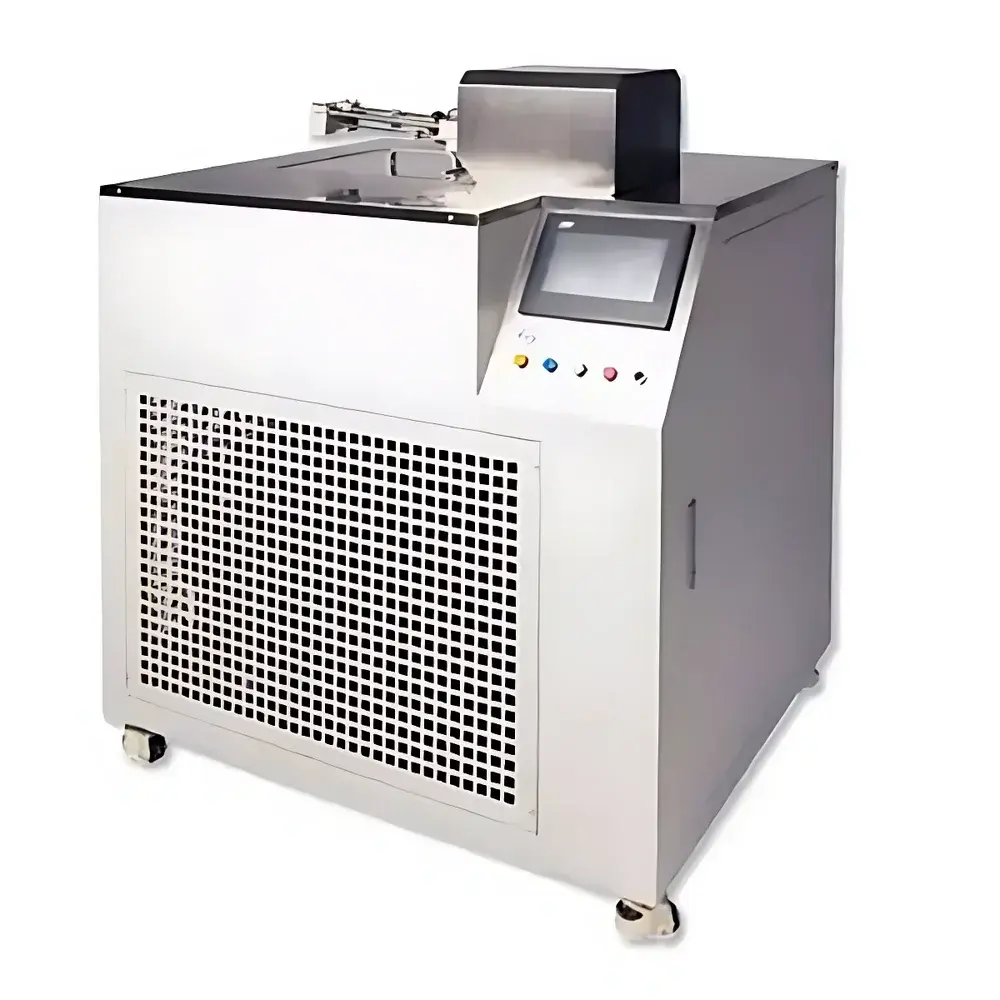
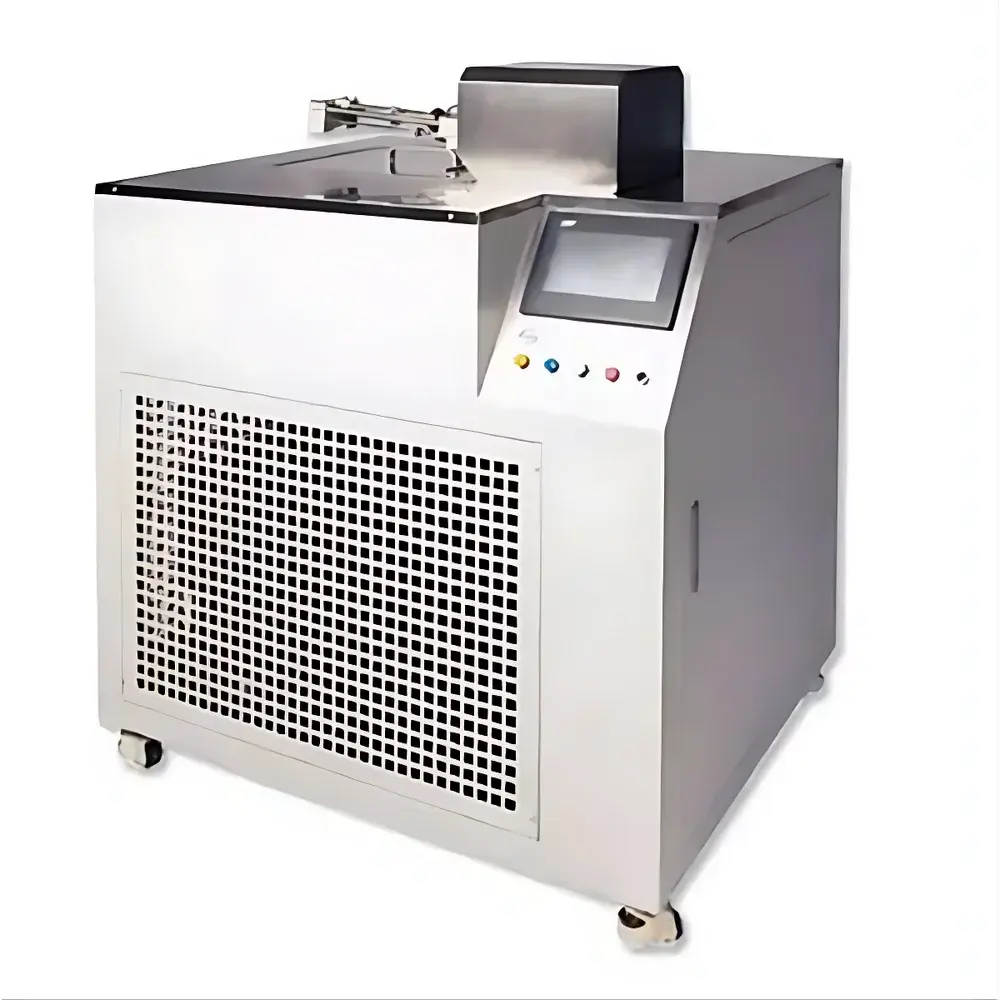
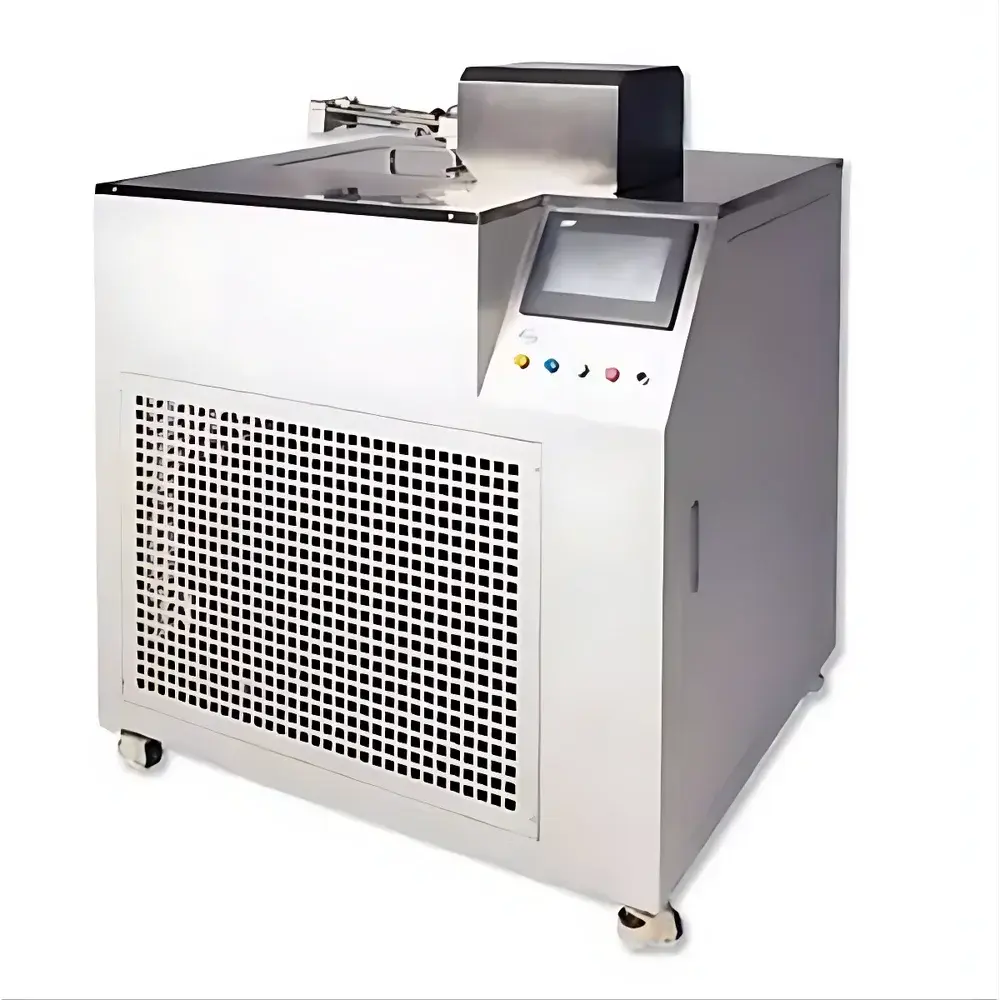
Changji Instruments SYD-0629 Asphalt Fracture Tester
| Brand | Changji Instruments |
|---|---|
| Origin | Shanghai, China |
| Model | SYD-0629 |
| Temperature Range | Ambient to –40 °C |
| Temperature Control Accuracy | ±0.1 °C |
| Power Supply | AC 220 V ±10%, 50 Hz |
| Max. Power Consumption | ≤3500 W |
| Dimensions (L×W×H) | 920×740×930 mm |
| Operating Environment | 20–25 °C, RH ≤80% |
Overview
The Changji Instruments SYD-0629 Asphalt Fracture Tester is a precision-controlled, low-temperature tensile testing system engineered for the quantitative evaluation of asphalt binder fracture behavior under direct tension—per ASTM D7405 and aligned with JTG E20-2011 Test Method T 0629-2011. It implements a controlled-rate uniaxial tensile loading protocol to determine critical mechanical failure parameters: fracture stress (MPa), fracture strain (%), and fracture energy (J/m²), all under thermally stabilized conditions ranging from ambient down to –40 °C. The instrument employs a dual-compressor cascade refrigeration architecture combined with high-resolution resistive heating elements to maintain thermal stability within ±0.1 °C—essential for capturing the brittle-to-ductile transition behavior of aged and unaged bituminous binders. Its design conforms to the fundamental requirements of mechanistic-empirical pavement design frameworks, where low-temperature cracking resistance is a primary performance criterion.
Key Features
- Integrated microcontroller-based control system with real-time closed-loop feedback for force, displacement, and temperature regulation
- Dual-compressor cascade cooling system enabling stable operation at –40 °C without cryogenic fluids or external chillers
- High-torque stepper motor actuator delivering precise, repeatable crosshead motion (0.1–50 mm/min adjustable)
- 800×480 color TFT capacitive touchscreen interface supporting intuitive test setup, parameter configuration, and live data visualization
- Simultaneous real-time display of tensile load (N), axial displacement (mm), and specimen temperature (°C) with auto-scaling graphs
- Onboard computation engine automatically calculates and reports fracture stress, fracture strain, and peak load at failure per ASTM D7405 Annex A1
- Three-wire RS-232 serial interface for optional integration with LIMS or external data acquisition systems
- Robust benchtop mechanical frame with vibration-damped base and rigid load train alignment to minimize parasitic bending moments
Sample Compatibility & Compliance
The SYD-0629 accommodates standard cylindrical asphalt binder specimens (typically 6 mm diameter × 100 mm length) prepared in accordance with AASHTO TP 101 or JTG E20 T 0602. It supports testing of unaged binders, RTFOT-aged residues (per AASHTO T 240), and PAV-aged binders (per AASHTO R 28). All operational parameters—including ramp rate, hold time, and termination criteria—are configurable to meet method-specific requirements. The system complies with ISO/IEC 17025 documentation traceability principles when operated under documented SOPs. While not inherently 21 CFR Part 11–compliant, its data export functionality (CSV via serial port) supports manual audit trail reconstruction for GLP/GMP-aligned laboratories performing QC/QA on paving-grade bitumen.
Software & Data Management
The embedded firmware provides full local test execution without PC dependency. All raw sensor data (load vs. time, displacement vs. time, temperature vs. time) are timestamped and stored internally in non-volatile memory. Post-test, users may export ASCII-formatted CSV files containing calibrated force, displacement, and temperature arrays—enabling post-processing in MATLAB, Python (NumPy/Pandas), or commercial rheology analysis packages. No proprietary software installation is required; however, Changji provides optional Windows-based utilities for batch report generation, trend charting across multiple specimens, and comparative analysis against specification limits (e.g., SHRP PG grading criteria). Audit logs record operator ID (manually entered), test date/time, calibration status flags, and environmental chamber readings.
Applications
- Evaluation of low-temperature cracking resistance of polymer-modified and conventional asphalt binders
- Performance grading (PG) verification under extreme cold climate specifications (e.g., PG 58-40, PG 64-34)
- Quality assurance testing during asphalt production and terminal blending operations
- Research into aging mechanisms—quantifying embrittlement kinetics following RTFOT and PAV conditioning
- Validation of rejuvenator efficacy by comparing fracture strain recovery before and after additive treatment
- Supporting mechanistic-empirical pavement design inputs for thermal stress modeling in software such as MEPDG 2015
- Academic research on viscoelastic fracture mechanics of bituminous materials
FAQ
What standards does the SYD-0629 comply with?
It is designed and validated per JTG E20-2011 T 0629-2011 and technically equivalent to ASTM D7405 “Standard Test Method for Determining the Fracture Energy of Asphalt Binder in Direct Tension (DT)
Can the instrument perform tests below –30 °C?
Yes—the dual-compressor cascade system achieves and maintains –40 °C with ±0.1 °C stability over 60-minute dwell periods under load.
Is calibration traceable to national metrology institutes?
Force transducers are factory-calibrated using NIST-traceable deadweight standards; temperature sensors are verified against PT100 reference probes certified to ISO/IEC 17025.
Does it support automated pass/fail judgment against specification limits?
Not natively—the system outputs raw and derived metrics; pass/fail logic must be implemented externally or via user-defined thresholds in post-processing tools.
What maintenance is required for long-term reliability?
Biannual verification of refrigerant charge, annual recalibration of load cell and RTD sensors, and routine cleaning of condenser coils and specimen grips are recommended per Changji’s Maintenance Schedule M-SYD0629 Rev. 3.





