
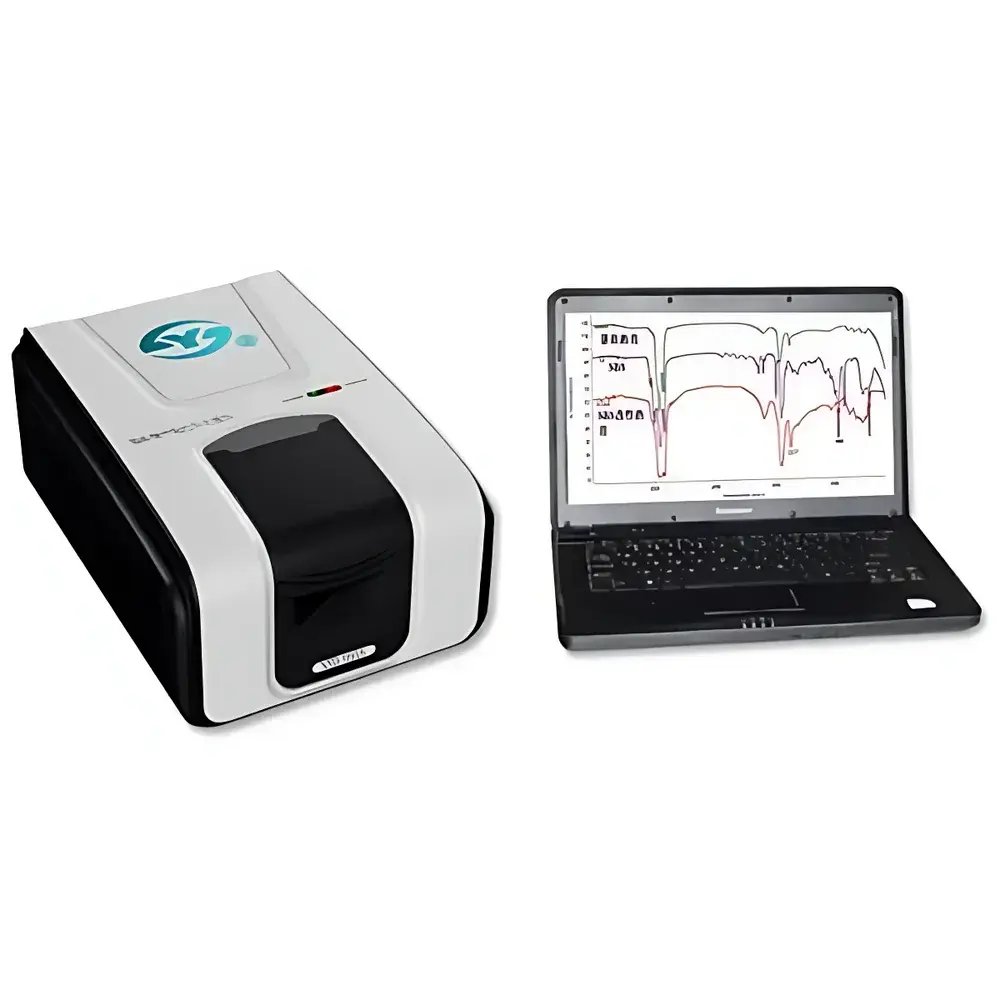
Changji Instruments SYD-0916 Fourier Transform Infrared Spectrometer for Fatty Acid Methyl Ester (FAME) Analysis
| Brand | Changji Instruments |
|---|---|
| Origin | Shanghai, China |
| Model | SYD-0916 |
| Instrument Type | Laboratory FTIR Spectrometer |
| Spectral Range | 7800–350 cm⁻¹ |
| Resolution | Better than 1.0 cm⁻¹, continuously adjustable |
| Signal-to-Noise Ratio | 30,000:1 (peak-to-peak, 4 cm⁻¹, 1-minute scan) |
| Beam Splitter | Ge-coated KBr substrate |
| Source | High-energy, long-life IR source with auto-sleep function |
| Interferometer | Magnetically suspended planar mirror, electromagnetic drive Michelson interferometer (30° incidence angle) |
| Detector | Moisture-resistant high-sensitivity DLATGS detector |
| Quantification Method | FAME concentration calculated from absorbance at 1745 cm⁻¹ using ASTM D7371-compliant calibration |
| Interface | USB 2.0 high-speed bidirectional port |
| OS Compatibility | Windows XP through Windows 10 |
Overview
The Changji Instruments SYD-0916 is a purpose-engineered Fourier Transform Infrared (FTIR) spectrometer optimized for the quantitative determination of Fatty Acid Methyl Ester (FAME) content in middle distillate fuels—including diesel and biodiesel blends—according to internationally recognized spectroscopic principles. Based on the Michelson interferometer architecture with magnetic suspension and electromagnetic drive, the instrument delivers high optical throughput and mechanical stability essential for reproducible spectral acquisition under routine laboratory conditions. Its spectral coverage (7800–350 cm⁻¹) fully encompasses the critical carbonyl stretching region (1740–1750 cm⁻¹), where FAME exhibits its characteristic absorption band, enabling direct quantification without derivatization or solvent extraction. Designed for compliance with ASTM D7371 and aligned with ISO 14564 and EN 14078 methodologies, the SYD-0916 supports regulatory-grade fuel quality assurance in refinery QC labs, independent testing facilities, and academic research environments focused on biofuel composition analysis.
Key Features
- Optimized optical architecture featuring a magnetically suspended planar mirror Michelson interferometer with 30° incidence angle—minimizing alignment drift and enhancing long-term wavenumber accuracy.
- High-stability infrared source with integrated auto-sleep functionality, extending operational lifetime while maintaining consistent radiant output across repeated measurement cycles.
- Ge-coated KBr beam splitter offering broad spectral transmission and low polarization dependence in the mid-IR range.
- Moisture-resistant DLATGS detector with protective hydrophobic film, engineered for reliable performance in non-purged or moderately controlled lab environments.
- Real-time self-diagnostic routines verifying laser alignment, mirror velocity, and detector response prior to each acquisition sequence.
- Automated spectral acquisition and baseline correction algorithms—reducing operator dependency and ensuring uniform data treatment across multi-user workflows.
- Dedicated desiccant chamber with intelligent humidity monitoring and visual alert system—mitigating water vapor interference, a primary source of spectral artifact in routine fuel analysis.
Sample Compatibility & Compliance
The SYD-0916 is validated for liquid-phase transmission analysis of neat diesel, B5–B20 biodiesel blends, and intermediate distillate samples prepared according to ASTM D7371 Annex A1. Sample introduction utilizes standard NaCl or KBr windows with fixed-pathlength cells (typically 100 µm), eliminating variability associated with manual cell filling. The instrument meets core functional requirements for GLP-compliant laboratories: audit-trail-capable software logging, user-access-controlled method files, and timestamped raw spectral storage. While not certified to FDA 21 CFR Part 11 out-of-the-box, its data structure and metadata tagging support integration into validated LIMS environments requiring electronic record integrity per ISO/IEC 17025 and EU Annex 11 guidelines.
Software & Data Management
The bundled Windows-native application provides full spectral acquisition, preprocessing (zero-filling, apodization, phase correction), and FAME-specific quantitation modules. All spectra are stored in vendor-neutral .SPA format, compatible with third-party chemometric tools (e.g., Unscrambler, MATLAB). Calibration curves follow the linear Beer–Lambert relationship at 1745 cm⁻¹, with optional polynomial correction for matrix effects. Software enforces mandatory entry of sample ID, operator name, and date/time stamp; raw interferograms and processed spectra are archived with embedded instrument configuration metadata. USB 2.0 interface ensures deterministic transfer latency and backward compatibility with legacy lab PCs.
Applications
- Regulatory compliance testing of FAME content in diesel fuel per ASTM D7371 and EN 14214.
- Batch release verification in biodiesel production facilities and blending terminals.
- Research-scale investigation of oxidation stability, cold flow properties, and ester degradation kinetics via time-resolved FTIR monitoring.
- Educational use in analytical chemistry and fuel science curricula for hands-on instruction in quantitative IR spectroscopy and multivariate calibration.
- Field-deployable QA screening when mounted on mobile lab carts—leveraging its compact footprint and low power consumption.
FAQ
What is the minimum detectable FAME concentration using the SYD-0916?
The practical lower limit of quantitation (LLOQ) is 0.5% v/v under standard 100-µm pathlength conditions, assuming proper background subtraction and reference spectrum quality.
Can the instrument be used for other fuel additives beyond FAME?
Yes—the full 7800–350 cm⁻¹ spectral range supports identification and semi-quantitative analysis of oxygenates (e.g., ethanol, ETBE), sulfur compounds, and aromatic markers, though dedicated calibration is required.
Is purge gas (dry air or N₂) mandatory for operation?
Not strictly required due to the integrated desiccant system; however, continuous purge is recommended for sub-0.1% FAME precision work or high-humidity ambient conditions.
Does the software support automated report generation compliant with ISO 17025?
Yes—customizable templates include instrument ID, calibration date, uncertainty statements, and digital signature fields, exportable as PDF or XML for audit submission.
What maintenance intervals are recommended for routine operation?
Desiccant replacement every 90 days under continuous use; optical window cleaning with spectroscopic-grade methanol every 200 scans; annual verification of wavenumber accuracy using polystyrene film standard.



