
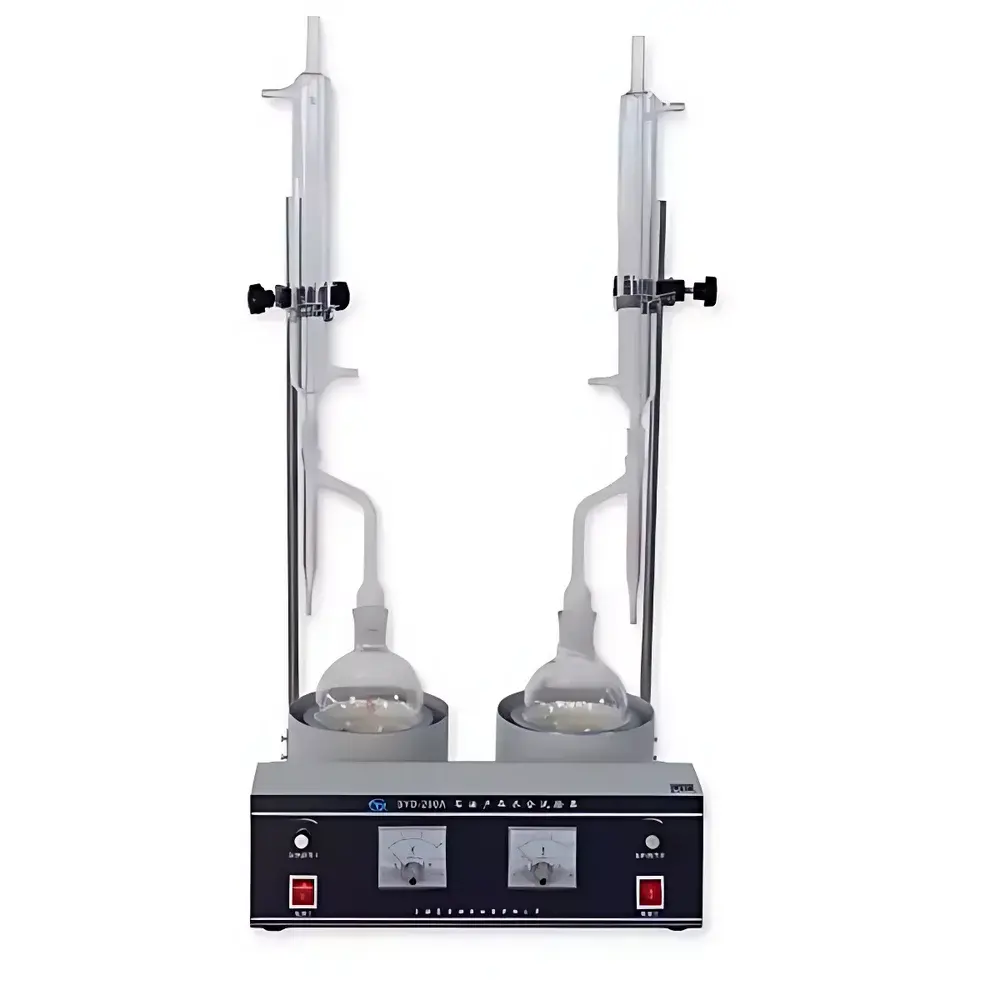
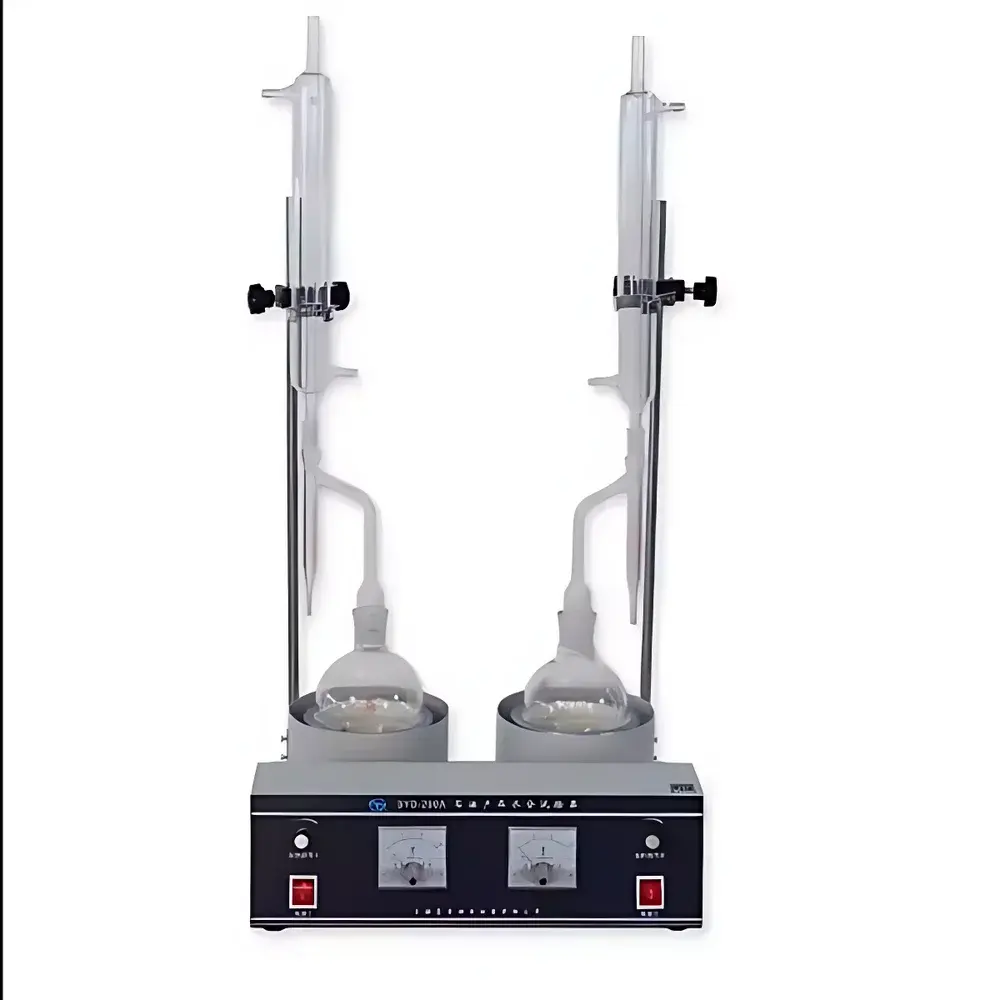
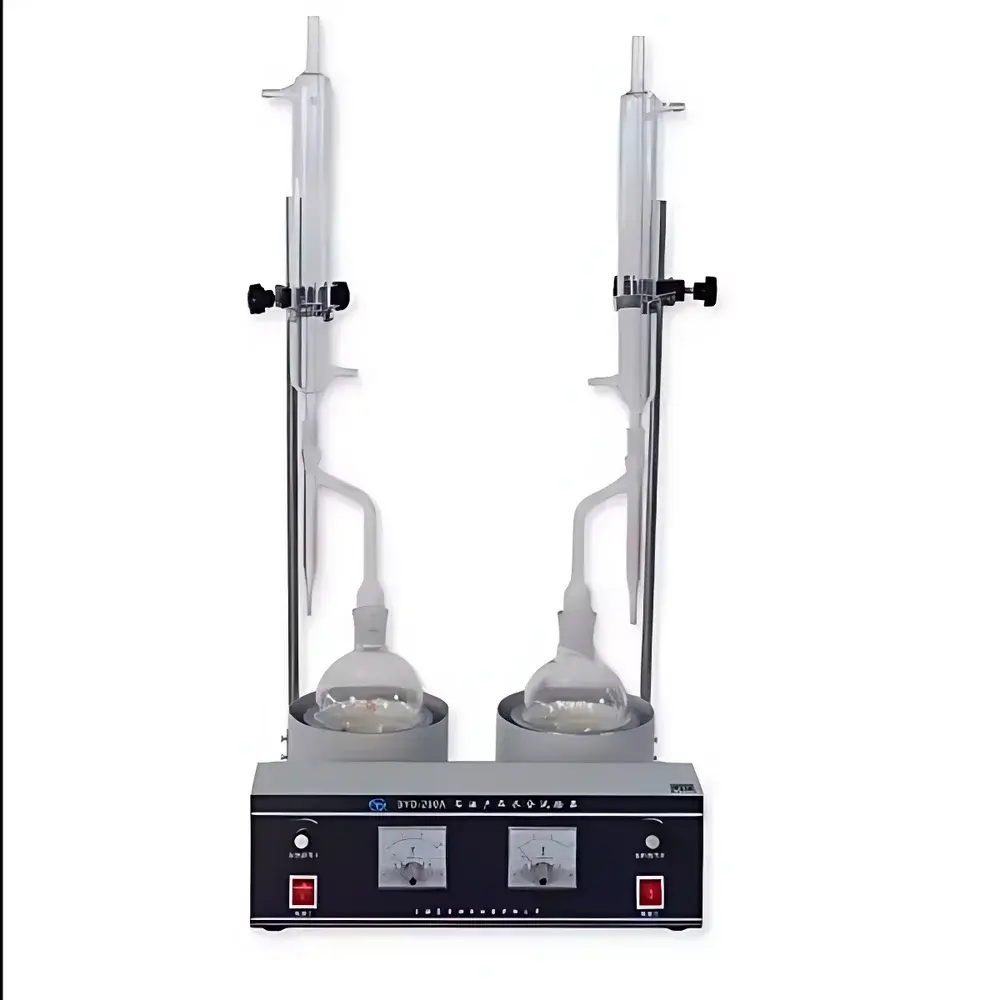
Changji Instruments SYD-260A Petroleum Products Water Content Tester
| Brand | Changji Instruments |
|---|---|
| Origin | Shanghai, China |
| Manufacturer Type | Authorized Distributor |
| Country of Origin | China |
| Model | SYD-260A |
| Power Rating | 1000 W × 2 (dual heating units) |
| Input Voltage | AC (220 ± 10%) V, 50 Hz |
| Heating Control | Bidirectional thyristor-based stepless voltage regulation |
| Test Capacity | Dual-sample parallel determination |
| Compliance | GB/T 260–2016, GB/T 512–2013 |
Overview
The Changji Instruments SYD-260A Petroleum Products Water Content Tester is a precision laboratory apparatus engineered for quantitative determination of water content in petroleum products and lubricating greases in strict accordance with standardized distillation methodology. It implements the principle of azeotropic distillation—where the sample is heated in a solvent (typically xylene or toluene) under reflux; water vapor co-distills with the solvent, condenses in a calibrated Dean-Stark trap, and separates volumetrically due to immiscibility and density difference. This gravimetric-volumetric hybrid method delivers traceable, reproducible results essential for quality control in refining, lubricant manufacturing, and third-party testing laboratories. Designed specifically to meet the procedural and apparatus requirements of GB/T 260–2016 *Petroleum Products — Determination of Water* and GB/T 512–2013 *Lubricating Grease — Determination of Water*, the SYD-260A provides a robust, manually operated alternative to fully automated Karl Fischer titrators—particularly where regulatory frameworks mandate classical distillation validation or where matrix interferences (e.g., emulsified water, high-boiling residues) limit electrochemical methods.
Key Features
- Dual independent heating stations (1000 W each), enabling simultaneous parallel analysis of two samples—reducing turnaround time and improving statistical reliability per ASTM D95 and ISO 9120 alignment.
- Stepless bidirectional thyristor power regulation with real-time analog power meter display—ensuring precise thermal control across diverse sample viscosities and boiling points without overshoot or thermal shock.
- Ergonomically optimized glassware holder assembly with quick-release mechanism for condenser mounting—minimizing mechanical stress on joints and facilitating rapid setup, cleaning, and maintenance.
- Integrated reflux condenser with standardized 400 mm length and 16 mm inner diameter, compliant with GB/T 260 dimensional specifications for consistent vapor path geometry and condensation efficiency.
- Stainless-steel insulated heating mantle design eliminating open-flame hazards—meeting OSHA-compliant lab safety protocols and supporting Class I, Division 2 hazardous location readiness when used with appropriate ventilation.
Sample Compatibility & Compliance
The SYD-260A accommodates a broad range of hydrocarbon-based matrices including crude oil fractions, gasoline, diesel, kerosene, fuel oils, transformer oils, hydraulic fluids, and NLGI-grade lubricating greases. Its design explicitly supports both light-end volatile samples (requiring low-power reflux) and heavy, high-viscosity greases (necessitating sustained high-temperature distillation). All operational procedures—including glassware calibration, solvent selection, heating ramp profiles, and endpoint interpretation—are fully traceable to GB/T 260–2016 Annex A and GB/T 512–2013 Clause 6. The system satisfies foundational requirements for GLP-compliant testing environments when paired with documented SOPs, analyst training records, and equipment logbooks. While not inherently 21 CFR Part 11 compliant (as it lacks digital audit trails), its manual operation ensures full analyst visibility and procedural transparency—critical for internal QA audits and CNAS-accredited laboratory workflows.
Software & Data Management
The SYD-260A operates as a stand-alone benchtop instrument with no embedded microprocessor or software interface. All operational parameters—including heating duration, power level, condensate collection volume, and final water volume reading—are recorded manually in laboratory notebooks or LIMS-integrated electronic worksheets. This analog architecture eliminates firmware validation burdens and ensures long-term operational continuity without dependency on proprietary drivers or OS updates. Users may integrate results into validated data management systems via standardized CSV or PDF reporting templates aligned with ISO/IEC 17025 documentation requirements. Optional accessories—including calibrated volumetric traps (±0.01 mL tolerance), certified reference standards (NIST-traceable water-in-oil suspensions), and digital readout magnifiers—support enhanced measurement repeatability and metrological traceability.
Applications
- Refinery QC labs verifying water limits in finished fuels per API RP 1172 and ASTM D1744 specifications (e.g., ≤0.05% v/v in aviation turbine fuel).
- Lubricant formulation centers assessing moisture ingress in grease storage stability studies per NLGI GC-LB performance criteria.
- Independent testing laboratories conducting contract analyses for customs clearance, insurance claims, or litigation support—where method transparency and chain-of-custody integrity are legally mandated.
- R&D facilities validating dehydration efficiency of coalescer filters or desiccant dryers using controlled-spiking recovery experiments.
- Educational institutions teaching classical ASTM/ISO wet chemistry techniques with emphasis on distillation thermodynamics, phase separation behavior, and uncertainty budgeting.
FAQ
What standards does the SYD-260A directly support?
GB/T 260–2016 and GB/T 512–2013. It is also functionally compatible with ASTM D95 and ISO 9120 when configured with appropriate solvents and calibrated traps.
Can the SYD-260A be used for biodiesel or bio-blended fuels?
Yes—provided methanol or ethanol interference is mitigated via solvent selection (e.g., xylene instead of toluene) and endpoint confirmation by visual meniscus stabilization per GB/T 260 Clause 8.3.
Is glassware included with the instrument?
Yes—the standard configuration includes two complete sets of GB/T 260-compliant distillation assemblies: round-bottom flasks (500 mL), reflux condensers (400 mm), and graduated receiver traps (5 mL, 0.01 mL divisions).
What maintenance is required for long-term accuracy?
Routine inspection of heating mantle insulation integrity, verification of power meter linearity against a calibrated wattmeter annually, and periodic recalibration of receiver traps per JJG 196–2023 guidelines.
Does Changji Instruments provide method validation documentation?
Upon request, Changji supplies a basic Instrument Qualification Package (IQ/OQ summary) and GB/T 260 test protocol templates—but full PQ execution remains the responsibility of the end-user’s QA department.





