
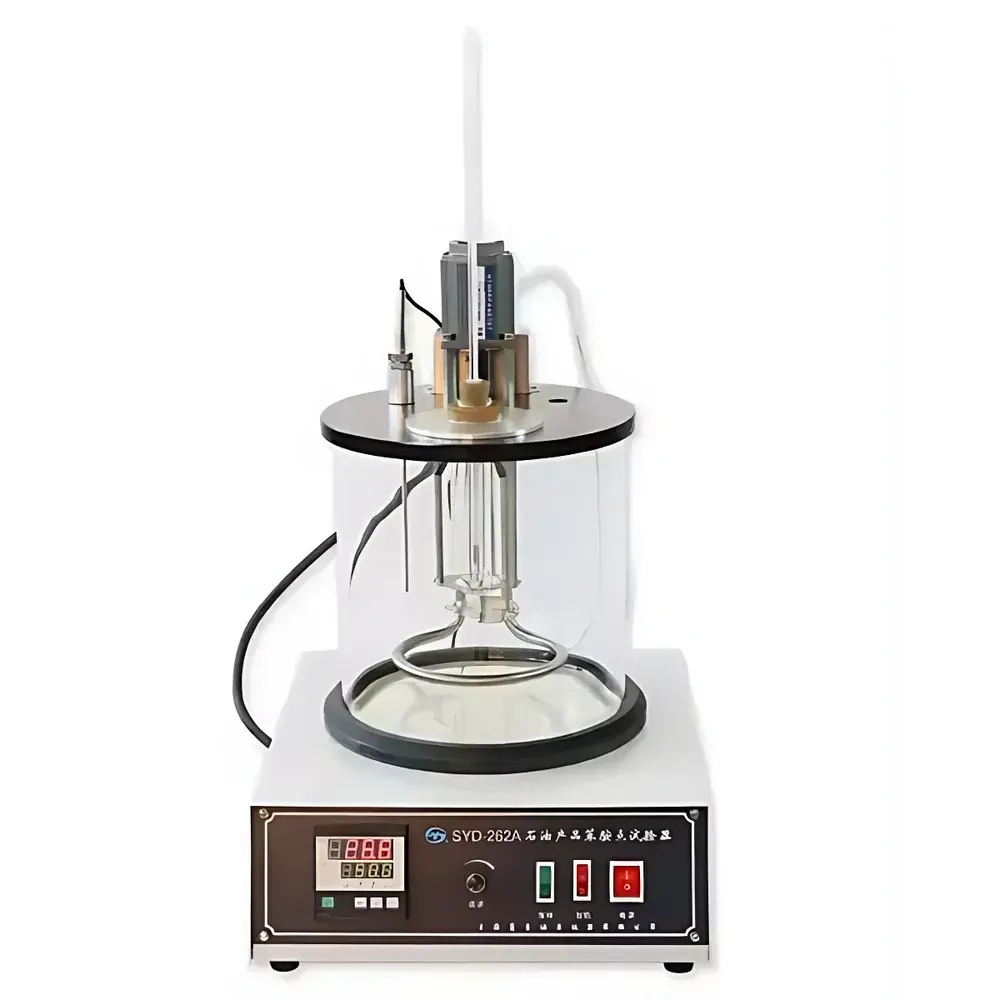
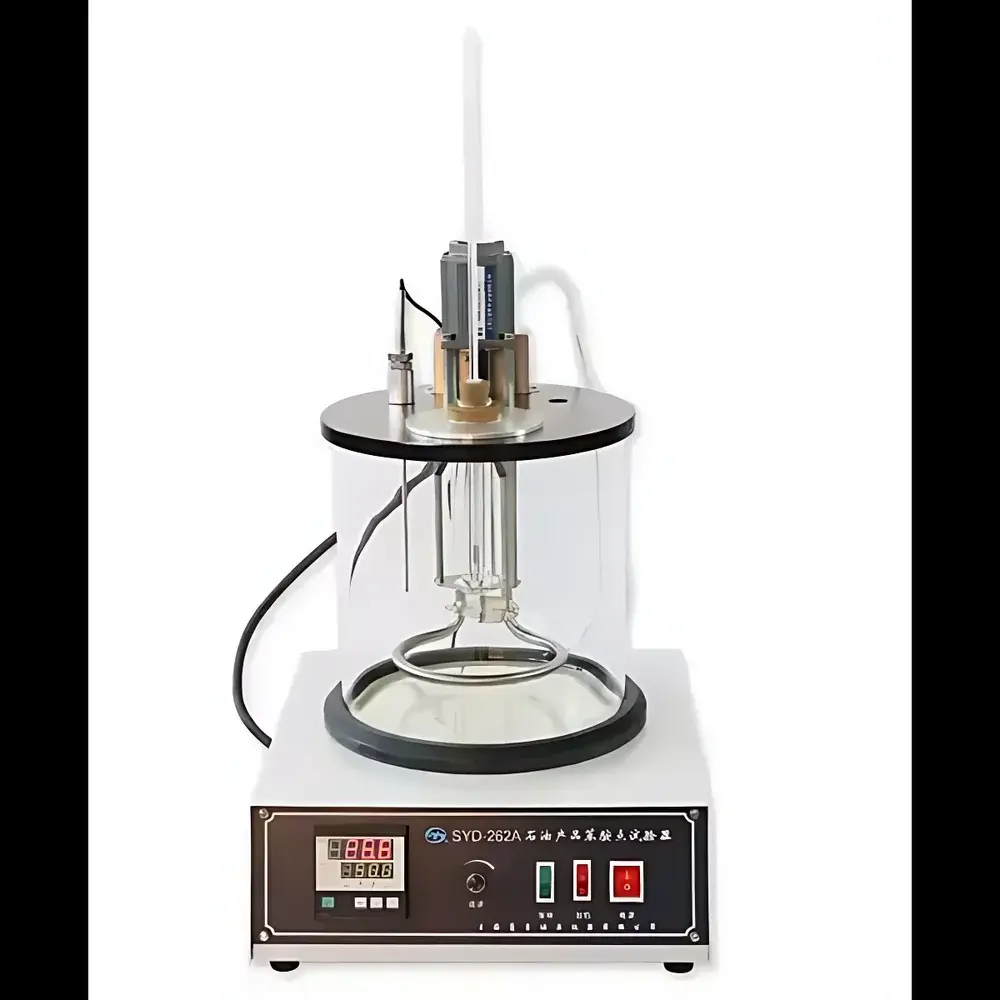
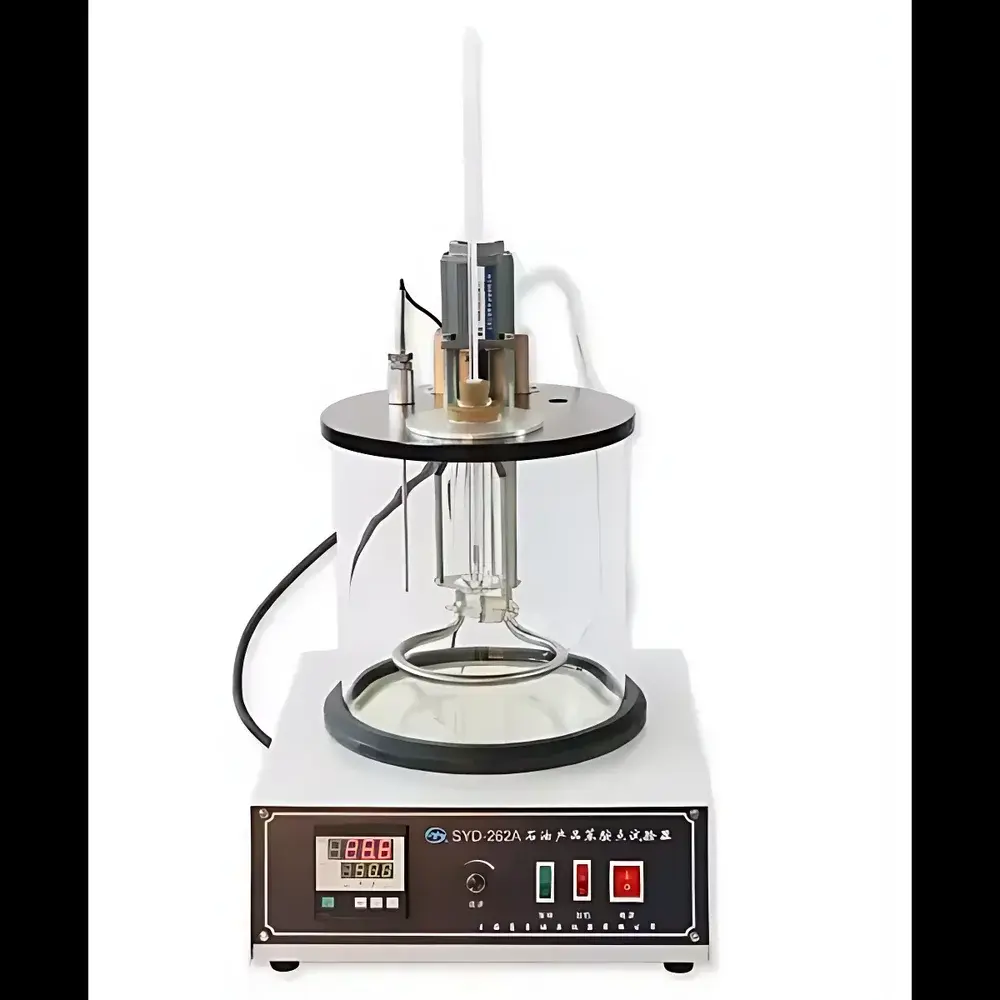
Changji Instruments SYD-262A Aniline Point Tester
| Brand | Changji Instruments |
|---|---|
| Origin | Shanghai, China |
| Model | SYD-262A |
| Power Supply | AC 220 V ±10%, 50 Hz |
| Motor Power | 6 W |
| Heating Power | 2 kW |
| Temperature Control Accuracy | ≤0.5 °C |
| Dual Test Configurations | Heavy Oil (Dark Products) & Light Oil (Pale Products) |
| Endpoint Detection | Automatic optical-acoustic endpoint recognition |
| Stirring | Continuously variable-speed electric stirrer |
| Included Accessories | SYD-262A main unit, borosilicate glass test tubes, two calibrated mercury thermometers (25–105 °C and 90–170 °C, 0.2 °C graduation), thermometer retaining collars, power cord |
| Reagents Not Included | Aniline (AR, 500 g), anhydrous calcium sulfate (industrial grade, 500 g), sodium/potassium hydroxide (CP, 500 g), n-heptane (99.75%, AR, 500 mL) |
Overview
The Changji Instruments SYD-262A Aniline Point Tester is a precision laboratory instrument engineered for the standardized determination of the aniline point of petroleum products in strict compliance with GB/T 262—2018, “Petroleum Products — Determination of Aniline Point”. The aniline point is defined as the minimum temperature at which equal volumes of aniline and the test sample form a single homogeneous liquid phase upon mixing. This thermodynamic parameter serves as a critical indicator of aromatic content, solvency behavior, and compatibility with elastomeric materials—making it indispensable in refinery quality control, lubricant formulation, and hydrocarbon characterization workflows. The SYD-262A implements a classical equilibrium-based method relying on visual phase transition detection under controlled thermal ramping and mechanical agitation. Its dual-configuration design accommodates both dark-colored (e.g., residual fuels, heavy distillates) and pale-colored (e.g., naphthas, kerosenes, white oils) samples without cross-contamination or procedural modification.
Key Features
- Dual-test configuration: Independent, physically segregated assemblies for heavy oil (dark product) and light oil (pale product) testing—eliminating carryover risk and enabling rapid method switching.
- High-stability PID temperature control system with digital display: Maintains setpoint accuracy within ±0.5 °C across the full operating range (25–170 °C), ensuring repeatability required for ASTM D611 / ISO 2977 / GB/T 262 conformance.
- Continuously variable-speed electric stirrer (6 W motor): Provides consistent, turbulence-free mixing during heating to promote uniform phase equilibration without splashing or emulsification artifacts.
- Automatic endpoint detection: Integrated optical sensor coupled with audible/visual alarm triggers precisely at the moment of complete miscibility—reducing operator subjectivity and improving inter-laboratory reproducibility.
- Robust thermal architecture: 2 kW tubular heating element with optimized thermal mass distribution ensures rapid warm-up, minimal overshoot, and stable plateau maintenance during endpoint dwell.
- Calibration-ready instrumentation: Supplied with two NIST-traceable mercury-in-glass thermometers (25–105 °C and 90–170 °C, 0.2 °C graduation), calibrated test tubes, and adjustable thermometer retention collars for precise immersion depth control per standard requirements.
Sample Compatibility & Compliance
The SYD-262A supports routine analysis of crude fractions, fuel oils, lubricating base stocks, and specialty hydrocarbons ranging from light naphthas to vacuum gas oils. Its design conforms to the physical geometry, immersion depth, and mixing intensity stipulated in GB/T 262, while also satisfying technical equivalency for ASTM D611 (Standard Test Method for Aniline Point of Petroleum Products) and ISO 2977 (Petroleum Products — Determination of Aniline Point). All wetted components—including glassware and sealing interfaces—are chemically resistant to aniline, n-heptane, and caustic wash reagents. The instrument’s operational envelope and procedural logic align with GLP documentation practices; raw temperature/time data, endpoint timestamps, and operator ID (via optional external LIMS integration) can be archived for audit readiness per ISO/IEC 17025 and FDA 21 CFR Part 11 requirements when paired with compliant data management software.
Software & Data Management
The SYD-262A operates as a standalone benchtop instrument with no embedded microprocessor or digital data logging. Temperature readings are recorded manually using supplied thermometers, and endpoint events are documented by timestamped operator entry. For laboratories requiring electronic recordkeeping, the instrument is fully compatible with third-party data acquisition systems via analog temperature output (optional retrofit) or manual transcription into validated ELN platforms. All calibration certificates for included thermometers are provided with traceability to national metrology institutes. Users implementing computerized systems must validate their software per 21 CFR Part 11 for electronic signatures and audit trails—Changji Instruments provides full technical specifications and interface schematics to support such validation protocols.
Applications
- Refinery QC: Monitoring aromaticity shifts during hydrotreating, catalytic reforming, or solvent extraction processes.
- Lubricant development: Correlating aniline point with base oil saturation level, oxidation stability, and seal swell compatibility.
- Fuel specification verification: Confirming conformance to jet fuel (ASTM D1655), diesel (ASTM D975), or marine fuel (ISO 8217) aromatic limits.
- Research labs: Studying solubility parameters (Hansen or Hildebrand), polymer–oil interactions, and structure–property relationships in hydrocarbon blends.
- Contract testing facilities: Supporting accredited testing under CNAS (China National Accreditation Service) or ILAC-MRA signatory scopes referencing GB/T 262 or ISO 2977.
FAQ
What standards does the SYD-262A comply with?
It is designed and verified for GB/T 262–2018, and its methodology is technically equivalent to ASTM D611 and ISO 2977.
Is automatic data export supported?
No—data capture is manual by default; however, analog temperature signal output can be added for integration with external DAQ systems.
Are reagents included with the instrument?
No—users must supply aniline (AR), n-heptane (≥99.75%), anhydrous CaSO₄, and NaOH/KOH (CP) separately.
Can the same apparatus be used for both light and dark oils?
Yes—two physically separate test modules prevent cross-contamination and allow immediate switching between sample types.
What maintenance is required for long-term reliability?
Regular cleaning of glassware with acetone, periodic verification of thermometer calibration, and inspection of heater insulation integrity every 6 months are recommended.






